The Next Generation of Timber Bridges
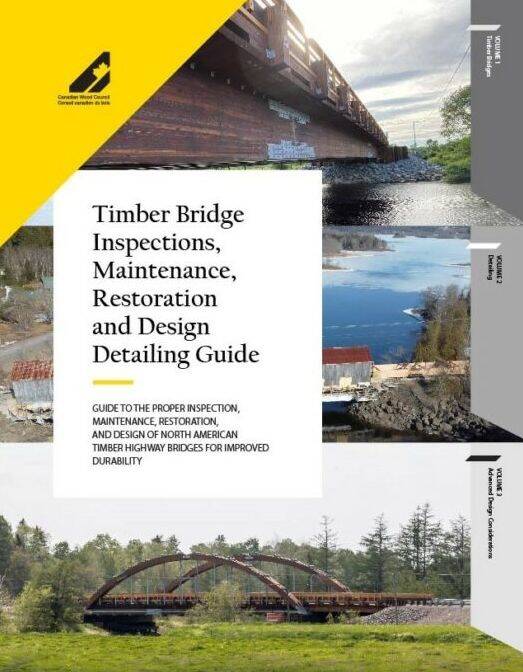
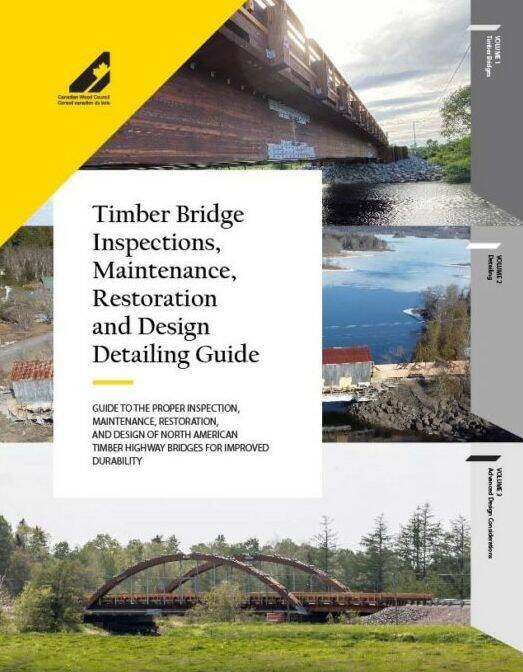
Across rural Nova Scotia, bridges do far more than carry traffic. They connect communities, support local economies, and provide critical access for emergency services. The province has more than 1,800 small- to medium-span timber bridges, with an average age of over 60 years, which poses a considerable infrastructure renewal challenge for the province relative to its population. Two recent projects, the Bass River Bridge and Pirate Harbour Bridge, demonstrate how modern engineered timber solution can provide a durable, cost-effective alternative to steel and concrete construction.

FEATURE
Atlantic Crossings: Modern Timber Bridges in Nova Scotia
Scroll to Read

Bridges That Belong
For many communities, a bridge is one of the most visible and enduring public investments they will make. Bridges are often the first landmark people see when entering a community and one of the last when leaving. A timber bridge offers a warmth and character that complements its natural surroundings. Whether crossing a quiet rural river or serving a busy provincial highway, a timber bridge becomes more than infrastructure, it becomes part of the landscape and a source of community pride.
The warmth of exposed wood and its timeless appeal make timber bridges a natural choice for parks, rural communities, and environmentally sensitive landscapes. Rather than dominating the landscape, timber complements it. When form and function work together, a bridge becomes an asset that communities are proud to preserve for generations.
A Lower Carbon Alternative
Timber bridges are more than just crossings, they are a smarter, more sustainable way to build road infrastructure. Timber is a renewable resource that stores carbon for decades. A single cubic meter of structural timber can store up 900 kg of CO₂, while the emissions from harvesting, manufacturing, transportation, and construction are typically only a fraction of that amount.
Timber bridges typically have lower embodied GHG emissions than concrete and steel. At WRD, projects such as the Bass River Bridge and Pirate Harbour Bridge pair this material advantage with high-performance engineering. Together, they demonstrate that sustainability and structural performance can go hand in hand in bridge projects, connecting communities while helping build a cleaner, lower-carbon future, one span at a time.
Every structural member undergoes quality verification, species confirmation, moisture content testing and specific gravity testing. For critical glulam girders, additional cyclic delamination and wet/dry shear tests are performed to provide an extra level of assurance that adhesive bond strength and long-term durability meet the demands of structural service.
Components are then precision-machined to a 2mm tolerance and, before shipment, the entire bridge is fully assembled as a trial fit. This step verifies that every connection aligns correctly and allows any adjustments to be made before the bridge reaches the project site, resulting in significantly reduced construction time.
Rapid Installation
Accelerated construction is one of the defining advantages of modern timber bridge systems. Components can be precision-fabricated in a controlled shop environment, treated and preassembled before being transported to site and lifted into place in a single operation. This approach reduces weather delays, improves quality control, minimizes on-site labour and, unlike concrete construction, eliminates curing time.
Timber’s lighter weight can further simplify construction. At equivalent design capacity, timber bridges have approximately one-eighth the dead weight of reinforced concrete bridges and one-fifth that of comparable steel bridges. This allows smaller cranes and equipment to be used, along with more economical substructure systems, helping bridges be completed and opened to the public sooner.
Simplified Maintenance
The true cost of a bridge isn't measured on opening day; it's measured over decades of ownership. No bridge should become a maintenance problem—it should remain a community asset.
At WRD, every timber bridge is engineered so owners can inspect, repair, and preserve the structure without unnecessary complexity. Durable detailing, preservative-treated components, and replaceable structural members allow owners to plan for repairs rather than react to emergencies. The result is lower maintenance costs, reduced traffic disruption, and greater value over the life of the bridge.
The maintenance program recommended by WRD is deliberately simple. At six months, fasteners are inspected and retightened as needed. After one year, and annually thereafter, owners remove leaves and debris, clean the scuppers and drains, and complete a general visual inspection. At five years, fasteners are retightened. At ten years, exposed timber receives field treatment as needed around shrinkage checks, and steel fasteners showing signs of bleeding are brushed and treated with site galvanizing compounds.
The full maintenance cycle is straightforward: inspect, clean, tighten, repair, and retreat. No recurring abrasive blasting. No corrosion-control painting program. No complicated maintenance regime. Just clear, scheduled tasks that municipal crews can schedule, budget for, and carry out before minor issues become expensive ones.
Conclusion
The Bass River and Pirate Harbour Bridges demonstrate that modern timber construction provides a practical, high-performance solution for highway infrastructure. Through advances in engineered wood products, prefabrication, preservative technologies, and durability-focused design, these projects showcase how timber can meet the demands of today's transportation networks while supporting Canada's sustainability goals.
In 1960, 80% of bridges built in North America were timber. By 2000, that number had fallen to just 0.5% because competing materials had convinced governments that wood was antiquated and no longer the right material for the job. Today, however, mass timber is regaining ground as a bridge-construction material. This shift has been driven by three factors: durability concerns with reinforced concrete, rising maintenance costs for both steel and concrete bridges, and growing interest in cost-effective, lower-carbon construction.
In this context, Bass River and Pirate Harbour provide more than isolated examples. They demonstrate how current engineering, fabrication and durability practices can give mass timber a renewed role in bridge construction. As transportation agencies confront the growing need to replace aging infrastructure, the lessons from these projects can help inform the next generation of timber bridges across Canada.
The design of timber bridges requires the use of structural design software that can accurately simulate the anisotropic nature of wood and the stiffness of connections so that load is distributed appropriately. Because wood is hygroscopic, the detailing of a timber bridge must allow for moisture-induced dimensional change and other key durability requirements.
Precision Built
Long before the first crane arrives on-site, every timber bridge produced by WRD has already been built once.
At less than half the next-lowest bid, the engineered timber design dramatically reduced the project’s cost and construction timeline. The choice was especially well suited to Pirate Harbour, which is located in one of North America’s most severe embedded and exposed corrosion zones. Because timber is not vulnerable to the same corrosion that affects structural steel and steel reinforcement, it offers long-term durability and performance in this demanding environment.
Durability by Design
Durability is not achieved with a single product or treatment; it is the result of a design approach that is carried faithfully through every decision. For Wood Research and Development (WRD), that approach includes design strategies that keep the wood dry, allow it to breathe, and eliminate details that trap moisture or create unnecessary stress concentrations. Proper drainage, thoughtful connection detailing, minimizing heavy notches into bright wood, and accommodating for natural dimensional movement are all fundamental to a durable design with extended service life.
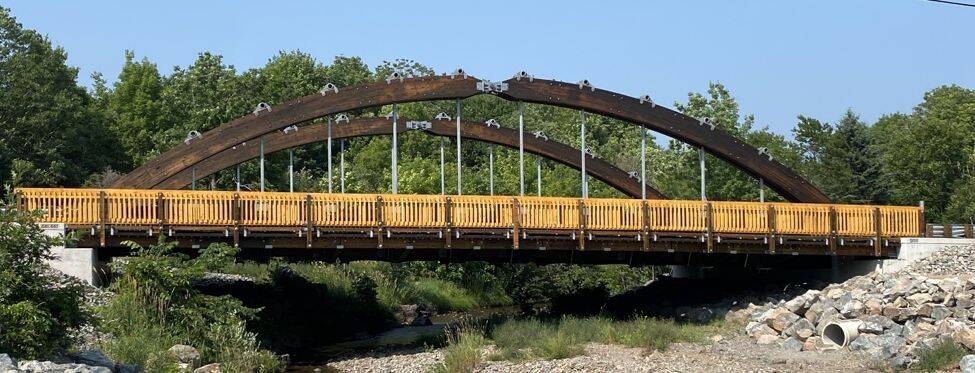
The approach taken was innovative. Rather than a conventional girder under-deck bridge, the Bass River Bridge uses independent three-pinned glulam arches. Transverse beams are suspended from the trussed arches and cantilevered to support the pedestrian walkways. The longitudinal beams provide bracing for the transverse beams, which share the load from the transverse glulam deck panels. Careful detailing allows each member to lengthen slightly as the bridge deforms and to expand in width and depth as moisture levels fluctuate. Stiffened by cambered tension chords, the arches deform only marginally under vehicular loads. The other superstructure elements move with the arches as a single system.
The real innovation lies not in any single feature, but in the way each engineering decision supported the next. The arch geometry supported ease of transportation > transportation requirements influenced how the members were spliced > the splicing strategy accommodated the preservative treatment > and the treatment improved durability so the bridge can achieve its 100-year design life.
Pirate Harbour Bridge
When the small community of Pirate Harbour needed to replace its main highway bridge, limited rerouting options made a conventional approach particularly expensive. A concrete replacement would have required a temporary panelized steel bypass, bringing the project cost to more than twice that of the timber solution proposed by Timber Restoration Services (TRS).For this bridge replacement, TRS utilized advanced fibre techniques to keep one lane of the old bridge open temporarily while the new bridge was lifted into place in two halves. The project offered an opportunity to rethink conventional bridge construction. Fabricated in just two weeks from receipt of materials to shipment to site, the Pirate Harbour Bridge was dropped in place in two preassembled halves that were manufactured at TRS’s facility in New Brunswick and shipped to the site preassembled. The first half was installed beside the restored single lane of the old bridge and then the old half was removed and the second half of the new bridge was installed. The total elapsed time for installing the bridge was just two days.
Bass River Bridge
The new Bass River Bridge replaced an aging two-span timber crossing on Trunk 2 in rural Colchester County. Designed for a 100-year service life. The new bridge carries three traffic lanes and two pedestrian pathways, demonstrating how engineered mass timber bridges have evolved to meet the demands of modern highway infrastructure.
The Next Generation of Timber Bridges
Across rural Nova Scotia, bridges do far more than carry traffic. They connect communities, support local economies, and provide critical access for emergency services. The province has more than 1,800 small- to medium-span timber bridges, with an average age of over 60 years, which poses a considerable infrastructure renewal challenge for the province relative to its population. Two recent projects, the Bass River Bridge and Pirate Harbour Bridge, demonstrate how modern engineered timber solution can provide a durable, cost-effective alternative to steel and concrete construction.
FEATURE
Atlantic Crossings: Modern Timber Bridges in Nova Scotia
Bridges That Belong
For many communities, a bridge is one of the most visible and enduring public investments they will make. Bridges are often the first landmark people see when entering a community and one of the last when leaving. A timber bridge offers a warmth and character that complements its natural surroundings. Whether crossing a quiet rural river or serving a busy provincial highway, a timber bridge becomes more than infrastructure, it becomes part of the landscape and a source of community pride.
The warmth of exposed wood and its timeless appeal make timber bridges a natural choice for parks, rural communities, and environmentally sensitive landscapes. Rather than dominating the landscape, timber complements it. When form and function work together, a bridge becomes an asset that communities are proud to preserve for generations.
Conclusion
The Bass River and Pirate Harbour Bridges demonstrate that modern timber construction provides a practical, high-performance solution for highway infrastructure. Through advances in engineered wood products, prefabrication, preservative technologies, and durability-focused design, these projects showcase how timber can meet the demands of today's transportation networks while supporting Canada's sustainability goals.
In 1960, 80% of bridges built in North America were timber. By 2000, that number had fallen to just 0.5% because competing materials had convinced governments that wood was antiquated and no longer the right material for the job. Today, however, mass timber is regaining ground as a bridge-construction material. This shift has been driven by three factors: durability concerns with reinforced concrete, rising maintenance costs for both steel and concrete bridges, and growing interest in cost-effective, lower-carbon construction.
In this context, Bass River and Pirate Harbour provide more than isolated examples. They demonstrate how current engineering, fabrication and durability practices can give mass timber a renewed role in bridge construction. As transportation agencies confront the growing need to replace aging infrastructure, the lessons from these projects can help inform the next generation of timber bridges across Canada.
A Lower Carbon Alternative
Timber bridges are more than just crossings, they are a smarter, more sustainable way to build road infrastructure. Timber is a renewable resource that stores carbon for decades. A single cubic meter of structural timber can store up 900 kg of CO₂, while the emissions from harvesting, manufacturing, transportation, and construction are typically only a fraction of that amount.
Timber bridges typically have lower embodied GHG emissions than concrete and steel. At WRD, projects such as the Bass River Bridge and Pirate Harbour Bridge pair this material advantage with high-performance engineering. Together, they demonstrate that sustainability and structural performance can go hand in hand in bridge projects, connecting communities while helping build a cleaner, lower-carbon future, one span at a time.
Every structural member undergoes quality verification, species confirmation, moisture content testing and specific gravity testing. For critical glulam girders, additional cyclic delamination and wet/dry shear tests are performed to provide an extra level of assurance that adhesive bond strength and long-term durability meet the demands of structural service.
Components are then precision-machined to a 2mm tolerance and, before shipment, the entire bridge is fully assembled as a trial fit. This step verifies that every connection aligns correctly and allows any adjustments to be made before the bridge reaches the project site, resulting in significantly reduced construction time.
Rapid Installation
Accelerated construction is one of the defining advantages of modern timber bridge systems. Components can be precision-fabricated in a controlled shop environment, treated and preassembled before being transported to site and lifted into place in a single operation. This approach reduces weather delays, improves quality control, minimizes on-site labour and, unlike concrete construction, eliminates curing time.
Timber’s lighter weight can further simplify construction. At equivalent design capacity, timber bridges have approximately one-eighth the dead weight of reinforced concrete bridges and one-fifth that of comparable steel bridges. This allows smaller cranes and equipment to be used, along with more economical substructure systems, helping bridges be completed and opened to the public sooner.
Simplified Maintenance
The true cost of a bridge isn't measured on opening day; it's measured over decades of ownership. No bridge should become a maintenance problem—it should remain a community asset.
At WRD, every timber bridge is engineered so owners can inspect, repair, and preserve the structure without unnecessary complexity. Durable detailing, preservative-treated components, and replaceable structural members allow owners to plan for repairs rather than react to emergencies. The result is lower maintenance costs, reduced traffic disruption, and greater value over the life of the bridge.
The maintenance program recommended by WRD is deliberately simple. At six months, fasteners are inspected and retightened as needed. After one year, and annually thereafter, owners remove leaves and debris, clean the scuppers and drains, and complete a general visual inspection. At five years, fasteners are retightened. At ten years, exposed timber receives field treatment as needed around shrinkage checks, and steel fasteners showing signs of bleeding are brushed and treated with site galvanizing compounds.
The full maintenance cycle is straightforward: inspect, clean, tighten, repair, and retreat. No recurring abrasive blasting. No corrosion-control painting program. No complicated maintenance regime. Just clear, scheduled tasks that municipal crews can schedule, budget for, and carry out before minor issues become expensive ones.
The design of timber bridges requires the use of structural design software that can accurately simulate the anisotropic nature of wood and the stiffness of connections so that load is distributed appropriately. Because wood is hygroscopic, the detailing of a timber bridge must allow for moisture-induced dimensional change and other key durability requirements.
Precision Built
Long before the first crane arrives on-site, every timber bridge produced by WRD has already been built once.
At less than half the next-lowest bid, the engineered timber design dramatically reduced the project’s cost and construction timeline. The choice was especially well suited to Pirate Harbour, which is located in one of North America’s most severe embedded and exposed corrosion zones. Because timber is not vulnerable to the same corrosion that affects structural steel and steel reinforcement, it offers long-term durability and performance in this demanding environment.
Durability by Design
Durability is not achieved with a single product or treatment; it is the result of a design approach that is carried faithfully through every decision. For Wood Research and Development (WRD), that approach includes design strategies that keep the wood dry, allow it to breathe, and eliminate details that trap moisture or create unnecessary stress concentrations. Proper drainage, thoughtful connection detailing, minimizing heavy notches into bright wood, and accommodating for natural dimensional movement are all fundamental to a durable design with extended service life.
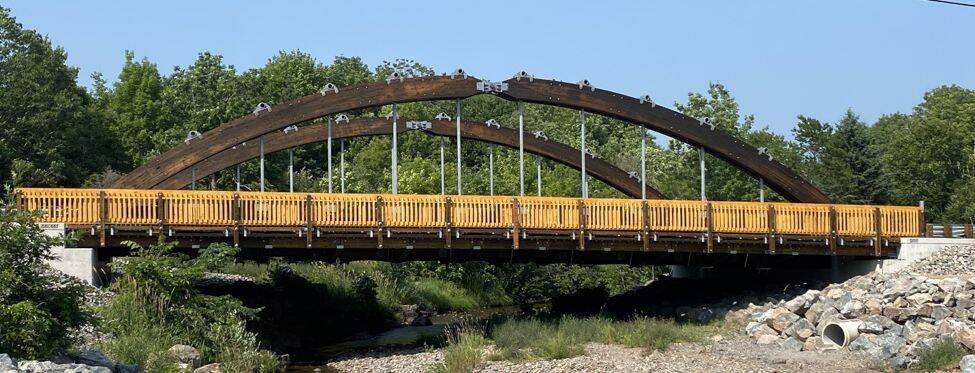
The approach taken was innovative. Rather than a conventional girder under-deck bridge, the Bass River Bridge uses independent three-pinned glulam arches. Transverse beams are suspended from the trussed arches and cantilevered to support the pedestrian walkways. The longitudinal beams provide bracing for the transverse beams, which share the load from the transverse glulam deck panels. Careful detailing allows each member to lengthen slightly as the bridge deforms and to expand in width and depth as moisture levels fluctuate. Stiffened by cambered tension chords, the arches deform only marginally under vehicular loads. The other superstructure elements move with the arches as a single system.
The real innovation lies not in any single feature, but in the way each engineering decision supported the next. The arch geometry supported ease of transportation > transportation requirements influenced how the members were spliced > the splicing strategy accommodated the preservative treatment > and the treatment improved durability so the bridge can achieve its 100-year design life.
Pirate Harbour Bridge
When the small community of Pirate Harbour needed to replace its main highway bridge, limited rerouting options made a conventional approach particularly expensive. A concrete replacement would have required a temporary panelized steel bypass, bringing the project cost to more than twice that of the timber solution proposed by Timber Restoration Services (TRS).For this bridge replacement, TRS utilized advanced fibre techniques to keep one lane of the old bridge open temporarily while the new bridge was lifted into place in two halves. The project offered an opportunity to rethink conventional bridge construction. Fabricated in just two weeks from receipt of materials to shipment to site, the Pirate Harbour Bridge was dropped in place in two preassembled halves that were manufactured at TRS’s facility in New Brunswick and shipped to the site preassembled. The first half was installed beside the restored single lane of the old bridge and then the old half was removed and the second half of the new bridge was installed. The total elapsed time for installing the bridge was just two days.
Bass River Bridge
The new Bass River Bridge replaced an aging two-span timber crossing on Trunk 2 in rural Colchester County. Designed for a 100-year service life. The new bridge carries three traffic lanes and two pedestrian pathways, demonstrating how engineered mass timber bridges have evolved to meet the demands of modern highway infrastructure.