Design Approach
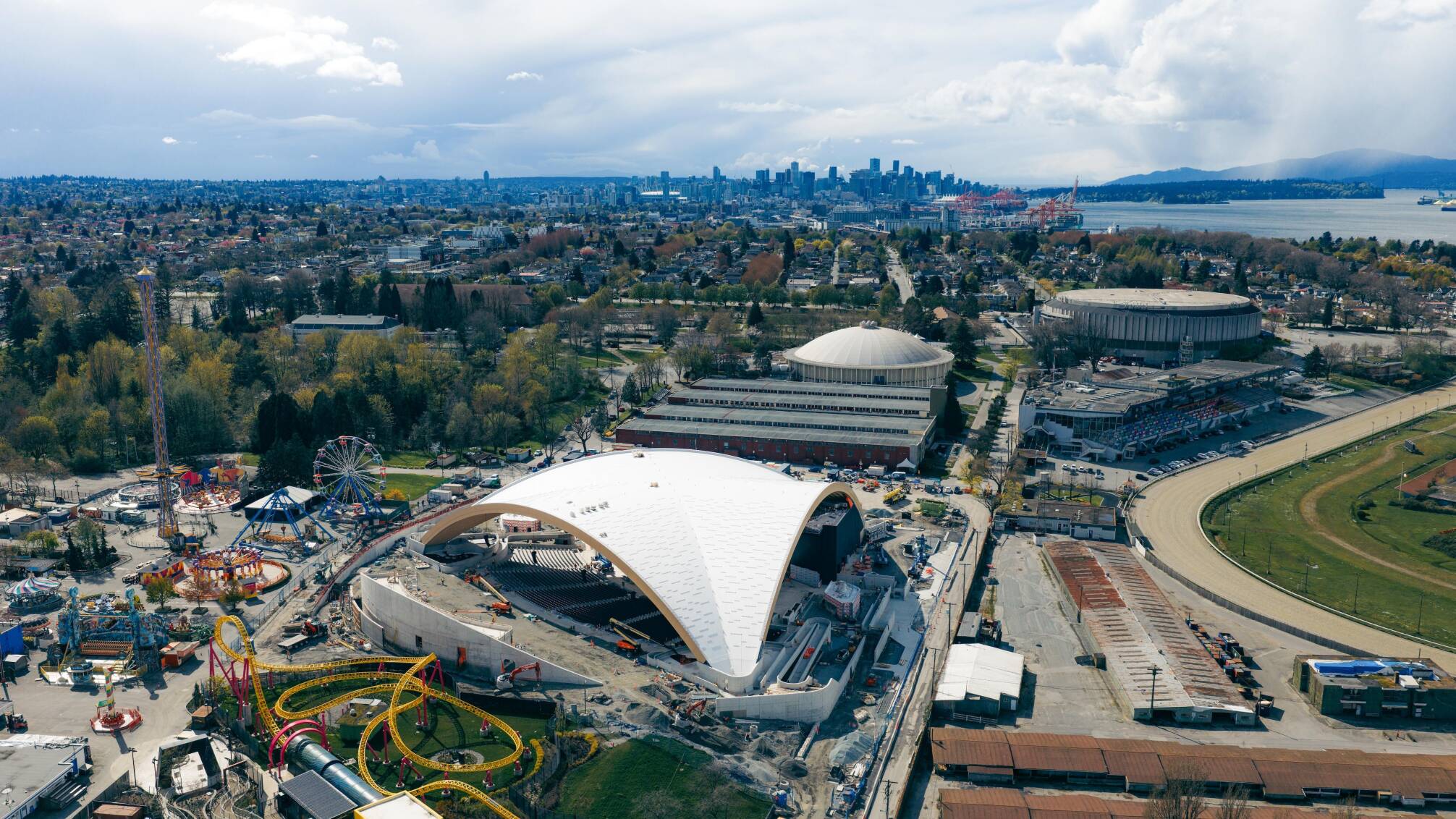
In response to program requirements and the clients’ desire to maximize views of the park and mountains, Revery Architecture designed an elegant, triangular arched structure for the Pacific National Exhibition’s (PNE) new amphitheatre. The colossal roof accommodates up to 10,000 patrons with a variety of seating areas including removable, fixed, box suites, and open-air lawn seating. Although monumental in scale, the open-air roof touches down gently at only three points, creating an intimate gathering space beneath the warm timber structure that preserves expansive views of the North Shore mountains, skyline, and coast.
The roof’s distinctive triangular form, from the perspective of Coast Salish artists, calls to mind traditional woven elements that can symbolize mountain ranges or water, relating to the natural setting framed by the amphitheatre’s arches. In the work of Angela George, a prominent weaver and artist from the Tsleil-Waututh Nation in North Vancouver, triangles have also represented the people of the region, with wave forms calling to the waterways that connect places and communities.

FEATURE
Structure and Spectacle:
an epic amphitheatre for the PNE
Scroll to Read

Photo by Ema Peter, courtesy of Revery
Photos by Fast + Epp, courtesy of Revery
Each timber arch connects to custom-fabricated head unit frames embedded within the concrete buttresses, which serve as the primary structural anchors for the roof system and establish a continuous load path throughout the structure. Designed to transfer exceptionally high structural loads across the building’s immense span, the connections were developed as large-scale, architecturally expressive assemblies balancing structural performance, constructability, and economy while accommodating the complex interface between timber and concrete.
Services Integration
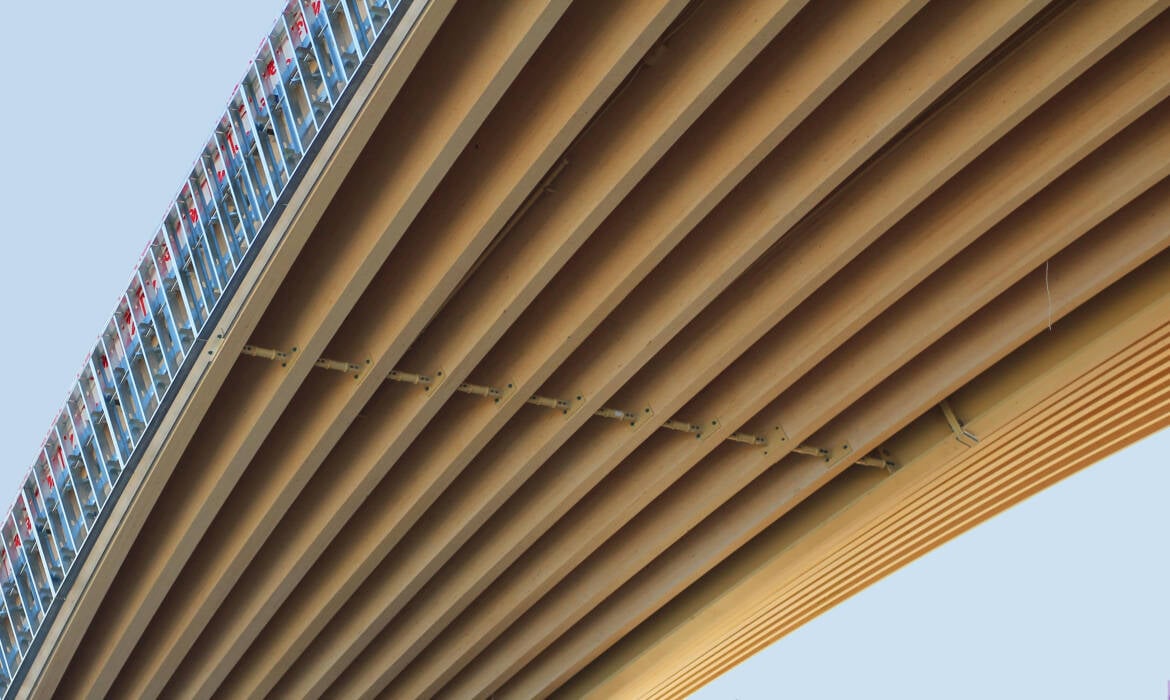
The visual clarity of the timber structure was preserved by concealing building services within the roof assembly. Mechanical, electrical, fire safety, acoustic, and lighting systems were integrated directly into the structure alongside buckling restraints, snow cleats, and rainwater collection infrastructure.
Photos (L) courtesy of Revery, (R) by SitePartners, courtesy of Revery
Annotated timelapse by EllisDon, courtesy of Revery
Photo by David Kvocak, courtesy of Revery
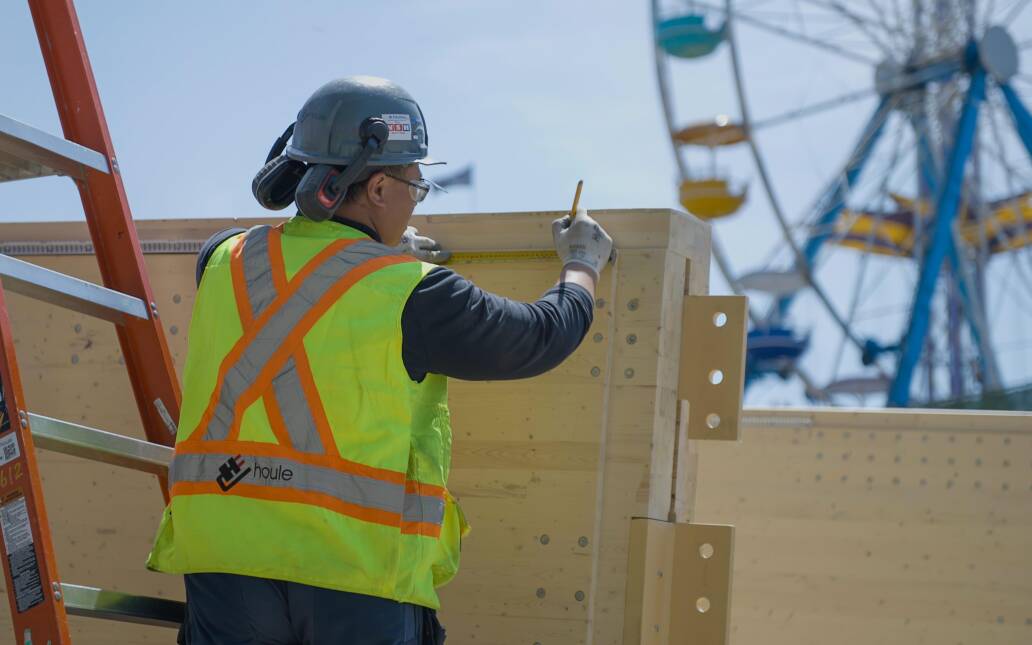
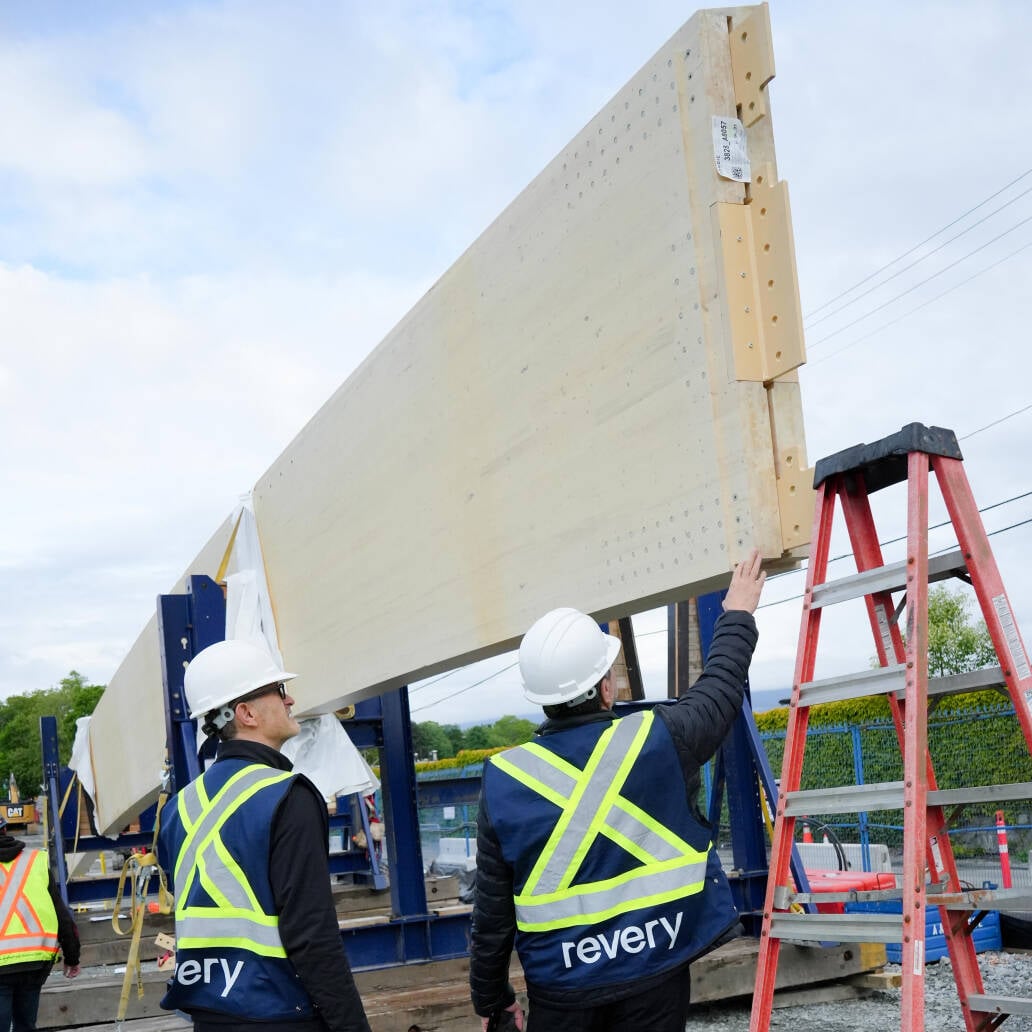
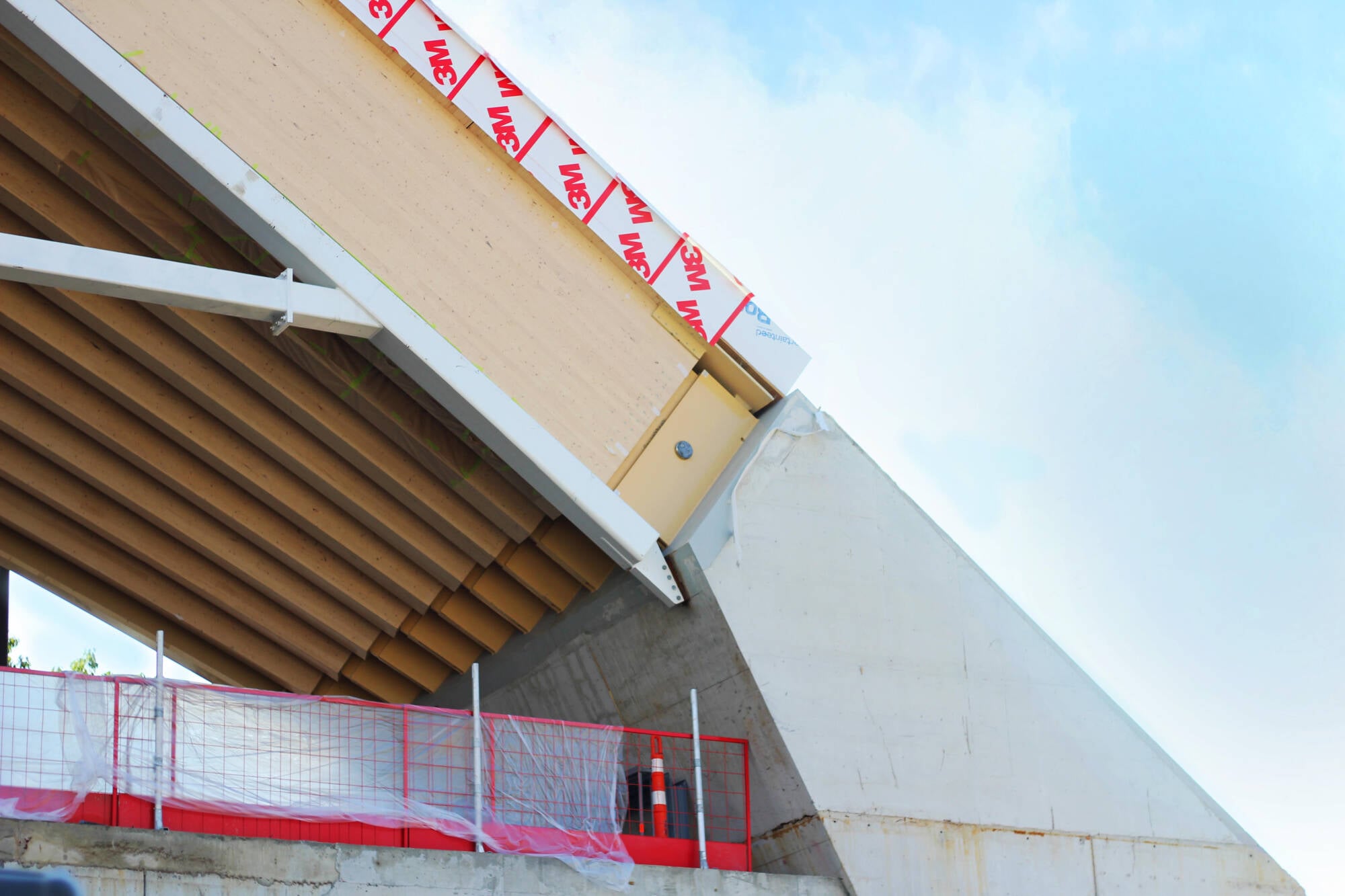
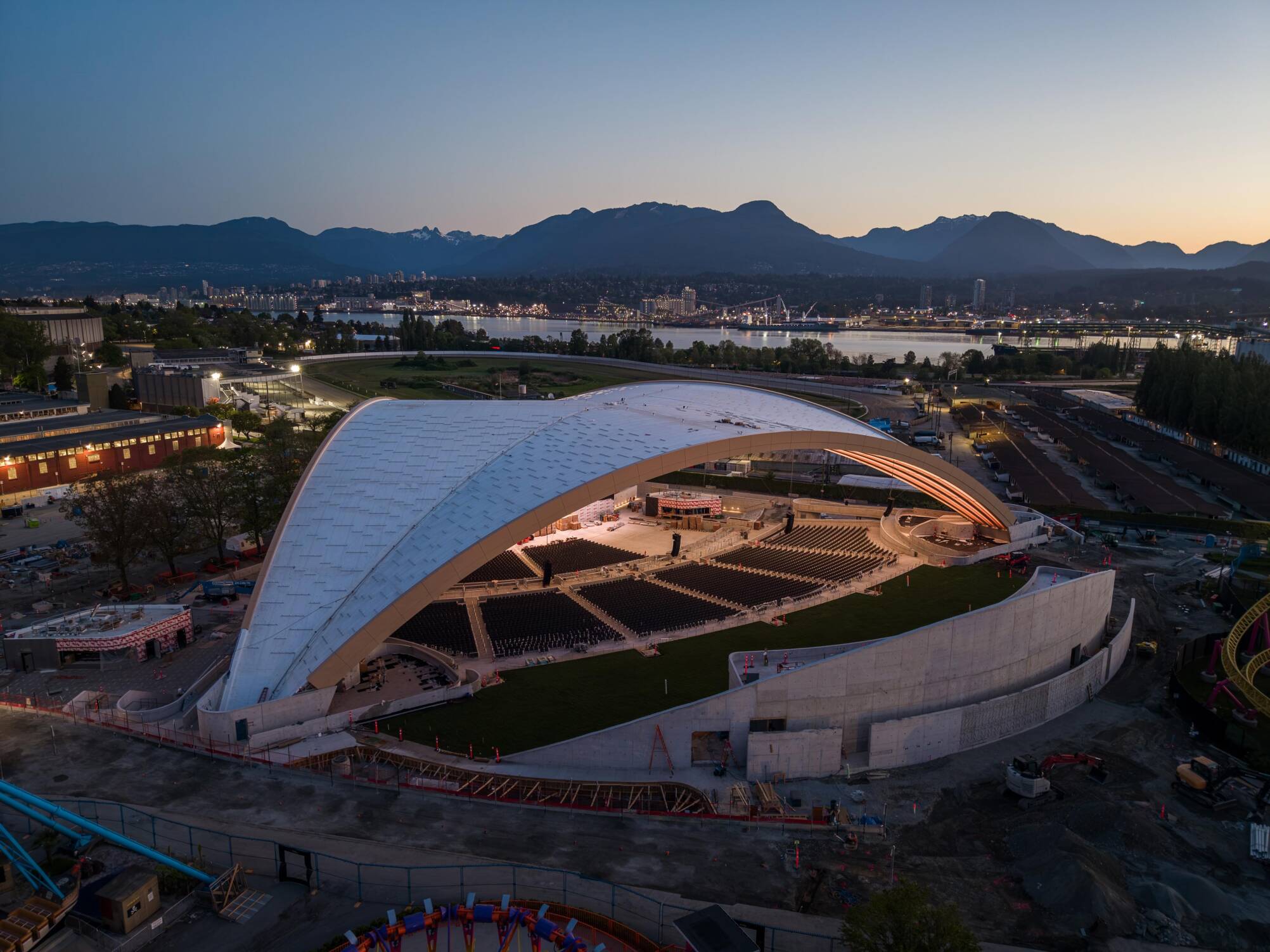
Photo by Fast + Epp, courtesy of Revery
Sustainability
To meet the sustainability goals established for the project, the principal building material needed to be low carbon, sourced from renewable materials, and durable enough to avoid carbon-intensive retrofits throughout the building’s lifespan. Mass timber was selected for the primary roof structure over more carbon-intensive alternatives. More than 2,000 cubic metres of mass timber were used for the landmark roof, achieving a 40% reduction in embodied carbon compared to baseline construction approaches.
Beyond the environmental benefits associated with mass timber construction, the new amphitheatre incorporates several additional sustainability strategies. The project is fully electric and designed to operate as a near-zero emissions facility. It also includes a rainwater capture and treatment system designed to collect and clean the first 48 mm of rainfall. The project is targeting LEED Gold, and Salmon Safe Certification, Rick Hansen Gold, and CaGBC Zero Carbon Building (ZCB) Performance Standard.
Conclusion
Wood construction at this scale establishes an important precedent for future long-span structures. Projects such as stadiums, arenas, airports, and hangars represent a growing market opportunity for mass timber systems, particularly where spans exceed 75 metres. The solutions developed for the PNE amphitheatre demonstrate how advanced timber engineering, prefabrication, and high-load connection design can enable increasingly ambitious civic structures in wood. The project also highlights the growing integration of architecture, engineering, manufacturing, and construction required to realize the next generation of large-scale timber buildings.
Beyond its technical achievements, the public interest and visibility generated by the project provide a valuable platform for sharing knowledge and demonstrating new possibilities for wood construction. As both a civic landmark and a highly visible demonstration project, the amphitheatre contributes to a broader exchange of ideas and expertise that continues to advance innovation across the wood construction sector.
Prefabrication and Sequencing
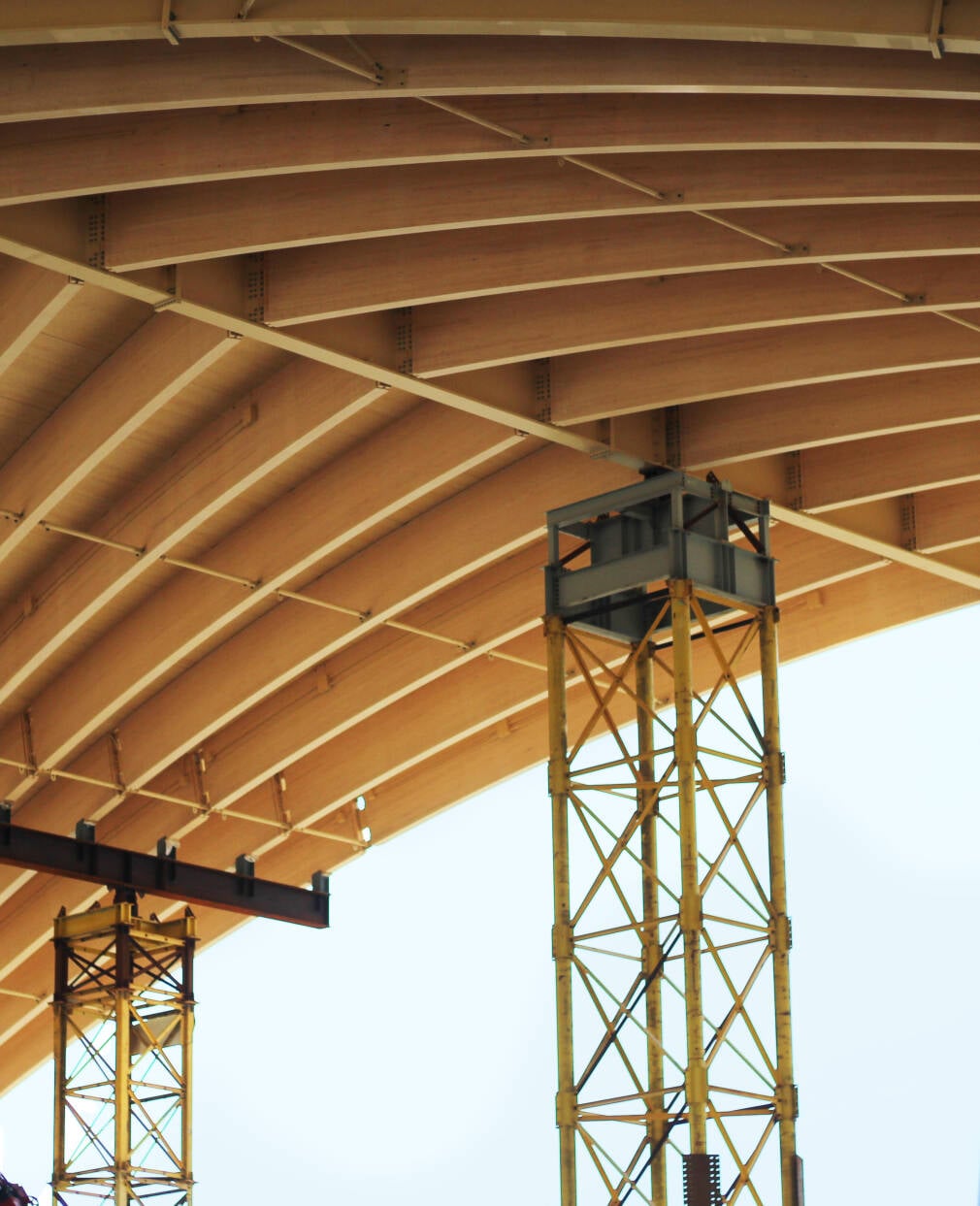
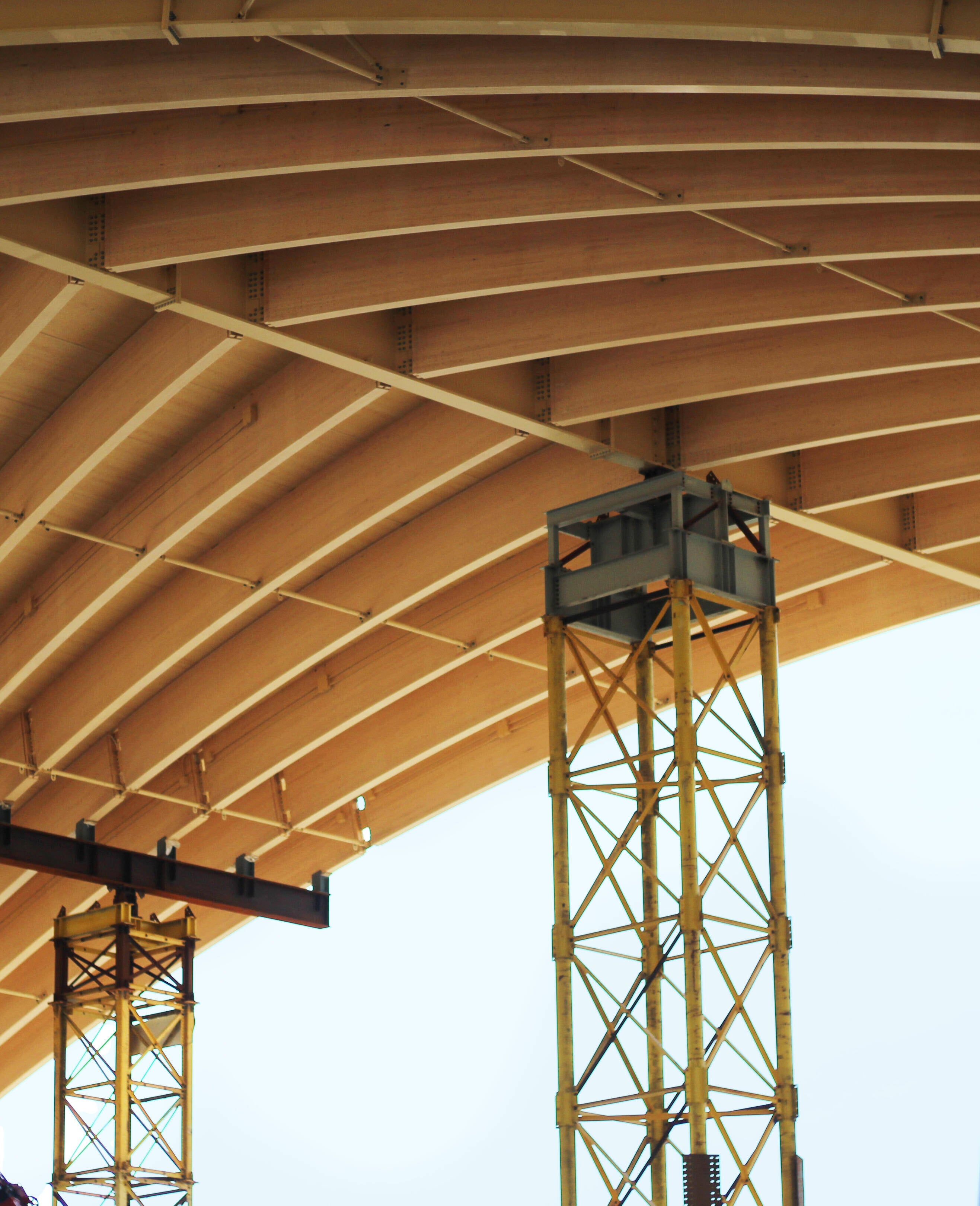
Following the formation and pouring of the three concrete buttresses, erection began with the three steel king arches, each composed of twenty-seven individual segments. The arches were assembled on a custom truss rack, with segments lifted into position by crane beginning at the concrete buttresses and progressing upward and inward toward the centre of the roof. Temporary shoring towers supported the structure throughout assembly.
Once the steel king arches were in place, the mass timber arch segments were spliced together and assembled on the ground before being lifted into place. Installation of the glulam arches and CLT roof diaphragm took about 14 weeks.
Constraints and Logistics
Manufactured by Nordic Structures, a vertically integrated supplier based in Québec, the mass timber components were carefully engineered to address both the project’s extraordinary span requirements and the logistical realities of transportation and installation. Fabrication and transport constraints played a significant role in determining segment lengths and connection locations throughout the structure.
To accommodate shipping and on-site assembly, the glulam members incorporate large-scale, high-stiffness, high-load-transfer splice connections that allowed the long structural elements to be segmented while remaining economical and constructible. Prefabricated steel and timber components were stored on site prior to installation and assembly was coordinated to support the complex erection sequence.
Connections
The timber arch segments were joined using highly coordinated splice connections incorporating many tight-fit pins, requiring close collaboration between design and fabrication teams to ensure precision fit-up and structural performance. To support this process, a full-scale mock-up of the connection detail was constructed in Fast + Epp’s Concept Lab, a research and development space located within the firm’s Vancouver office. The prototype allowed the team to better understand installation sequencing and connection behaviour ahead of on-site assembly.
Structure and Span
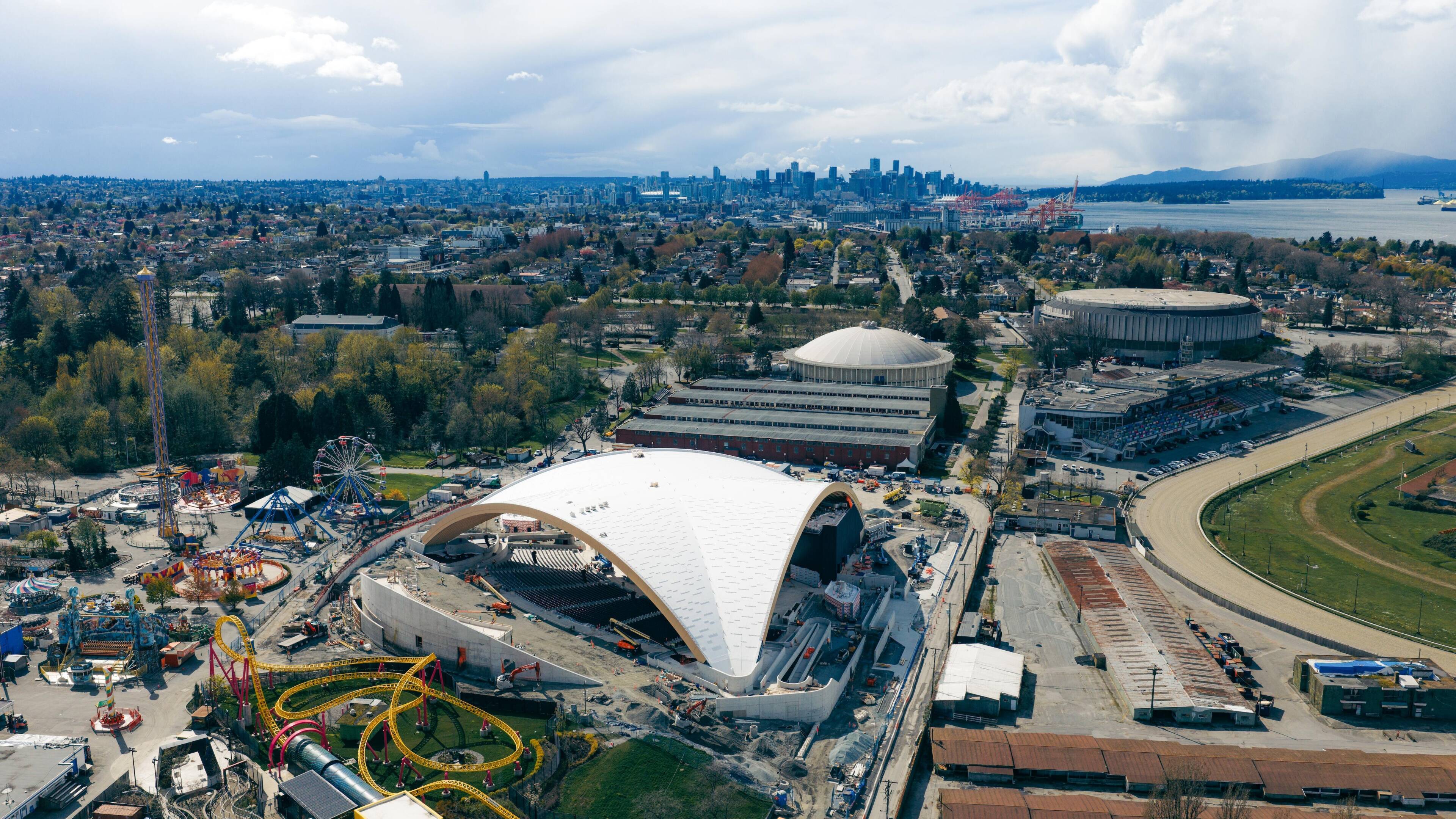
Guided by the City of Vancouver’s sustainability objectives and desire for an efficient long-span structure, Fast + Epp Structural Engineers proposed a mass timber hybrid solution to span the 105 metres (345 feet) from buttress tip to buttress tip. The roof is comprised of six barrel-vaulted segments that intersect along diagonal planes to form the amphitheatre’s distinctive starburst geometry.
Influenced by the technical legacy of Pier Luigi Nervi’s CNIT building in Paris, a pioneering concrete shell structure from the 1950s, the design harnesses the compressive capabilities of mass timber by using it for both the primary ribs and the roof deck. The resulting structure is one of the longest free-span timber arch roofs in the world, where the structural system also serves as the project’s defining architectural expression.
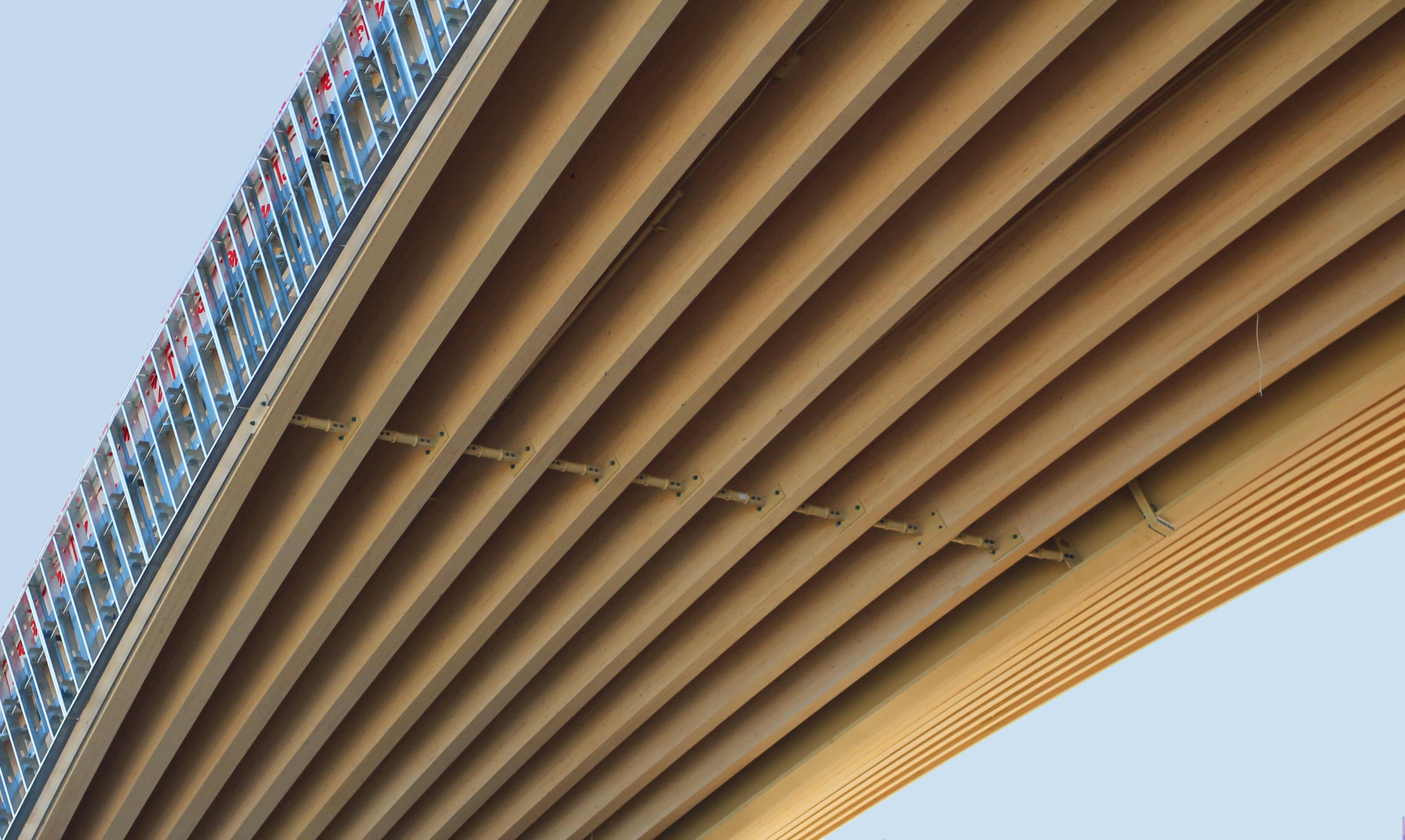
The roof structure is defined by three monumental steel king arches supporting curved 120-foot-long glulam arches. Extending from the steel framework are sixty segmented glulam arches arranged in six intersecting barrel vaults. These include nine jack arches inclined relative to the cylindrical axis and one queen arch positioned orthogonally to it along each steel arch. A three-ply (89 mm) Spruce Pine Fir (SPF) cross-laminated timber (CLT) deck spans between the arches to form the roof diaphragm and provide structural stability.
Design Approach
In response to program requirements and the clients’ desire to maximize views of the park and mountains, Revery Architecture designed an elegant, triangular arched structure for the Pacific National Exhibition’s (PNE) new amphitheatre. The colossal roof accommodates up to 10,000 patrons with a variety of seating areas including removable, fixed, box suites, and open-air lawn seating. Although monumental in scale, the open-air roof touches down gently at only three points, creating an intimate gathering space beneath the warm timber structure that preserves expansive views of the North Shore mountains, skyline, and coast.
The roof’s distinctive triangular form, from the perspective of Coast Salish artists, calls to mind traditional woven elements that can symbolize mountain ranges or water, relating to the natural setting framed by the amphitheatre’s arches. In the work of Angela George, a prominent weaver and artist from the Tsleil-Waututh Nation in North Vancouver, triangles have also represented the people of the region, with wave forms calling to the waterways that connect places and communities.
FEATURE
Structure and Spectacle:
an epic amphitheatre for the PNE
Photo by Ema Peter, courtesy of Revery
Photos by Fast + Epp, courtesy of Revery
Photos (L) courtesy of Revery, (R) by SitePartners, courtesy of Revery
Annotated timelapse by EllisDon, courtesy of Revery
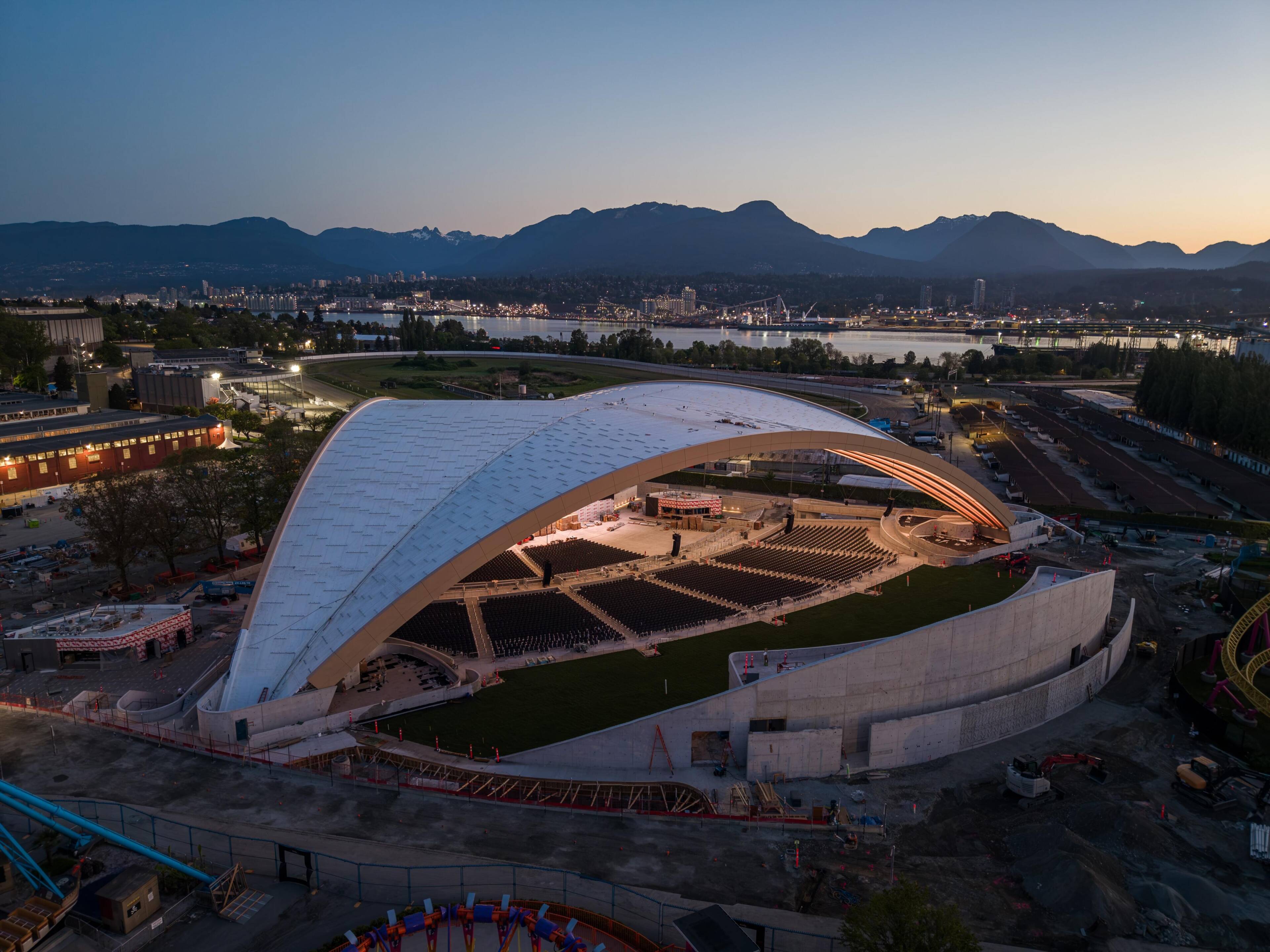
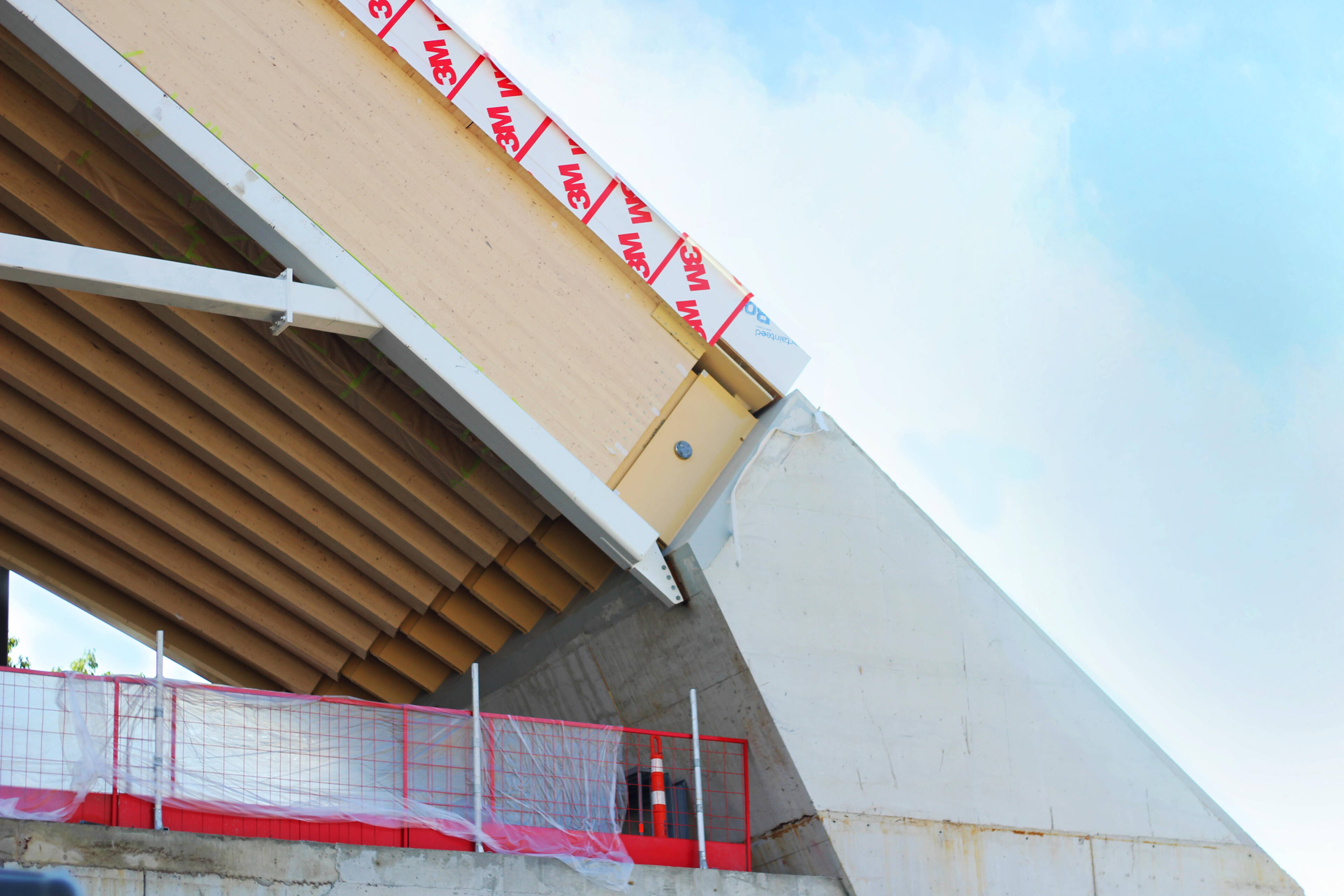
Photo by David Kvocak, courtesy of Revery
Sustainability
To meet the sustainability goals established for the project, the principal building material needed to be low carbon, sourced from renewable materials, and durable enough to avoid carbon-intensive retrofits throughout the building’s lifespan. Mass timber was selected for the primary roof structure over more carbon-intensive alternatives. More than 2,000 cubic metres of mass timber were used for the landmark roof, achieving a 40% reduction in embodied carbon compared to baseline construction approaches.
Beyond the environmental benefits associated with mass timber construction, the new amphitheatre incorporates several additional sustainability strategies. The project is fully electric and designed to operate as a near-zero emissions facility. It also includes a rainwater capture and treatment system designed to collect and clean the first 48 mm of rainfall. The project is targeting LEED Gold, and Salmon Safe Certification, Rick Hansen Gold, and CaGBC Zero Carbon Building (ZCB) Performance Standard.
Conclusion
Wood construction at this scale establishes an important precedent for future long-span structures. Projects such as stadiums, arenas, airports, and hangars represent a growing market opportunity for mass timber systems, particularly where spans exceed 75 metres. The solutions developed for the PNE amphitheatre demonstrate how advanced timber engineering, prefabrication, and high-load connection design can enable increasingly ambitious civic structures in wood. The project also highlights the growing integration of architecture, engineering, manufacturing, and construction required to realize the next generation of large-scale timber buildings.
Beyond its technical achievements, the public interest and visibility generated by the project provide a valuable platform for sharing knowledge and demonstrating new possibilities for wood construction. As both a civic landmark and a highly visible demonstration project, the amphitheatre contributes to a broader exchange of ideas and expertise that continues to advance innovation across the wood construction sector.
Each timber arch connects to custom-fabricated head unit frames embedded within the concrete buttresses, which serve as the primary structural anchors for the roof system and establish a continuous load path throughout the structure. Designed to transfer exceptionally high structural loads across the building’s immense span, the connections were developed as large-scale, architecturally expressive assemblies balancing structural performance, constructability, and economy while accommodating the complex interface between timber and concrete.
Services Integration
The visual clarity of the timber structure was preserved by concealing building services within the roof assembly. Mechanical, electrical, fire safety, acoustic, and lighting systems were integrated directly into the structure alongside buckling restraints, snow cleats, and rainwater collection infrastructure.
Photo by Fast + Epp, courtesy of Revery
Connections
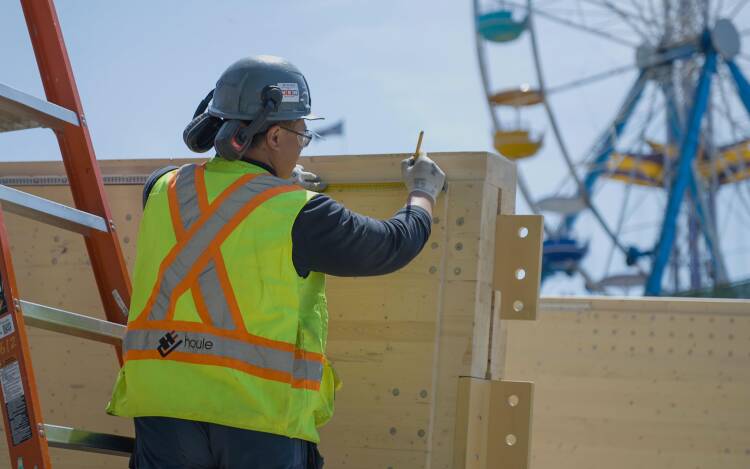
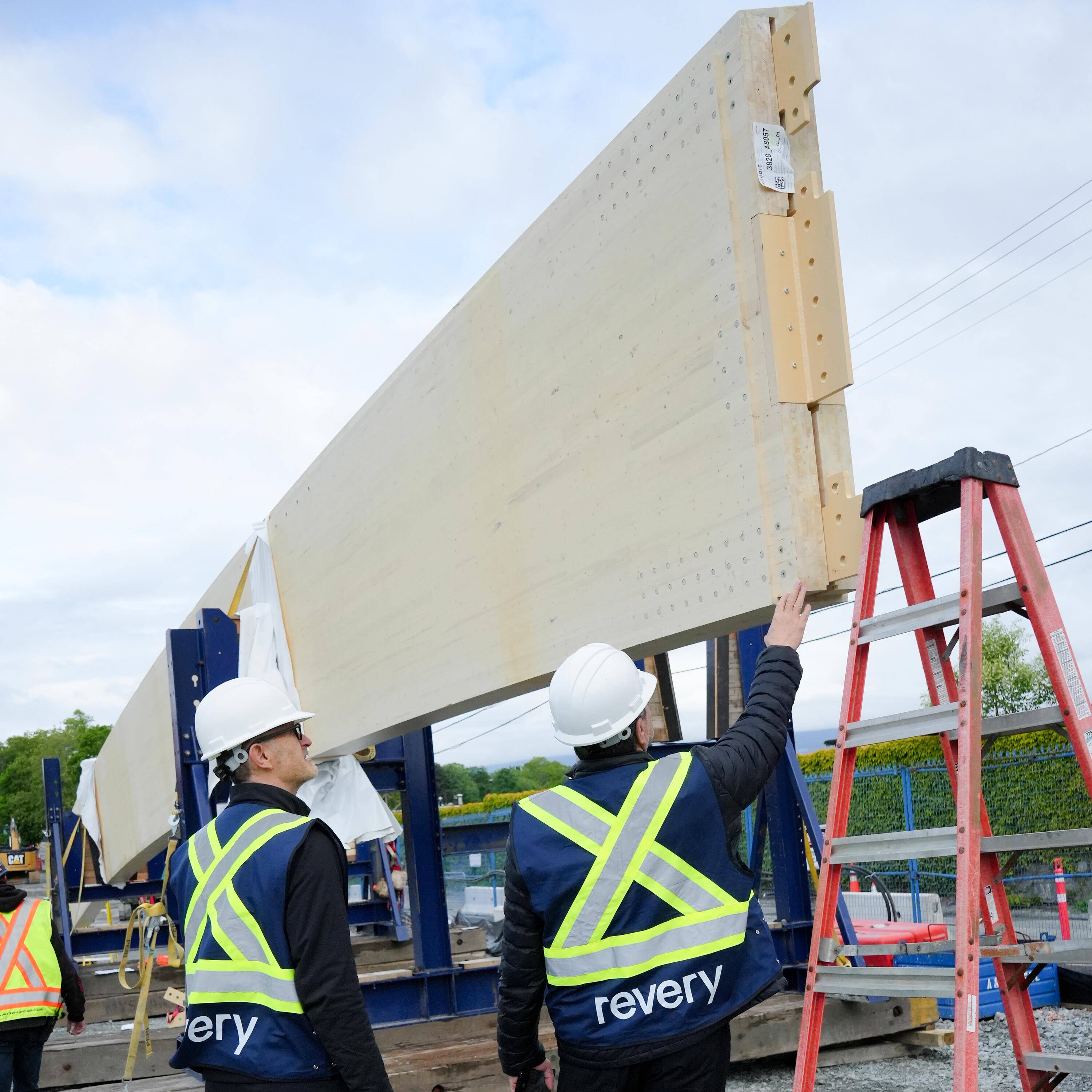
The timber arch segments were joined using highly coordinated splice connections incorporating many tight-fit pins, requiring close collaboration between design and fabrication teams to ensure precision fit-up and structural performance. To support this process, a full-scale mock-up of the connection detail was constructed in Fast + Epp’s Concept Lab, a research and development space located within the firm’s Vancouver office. The prototype allowed the team to better understand installation sequencing and connection behaviour ahead of on-site assembly.
Prefabrication and Sequencing
Following the formation and pouring of the three concrete buttresses, erection began with the three steel king arches, each composed of twenty-seven individual segments. The arches were assembled on a custom truss rack, with segments lifted into position by crane beginning at the concrete buttresses and progressing upward and inward toward the centre of the roof. Temporary shoring towers supported the structure throughout assembly.
Once the steel king arches were in place, the mass timber arch segments were spliced together and assembled on the ground before being lifted into place. Installation of the glulam arches and CLT roof diaphragm took about 14 weeks.
Constraints and Logistics
Manufactured by Nordic Structures, a vertically integrated supplier based in Québec, the mass timber components were carefully engineered to address both the project’s extraordinary span requirements and the logistical realities of transportation and installation. Fabrication and transport constraints played a significant role in determining segment lengths and connection locations throughout the structure.
To accommodate shipping and on-site assembly, the glulam members incorporate large-scale, high-stiffness, high-load-transfer splice connections that allowed the long structural elements to be segmented while remaining economical and constructible. Prefabricated steel and timber components were stored on site prior to installation and assembly was coordinated to support the complex erection sequence.
Structure and Span
Guided by the City of Vancouver’s sustainability objectives and desire for an efficient long-span structure, Fast + Epp Structural Engineers proposed a mass timber hybrid solution to span the 105 metres (345 feet) from buttress tip to buttress tip. The roof is comprised of six barrel-vaulted segments that intersect along diagonal planes to form the amphitheatre’s distinctive starburst geometry.
Influenced by the technical legacy of Pier Luigi Nervi’s CNIT building in Paris, a pioneering concrete shell structure from the 1950s, the design harnesses the compressive capabilities of mass timber by using it for both the primary ribs and the roof deck. The resulting structure is one of the longest free-span timber arch roofs in the world, where the structural system also serves as the project’s defining architectural expression.
The roof structure is defined by three monumental steel king arches supporting curved 120-foot-long glulam arches. Extending from the steel framework are sixty segmented glulam arches arranged in six intersecting barrel vaults. These include nine jack arches inclined relative to the cylindrical axis and one queen arch positioned orthogonally to it along each steel arch. A three-ply (89 mm) Spruce Pine Fir (SPF) cross-laminated timber (CLT) deck spans between the arches to form the roof diaphragm and provide structural stability.