The rectangular box that is Mi’kma’ki Place – a five-storey office building in downtown Sydney, N.S. – might appear plain at first glance. But step inside and the box reveals a jewel of exposed mass timber and environmentally conscious design.
Mi’kma’ki Place is a first for many. It’s the first mass timber build of its size for Atlantic Canada, and the first mass timber project for owner Membertou First Nation as well as Membertou’s in-house architect Gerry Lalonde.
Lalonde is a 10-year project manager for Membertou Corporate Division and says it's an unwritten policy for the First Nation community that new buildings are as sustainable as possible within their financial constraints.
“The cost difference between building in reinforced concrete and wood was so small that Membertou decided to take on the challenge of doing the first mass timber building,” Lalonde explains.
The project was also a first for DORA Construction, the Nova Scotia contractor that won the design build bid, and for DORA’s project manager Stephen Cantwell.
Cantwell’s engineering background is primarily in structural steel, including five years working with a steel fabricator. Making the switch to mass timber was not difficult, he says, but required different processes both before and during construction.
FEATURE
Mi’kma’ki Mission:
Membertou First Nation aims high with 5-storey mass timber build in Cape Breton
Scroll to Read

Mi’kma’ki Place – a five-storey, 90,000 square-foot structure – was erected in just 16 weeks. Photo: Dora Construction.
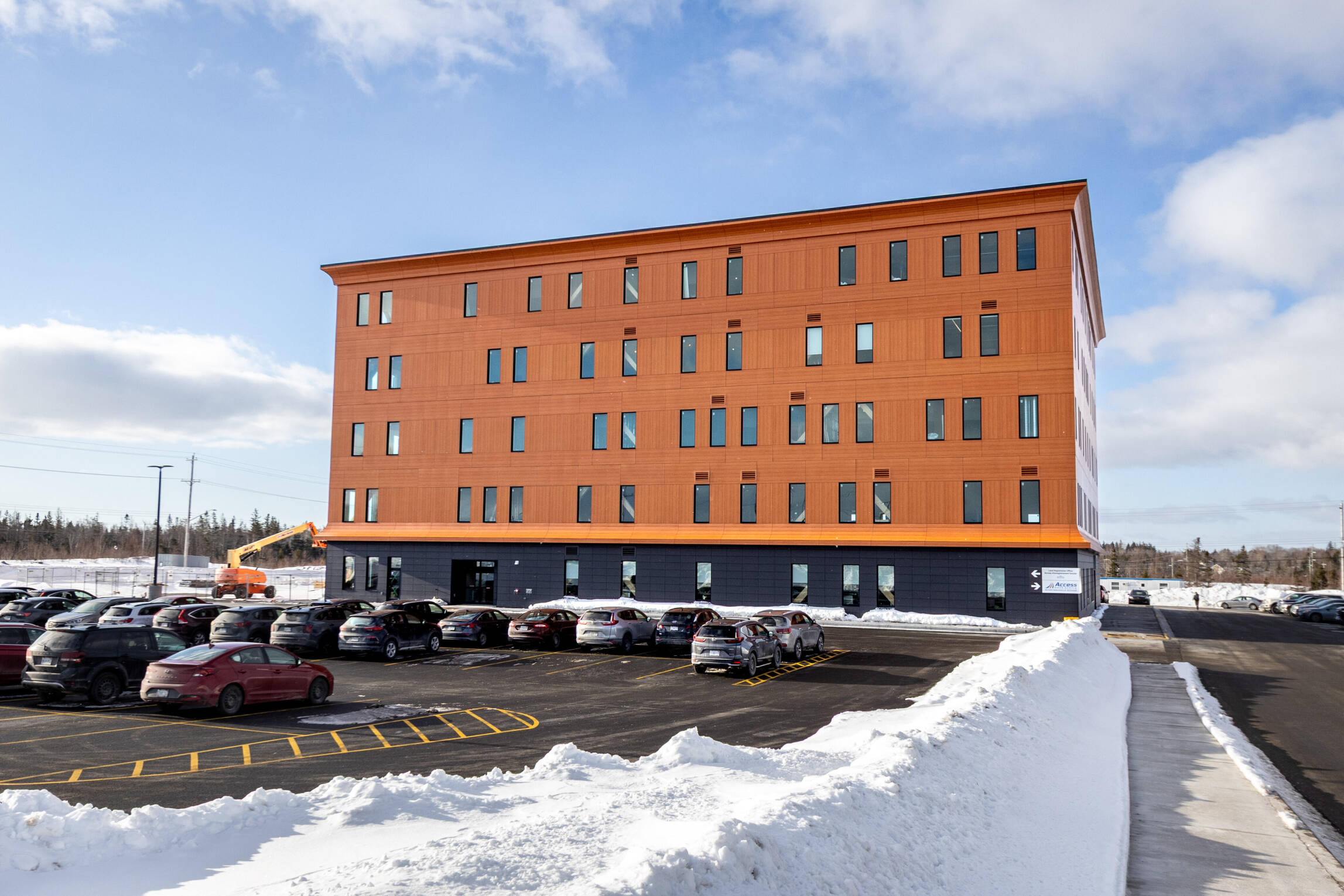
A striking organe-coloured phenolic resin with a subtle wood grain design completes the exterior of Mi’kma’ki Place, a five-storey mass timber office building in downtown Sydney, N.S. Photo courtesy Margaret Jourdan Studios, margaretjourdanstudios@gmail.com.
A striking orange-coloured phenolic resin with a subtle wood grain design completes the exterior of Mi’kma’ki Place, a five-storey mass timber office building in downtown Sydney, N.S. Photo courtesy Margaret Jourdan Studios, margaretjourdanstudios@gmail.com.
Quebec-based mass timber manufacturer Nordic Structures supplied the glulam and cross-laminated timber for Mi’kma’ki Place and were a vital resource for the builders. Photo: Dora Construction.
Quebec-based mass timber manufacturer Nordic Structures supplied the glulam and cross-laminated timber for Mi’kma’ki Place and were a vital resource for the builders. Photo: Dora Construction.
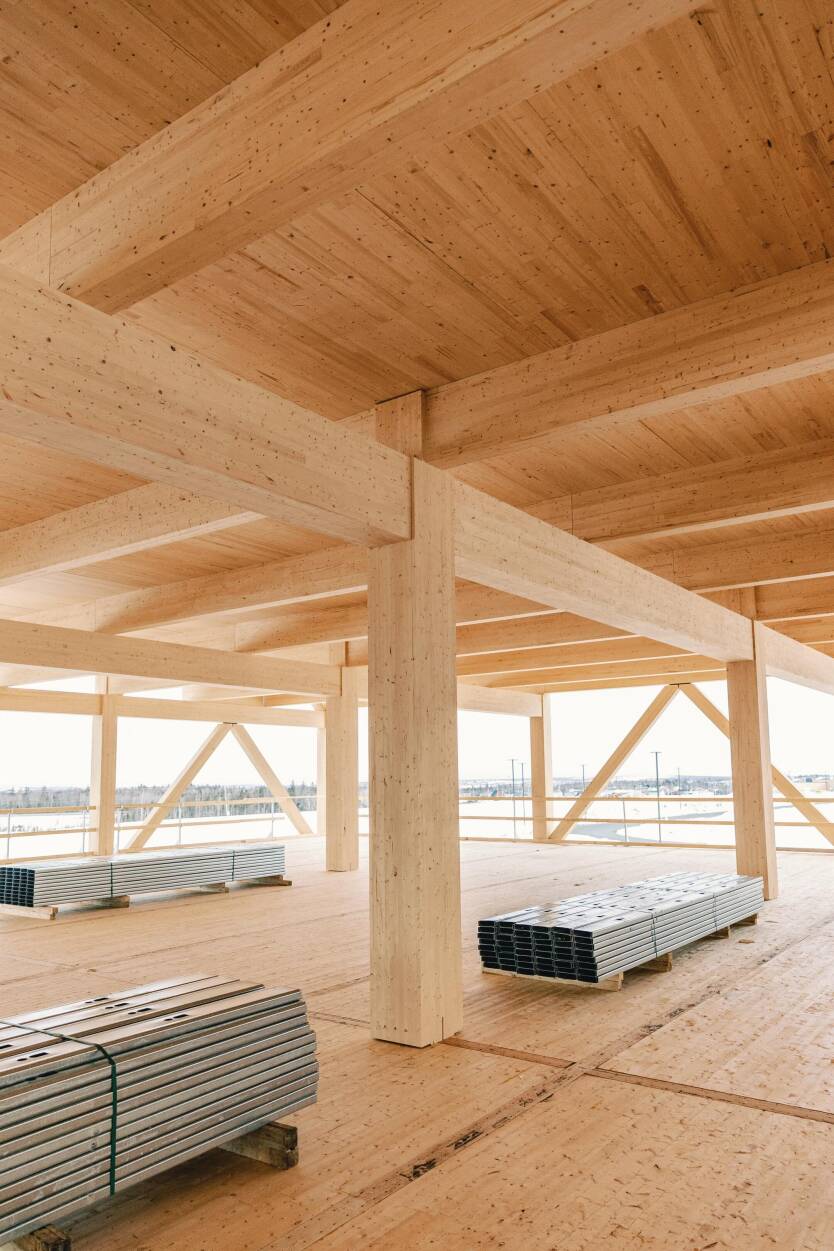
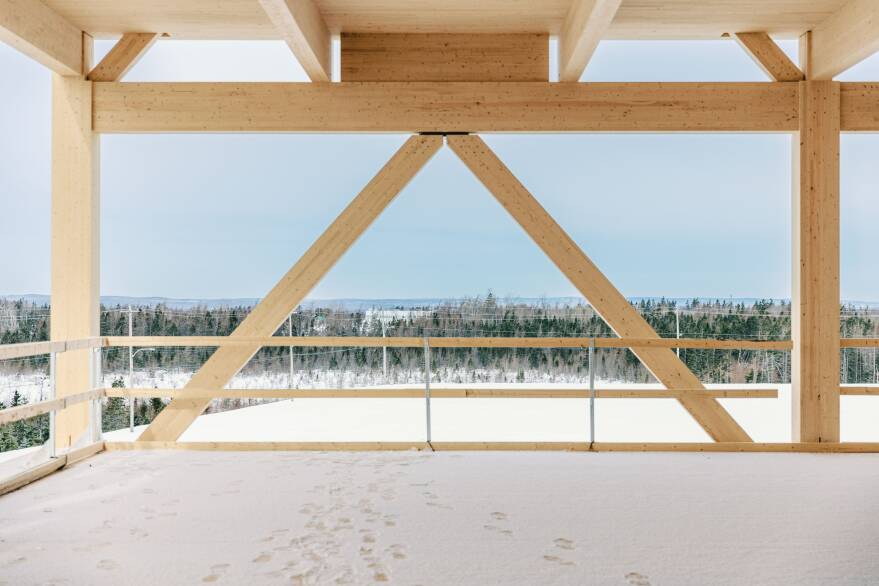
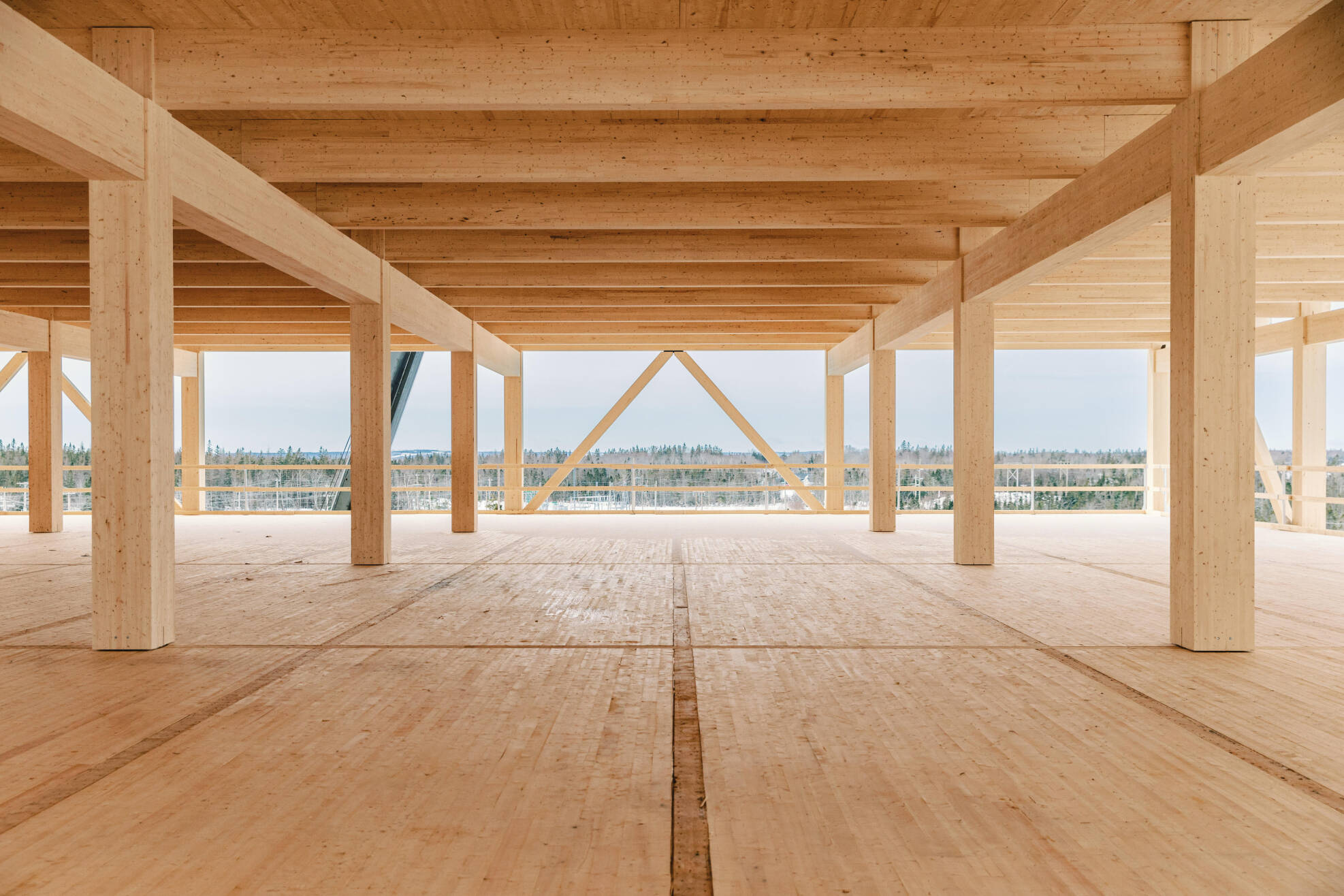
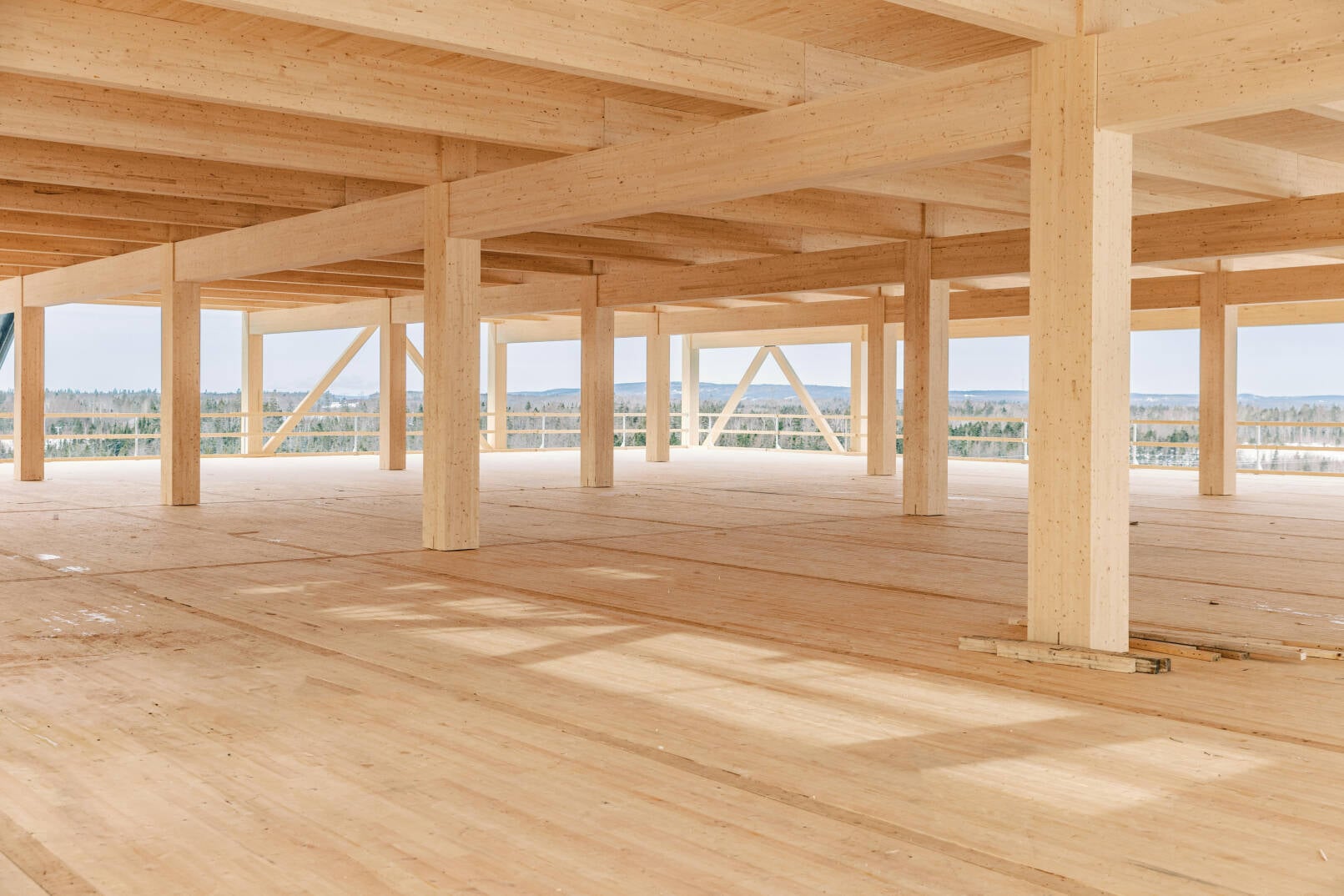
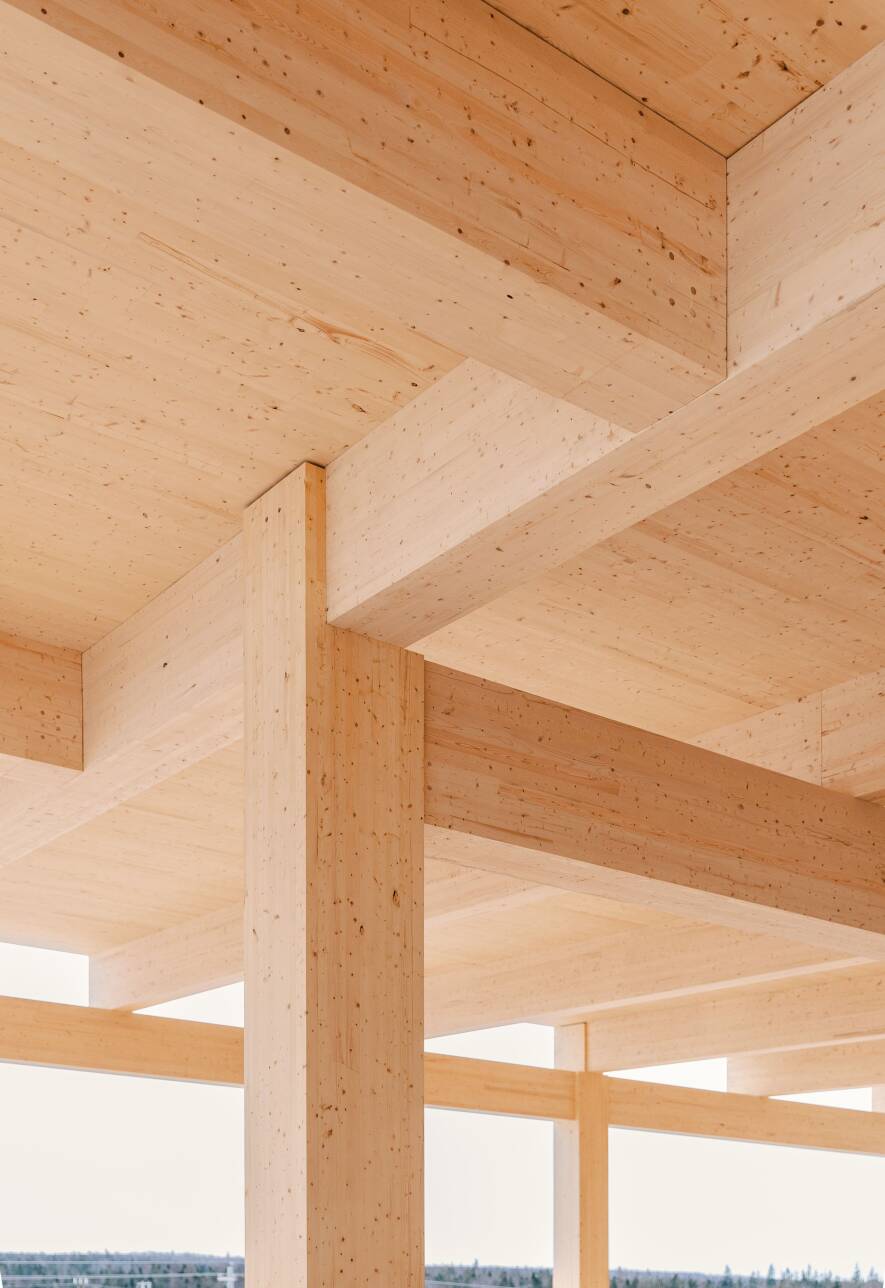
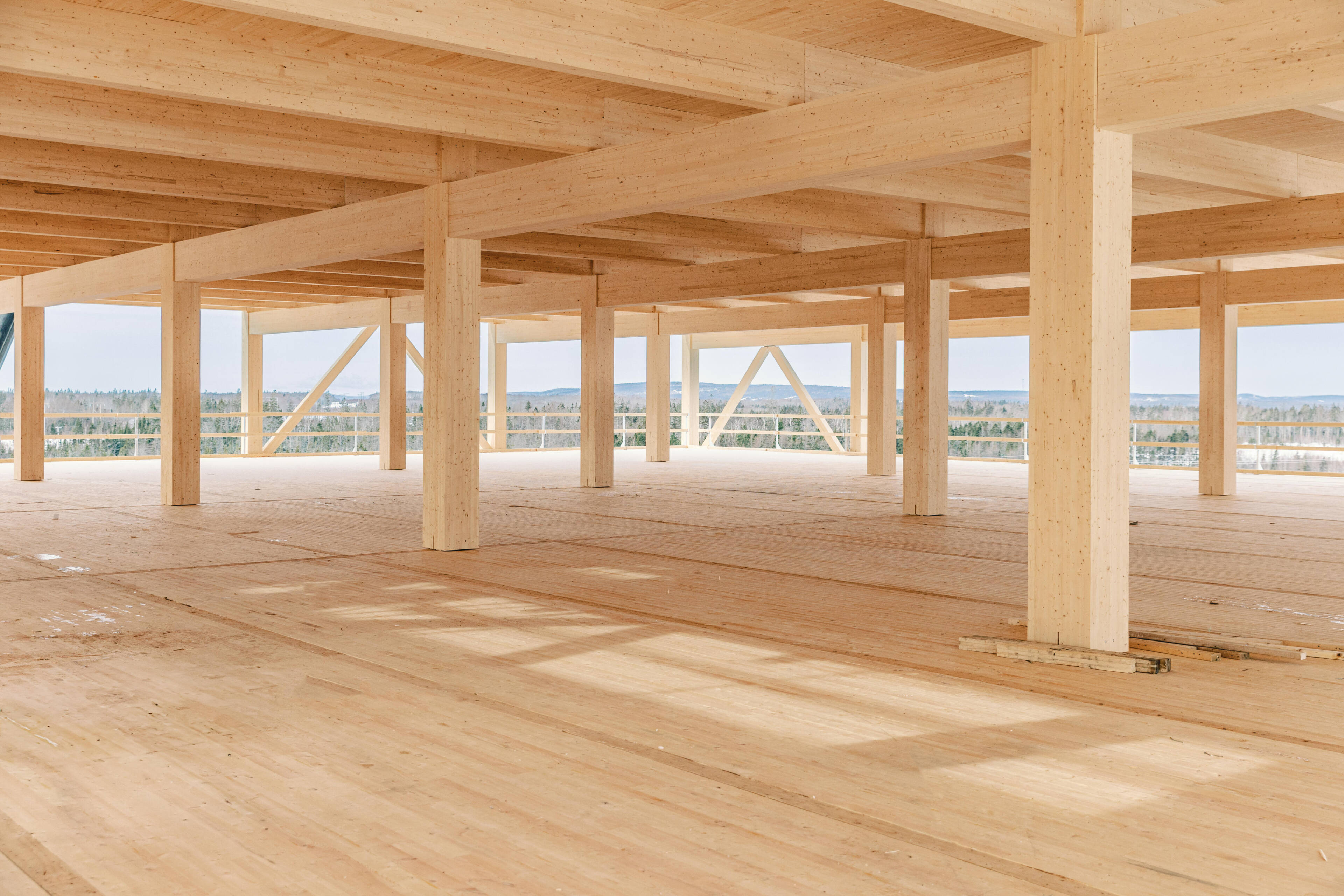
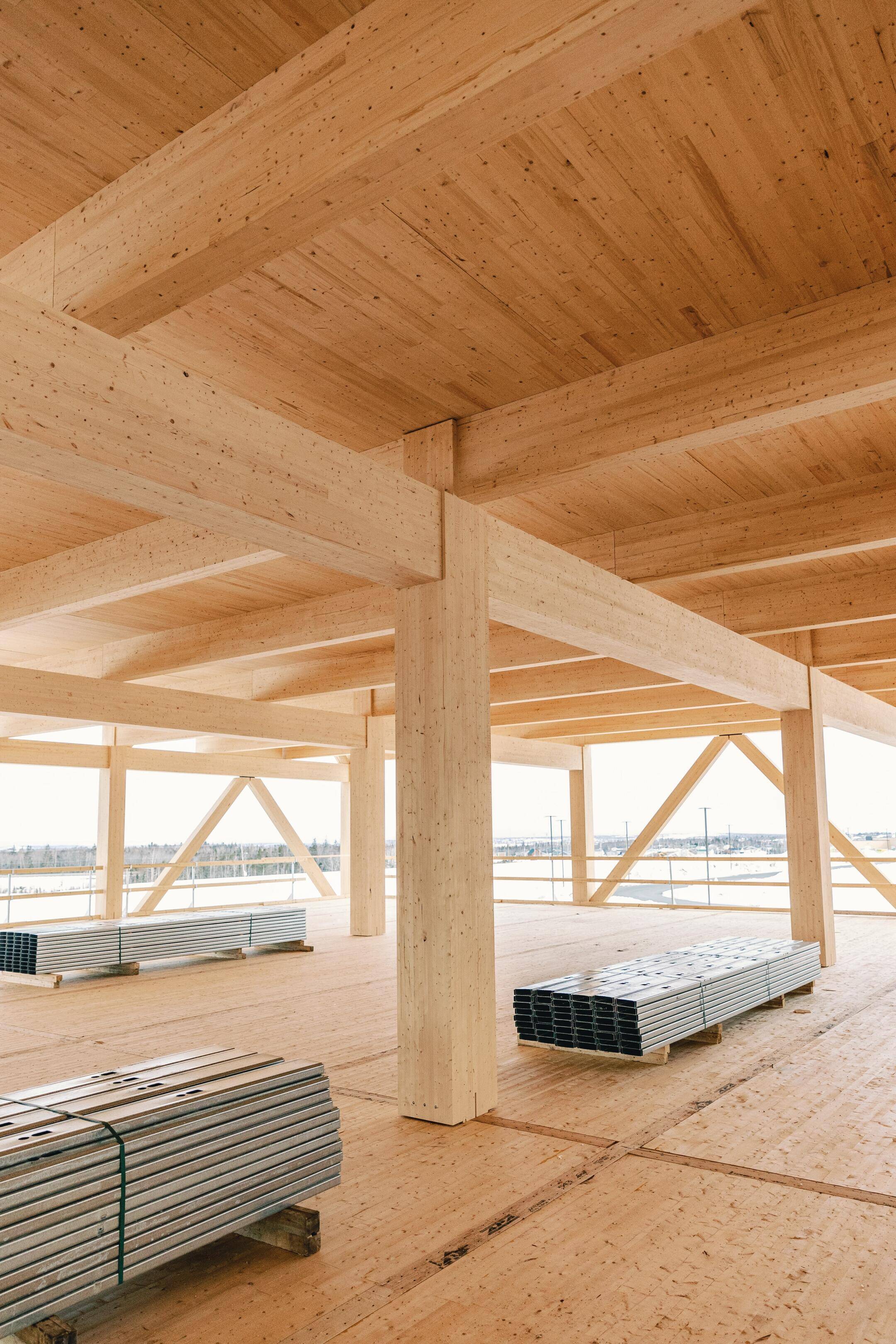
Each of the five storeys began with a CLT panel. Columns in a grid pattern support girders, followed by purlins sitting at 90 degrees. A CLT panel completes the level, acting as both ceiling and floor for the next level. Photo: Dora Construction.
Quebec-based mass timber manufacturer Nordic Structures supplied the glulam and cross-laminated timber for Mi’kma’ki Place and were a vital resource for the builders. Photo: Dora Construction.
Sticking to schedule
Construction speed is one of the strengths of mass timber, and Mi’kma’ki Place was no exception. The five-storey structure went up in just 16 weeks.
Incredibly, those weeks were in the dead of winter and included a record snowfall for the province, which locals refer to as Snowmaggedon. Sydney saw upwards of 150 centimeters of snow over three days.
Despite her best efforts, Mother Nature couldn’t prevent the builders from reaching the finish line.
“We probably would have been ahead of schedule at least a week or more if we didn’t get Snowmageddon in February. Things shut down here for about a week. It was pretty impressive to see [the build] happen and for it to be on schedule,” Cantwell says.
Taking a closer look at sequence and timeline, the building’s concrete foundation was poured in summer 2023, followed by exterior concrete walls with bases and pilasters to house anchor bolts.
The mass timber structure went vertical in December that year. 18”X18” glulam columns, each with a steel base plate, were attached to the anchor bolts in a grid pattern. 14”X24” girders were then attached to the columns and 8”X20”purlins on top of that sitting at 90 degrees. Each level was finished with a CLT deck 3-1/2” that acts as both ceiling and floor of the next level.
Exterior walls went up at roughly the same time as each level in an effort to seal off and protect the mass timber, Cantwell says. The final CLT roof deck with a modified bitumen roof product completed the mass timber structure on schedule in March 2024.
“It was quite something to see,” Lalonde says of the build process. “It went together like so many children’s building blocks.”
The exterior features curved parapets made of CNC-machined glulam that wrap around the second storey, acting as an overhang. It’s a unique mass timber detail that was designed and installed with care, Cantwell says, and the results are worth it.
The completed building is striking. Exterior walls are clad with a steel rain screen system, finished with a phenolic resin in a striking orange colour. A subtle wood-grain texture nods to the mass timber interior.
Up and at it
Membertou expects to hold a grand opening for the building in the coming months.
Lalonde says as a community architect the positive feedback has been satisfying. The building was the largest he’s worked on and is also his last before a planned retirement in the coming weeks.
Choosing mass timber wasn’t a risk, per se, but there were a lot of unknowns, Lalonde explains. Looking back at the project as a whole: “There were no downsides at all,” he says.
Beyond the competitive cost, mass timber has intangible benefits, not the least of which is the beauty of the exposed wood. Lalonde says his research found wood office environments can reduce absenteeism and improve staff outcomes.
“I would not hesitate to use the word biophilic,” Lalonde says. “That’s a common word now. It didn’t used to be, but it certainly is entering the common construction language these days.”
The building’s environmentally conscious design extended beyond carbon-storing wood materials to energy efficient windows and HVAC systems. A ground-floor heat pump unit heats and cools glycol, which is then pumped throughout the building to fan coils that transfer it into forced air.
Both Membertou and DORA are not done with mass timber. Just down the street from Mi’kma’ki Place the partners are working on a retail strip project that will use CLT panels as roof components.
“I think Membertou is a community and an organization that likes to be leading the charge,” Lalonde explains. “It’s thanks to the vision of Chief Terry Paul. He’s the guy who was willing to take the chance.”
Reflecting on the future of mass timber in the province, Cantwell says he is seeing growing client interest in both sustainability and Canadian-made products. Mass timber is the answer to both.
“Every ounce of this wood is from Quebec – it’s black spruce primarily – so it’s Canadian grown, Canadian manufactured, and Canadian erected. That’s huge,” he says.
Working with mass timber
Working with a new building method and material naturally came with lessons learned for both Cantwell and Lalonde.
Fire resistance rating was top of mind for Lalonde. In a multi-storey building, floors must be rated for one-hour fire separation. To fire-rate steel structures you need to encapsulate with drywall or spray with a fire-resistant coating.
“[Spray coating] is very messy, and I've done it before, and I swore I would never do it again,” Lalonde says with a laugh.
Mass timber components such as CLT have been proven to exceed fire-rating requirements. In a fire event, the dense wood forms a carbon layer on the surface that slows down combustion. Picture a log on the fire – it can take hours to burn through a single log, slowly smoldering away.
Acoustic ratings stood out for Cantwell. A typical building would have dropped ceilings with acoustic panels between. Exposing the mass timber ceilings removes that option and limits how you can dampen the sound between floors.
Originally their design had a poured concrete topping over each floor, but that would not have met acoustic ratings. The team pivoted and went with a Pliteq rubber floor system. The system layers rubber and gypsum and is assembled as tiles over the floor.
“We were quite relieved. It performs very well,” Cantwell says. “You can be working on a floor below and you have a crew upstairs doing piping or whatever and you don’t hear them.”
Both project managers noted the learning curve to working with mass timber as both structural components and a final product. Extra care was required during construction beyond what you would see when building with steel and concrete that will eventually be covered by other materials.
“From the day of erection you have it in the back of your mind that you want to get this building closed in so that nothing happens to the mass timber,” Cantwell says.
At the same time, both Cantwell and Lalonde note that wood by nature is a resilient material that is easily fixed with simple tools.
“It’s a natural product so there are random patterns, small knots, or little blemishes already that hide all kinds of sins,” Lalonde says.
All parties leaned on the expertise of Quebec-based mass timber manufacturer Nordic Structures, Cantwell says, which supplied the glulam and cross-laminated timber (CLT) for the 90,000 square-foot structure.
Right from the initial design process, strong, consistent communication was essential for a smooth, efficient build.
“From Day 1 we had everyone involved in the design process,” Cantwell says. “We had Membertou, ourselves, our consultants and subcontractors meeting together to go through the process. There are certainly lots of benefits to doing it that way. It’s a bit of an open book – you’re able to discuss any challenges you might have immediately as opposed to going back and forth between parties to find solutions.”
The rectangular box that is Mi’kma’ki Place – a five-storey office building in downtown Sydney, N.S. – might appear plain at first glance. But step inside and the box reveals a jewel of exposed mass timber and environmentally conscious design.
Mi’kma’ki Place is a first for many. It’s the first mass timber build of its size for Atlantic Canada, and the first mass timber project for owner Membertou First Nation as well as Membertou’s in-house architect Gerry Lalonde.
Lalonde is a 10-year project manager for Membertou Corporate Division and says it's an unwritten policy for the First Nation community that new buildings are as sustainable as possible within their financial constraints.
“The cost difference between building in reinforced concrete and wood was so small that Membertou decided to take on the challenge of doing the first mass timber building,” Lalonde explains.
The project was also a first for DORA Construction, the Nova Scotia contractor that won the design build bid, and for DORA’s project manager Stephen Cantwell.
Cantwell’s engineering background is primarily in structural steel, including five years working with a steel fabricator. Making the switch to mass timber was not difficult, he says, but required different processes both before and during construction.
FEATURE
Mi’kma’ki Mission:
Membertou First Nation aims high with 5-storey mass timber build in Cape Breton
A striking orange-coloured phenolic resin with a subtle wood grain design completes the exterior of Mi’kma’ki Place, a five-storey mass timber office building in downtown Sydney, N.S. Photo courtesy Margaret Jourdan Studios, margaretjourdanstudios@gmail.com.


Each of the five storeys began with a CLT panel. Columns in a grid pattern support girders, followed by purlins sitting at 90 degrees. A CLT panel completes the level, acting as both ceiling and floor for the next level. Photo: Dora Construction.

Quebec-based mass timber manufacturer Nordic Structures supplied the glulam and cross-laminated timber for Mi’kma’ki Place and were a vital resource for the builders. Photo: Dora Construction.

Working with mass timber
Working with a new building method and material naturally came with lessons learned for both Cantwell and Lalonde.
Fire resistance rating was top of mind for Lalonde. In a multi-storey building, floors must be rated for one-hour fire separation. To fire-rate steel structures you need to encapsulate with drywall or spray with a fire-resistant coating.
“[Spray coating] is very messy, and I've done it before, and I swore I would never do it again,” Lalonde says with a laugh.
Mass timber components such as CLT have been proven to exceed fire-rating requirements. In a fire event, the dense wood forms a carbon layer on the surface that slows down combustion. Picture a log on the fire – it can take hours to burn through a single log, slowly smoldering away.
Acoustic ratings stood out for Cantwell. A typical building would have dropped ceilings with acoustic panels between. Exposing the mass timber ceilings removes that option and limits how you can dampen the sound between floors.
Originally their design had a poured concrete topping over each floor, but that would not have met acoustic ratings. The team pivoted and went with a Pliteq rubber floor system. The system layers rubber and gypsum and is assembled as tiles over the floor.
“We were quite relieved. It performs very well,” Cantwell says. “You can be working on a floor below and you have a crew upstairs doing piping or whatever and you don’t hear them.”
Both project managers noted the learning curve to working with mass timber as both structural components and a final product. Extra care was required during construction beyond what you would see when building with steel and concrete that will eventually be covered by other materials.
“From the day of erection you have it in the back of your mind that you want to get this building closed in so that nothing happens to the mass timber,” Cantwell says.
At the same time, both Cantwell and Lalonde note that wood by nature is a resilient material that is easily fixed with simple tools.
“It’s a natural product so there are random patterns, small knots, or little blemishes already that hide all kinds of sins,” Lalonde says.
Mi’kma’ki Place – a five-storey, 90,000 square-foot structure – was erected in just 16 weeks. Photo: Dora Construction.
Up and at it
Membertou expects to hold a grand opening for the building in the coming months.
Lalonde says as a community architect the positive feedback has been satisfying. The building was the largest he’s worked on and is also his last before a planned retirement in the coming weeks.
Choosing mass timber wasn’t a risk, per se, but there were a lot of unknowns, Lalonde explains. Looking back at the project as a whole: “There were no downsides at all,” he says.
Beyond the competitive cost, mass timber has intangible benefits, not the least of which is the beauty of the exposed wood. Lalonde says his research found wood office environments can reduce absenteeism and improve staff outcomes.
“I would not hesitate to use the word biophilic,” Lalonde says. “That’s a common word now. It didn’t used to be, but it certainly is entering the common construction language these days.”
The building’s environmentally conscious design extended beyond carbon-storing wood materials to energy efficient windows and HVAC systems. A ground-floor heat pump unit heats and cools glycol, which is then pumped throughout the building to fan coils that transfer it into forced air.
Both Membertou and DORA are not done with mass timber. Just down the street from Mi’kma’ki Place the partners are working on a retail strip project that will use CLT panels as roof components.
“I think Membertou is a community and an organization that likes to be leading the charge,” Lalonde explains. “It’s thanks to the vision of Chief Terry Paul. He’s the guy who was willing to take the chance.”
Reflecting on the future of mass timber in the province, Cantwell says he is seeing growing client interest in both sustainability and Canadian-made products. Mass timber is the answer to both.
“Every ounce of this wood is from Quebec – it’s black spruce primarily – so it’s Canadian grown, Canadian manufactured, and Canadian erected. That’s huge,” he says.
Quebec-based mass timber manufacturer Nordic Structures supplied the glulam and cross-laminated timber for Mi’kma’ki Place and were a vital resource for the builders. Photo: Dora Construction.
Quebec-based mass timber manufacturer Nordic Structures supplied the glulam and cross-laminated timber for Mi’kma’ki Place and were a vital resource for the builders. Photo: Dora Construction.
Sticking to schedule
Construction speed is one of the strengths of mass timber, and Mi’kma’ki Place was no exception. The five-storey structure went up in just 16 weeks.
Incredibly, those weeks were in the dead of winter and included a record snowfall for the province, which locals refer to as Snowmaggedon. Sydney saw upwards of 150 centimeters of snow over three days.
Despite her best efforts, Mother Nature couldn’t prevent the builders from reaching the finish line.
“We probably would have been ahead of schedule at least a week or more if we didn’t get Snowmageddon in February. Things shut down here for about a week. It was pretty impressive to see [the build] happen and for it to be on schedule,” Cantwell says.
Taking a closer look at sequence and timeline, the building’s concrete foundation was poured in summer 2023, followed by exterior concrete walls with bases and pilasters to house anchor bolts.
The mass timber structure went vertical in December that year. 18”X18” glulam columns, each with a steel base plate, were attached to the anchor bolts in a grid pattern. 14”X24” girders were then attached to the columns and 8”X20”purlins on top of that sitting at 90 degrees. Each level was finished with a CLT deck 3-1/2” that acts as both ceiling and floor of the next level.
Exterior walls went up at roughly the same time as each level in an effort to seal off and protect the mass timber, Cantwell says. The final CLT roof deck with a modified bitumen roof product completed the mass timber structure on schedule in March 2024.
“It was quite something to see,” Lalonde says of the build process. “It went together like so many children’s building blocks.”
The exterior features curved parapets made of CNC-machined glulam that wrap around the second storey, acting as an overhang. It’s a unique mass timber detail that was designed and installed with care, Cantwell says, and the results are worth it.
The completed building is striking. Exterior walls are clad with a steel rain screen system, finished with a phenolic resin in a striking orange colour. A subtle wood-grain texture nods to the mass timber interior.
All parties leaned on the expertise of Quebec-based mass timber manufacturer Nordic Structures, Cantwell says, which supplied the glulam and cross-laminated timber (CLT) for the 90,000 square-foot structure.
Right from the initial design process, strong, consistent communication was essential for a smooth, efficient build.
“From Day 1 we had everyone involved in the design process,” Cantwell says. “We had Membertou, ourselves, our consultants and subcontractors meeting together to go through the process. There are certainly lots of benefits to doing it that way. It’s a bit of an open book – you’re able to discuss any challenges you might have immediately as opposed to going back and forth between parties to find solutions.”