Winter construction in Edmonton is harsh. Add a confined site, nearby light rail transit construction, and neighbouring retail businesses working hard to attract customers, and the resulting construction environment is very complex.
The Cantiro Group, an Edmonton-based builder with projects stretching from B.C. to Ontario, used prefabricated wood construction methods to help to overcome these challenges to build a six-storey, 104-unit apartment rental property called 200 West Block.
With a construction window from summer 2025 to fall 2026, the 200 West Block midrise is just one of five buildings in the company's massive, phased, mixed-use, 1.4-hectare West Block development in the prestigious Glenora neighborhood of west central Edmonton.

FEATURE
Efficiency Under Pressure:
Prefabrication Reduces
On-Site Building Activity
by 15% for Busy Edmonton Midrise Construction Project
Scroll to Read

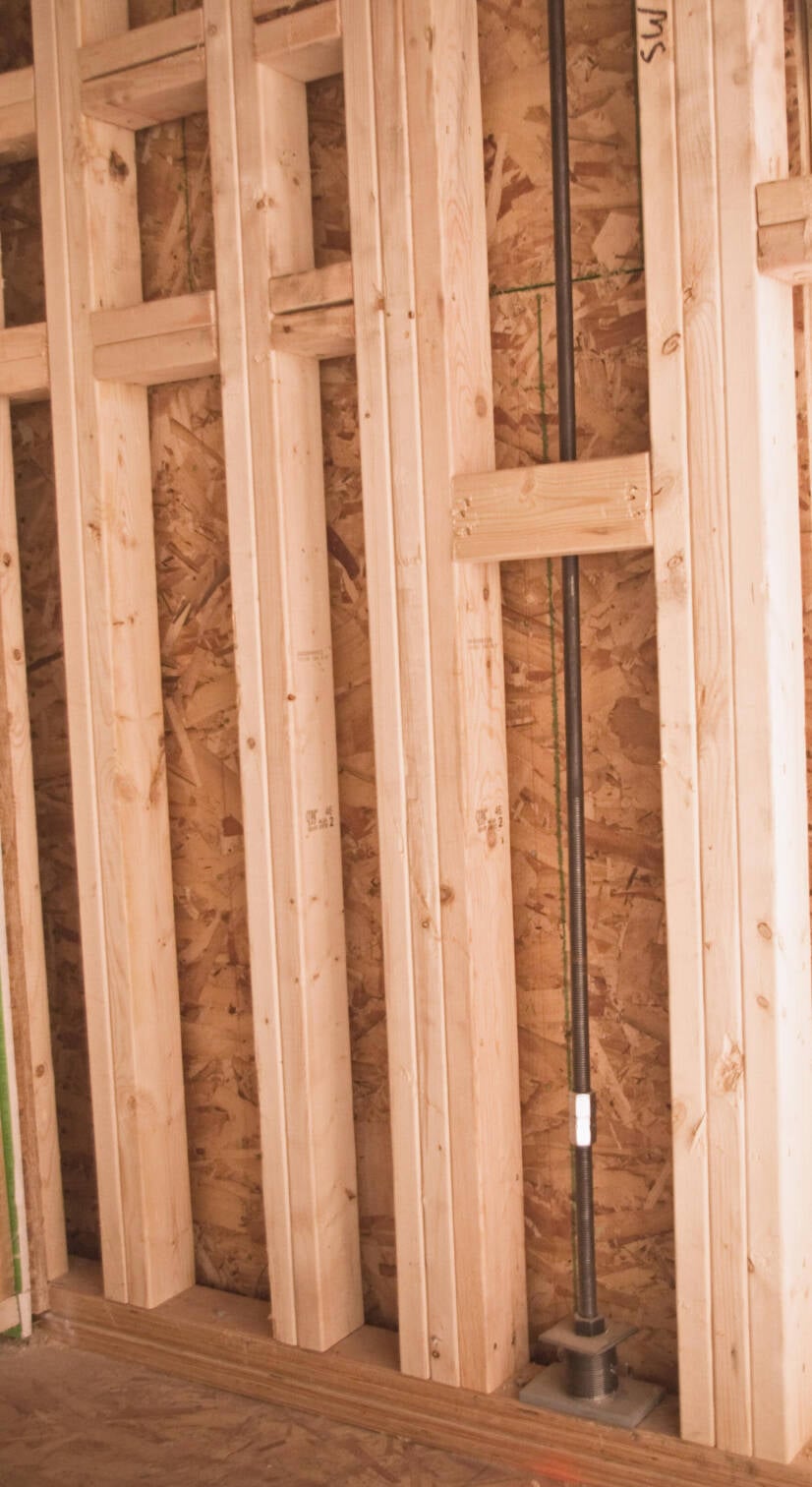
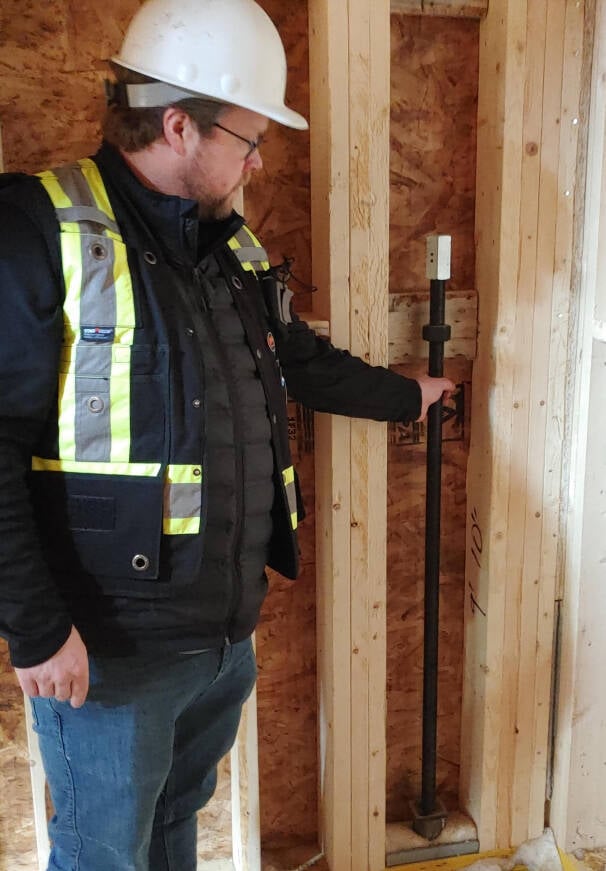
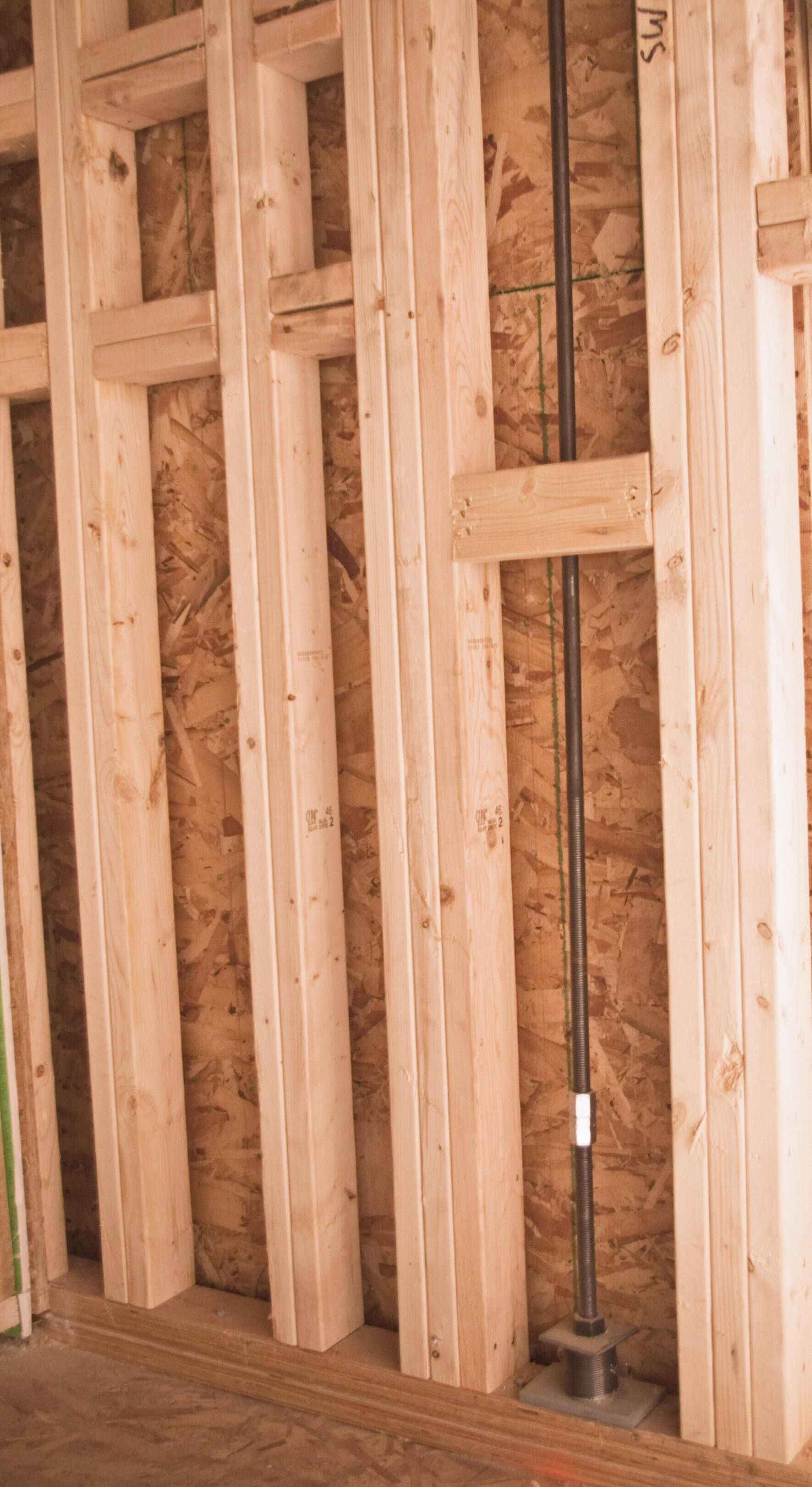
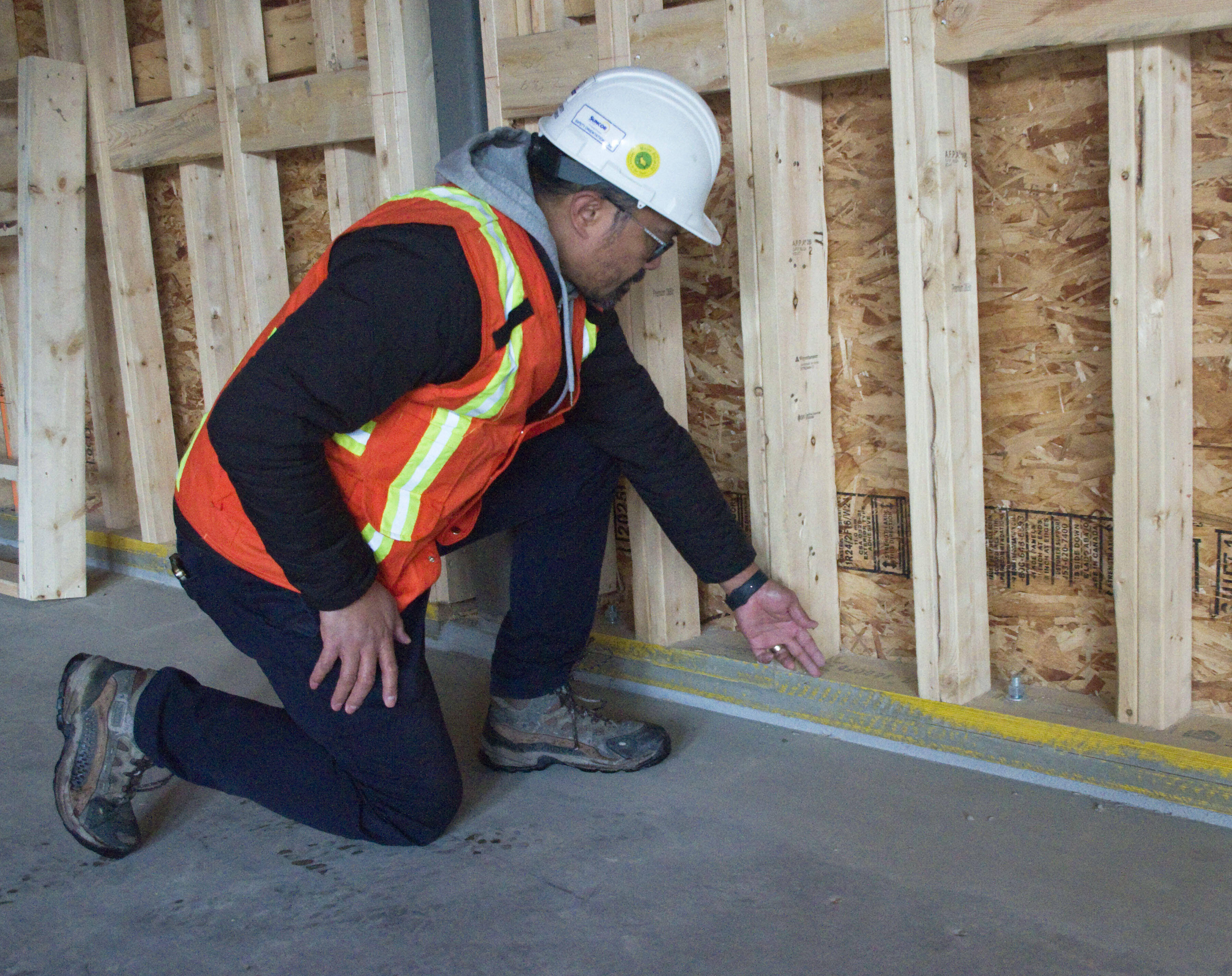
The over 100 vertical steel hold down rods for seismic loading, wind uplift and shrinkage protection were installed one floor below each active construction zone and all firmly tightened once building erection was complete.
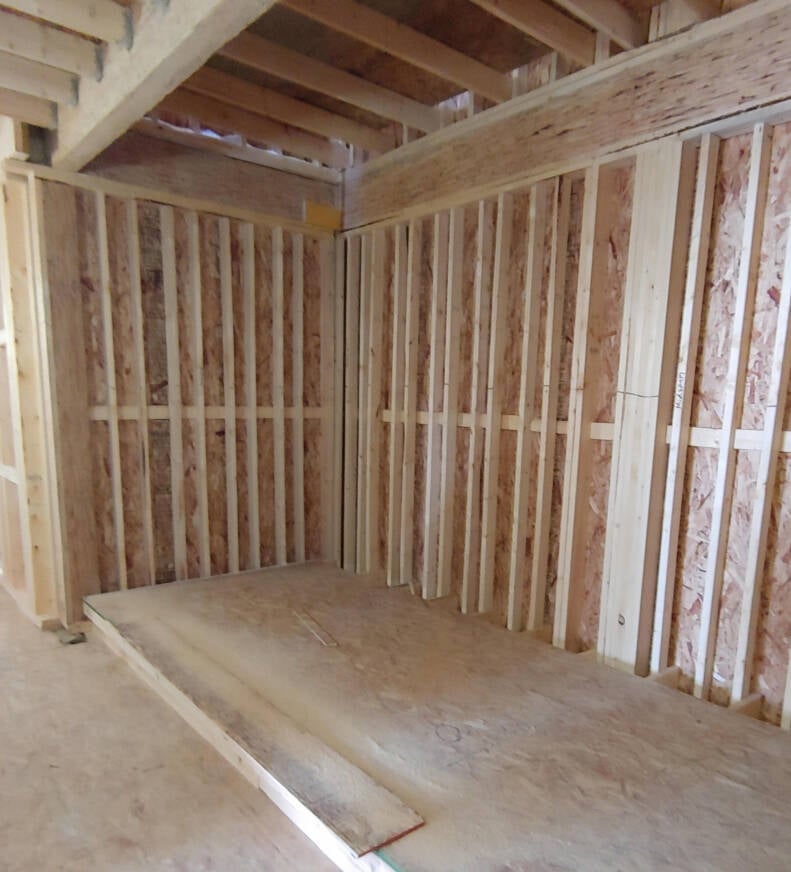
Cantiro was able to maintain construction momentum by using prefabricated wall panels as enclosures for the elevator and stair shafts versus having to wait for and connect with concrete masonry units during the building erection phase.
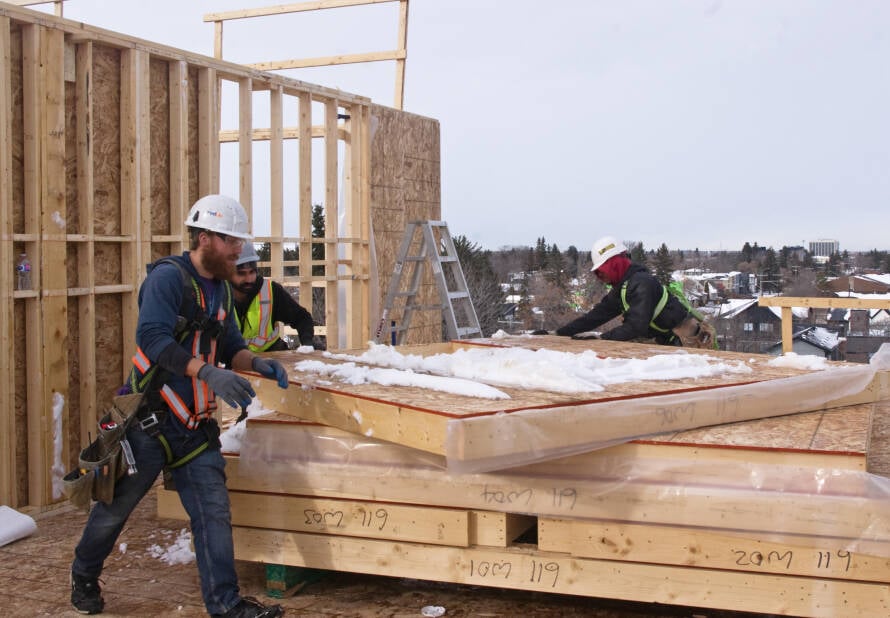
Prefabricated wall panel packages delivered to each floor feature a mix of exterior and interior walls. Typically, the framing contractor will have dedicated crews for each type of panel install. The sequence of installation is exterior walls, followed by corridors, interior walls, and plumbing walls.
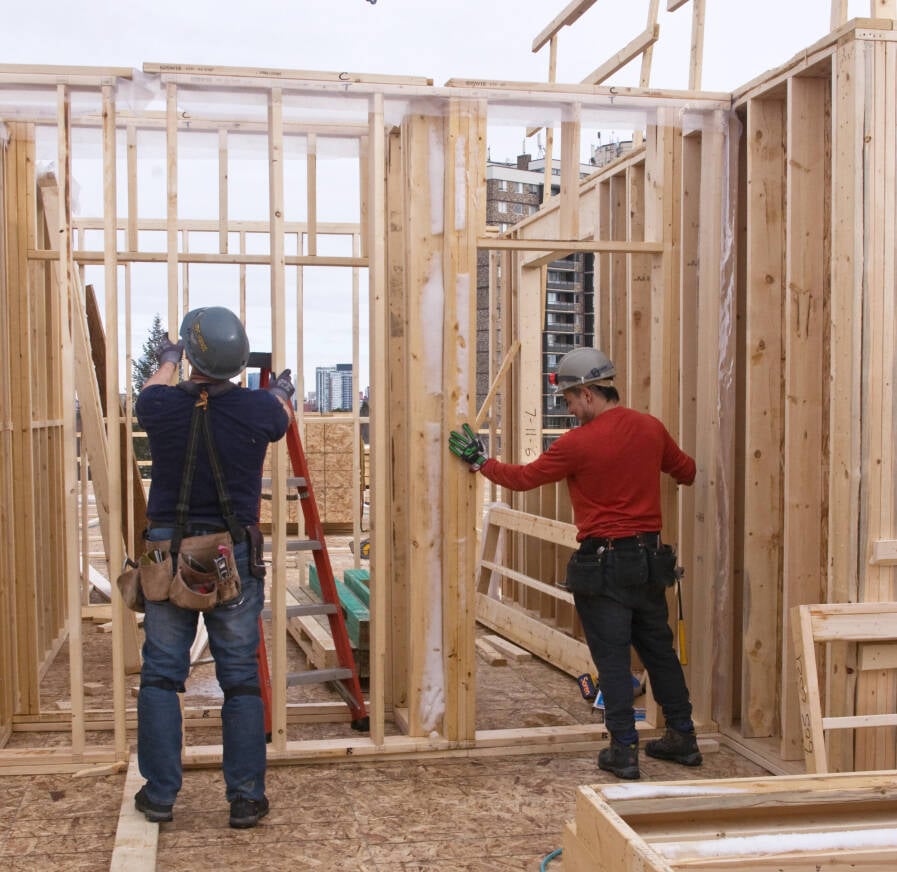
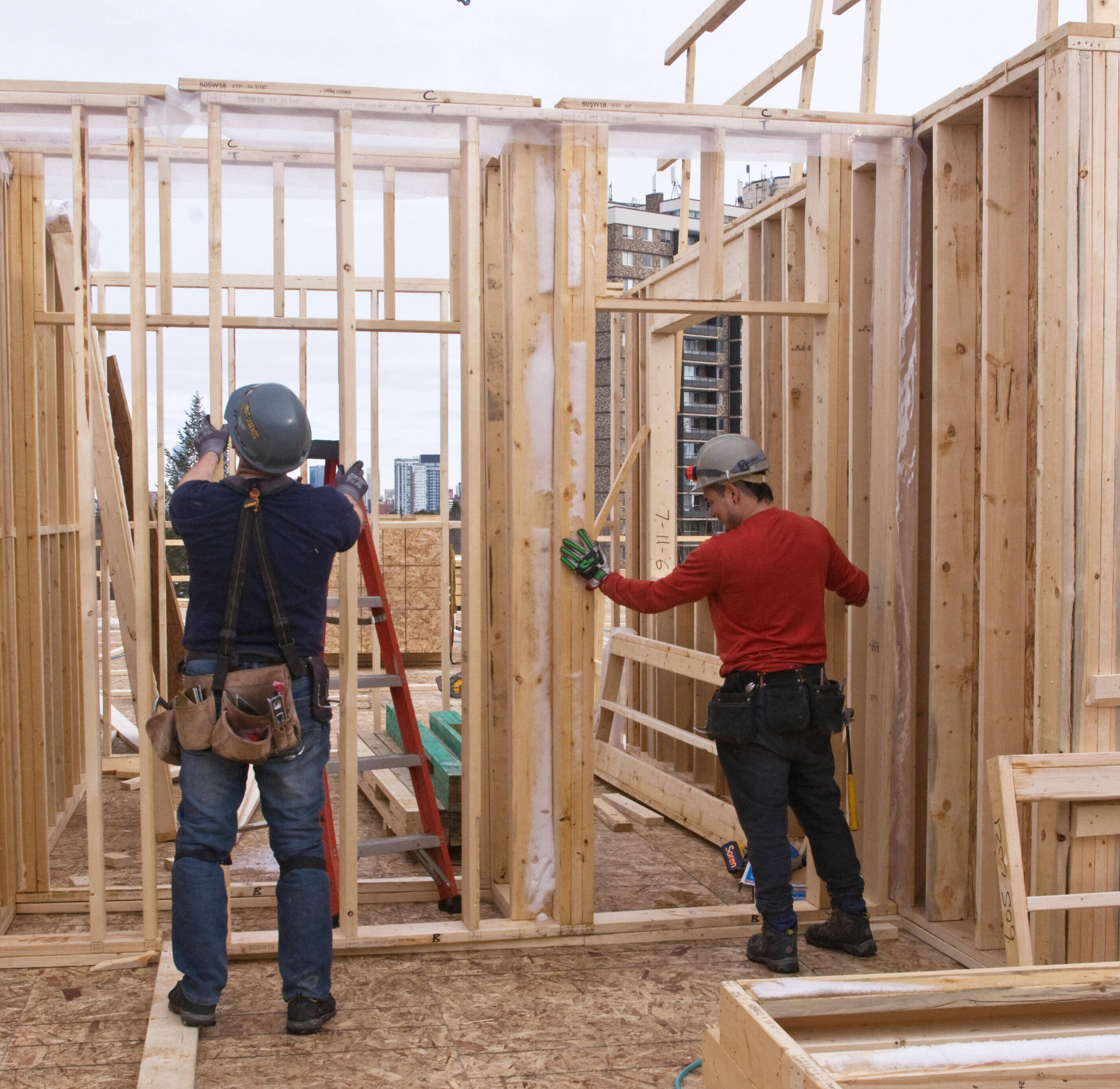
A journeyman carpenter puts the finishing touches to a newly-installed wood panel. The job of this trade on a construction site using prefabricated wall panels has changed considerably compared to sites featuring stick built construction, typically involving a lot more crew and installation oversight and less hands-on sawing and nailing.
The installation ease of prefabricated wall panels makes for a much more tolerable work environment for Alberta framers who will work in winter conditions to as low as -20 C.
It was just a matter of reading labels for members of the framing crew in terms of knowing exactly where each prefabricated wall panel was to be installed. The framing contractor on the 200 West Block project had considerable previous experience with this type of construction, and even sourced and supplied the prefabricated wall panels as part of their contract.
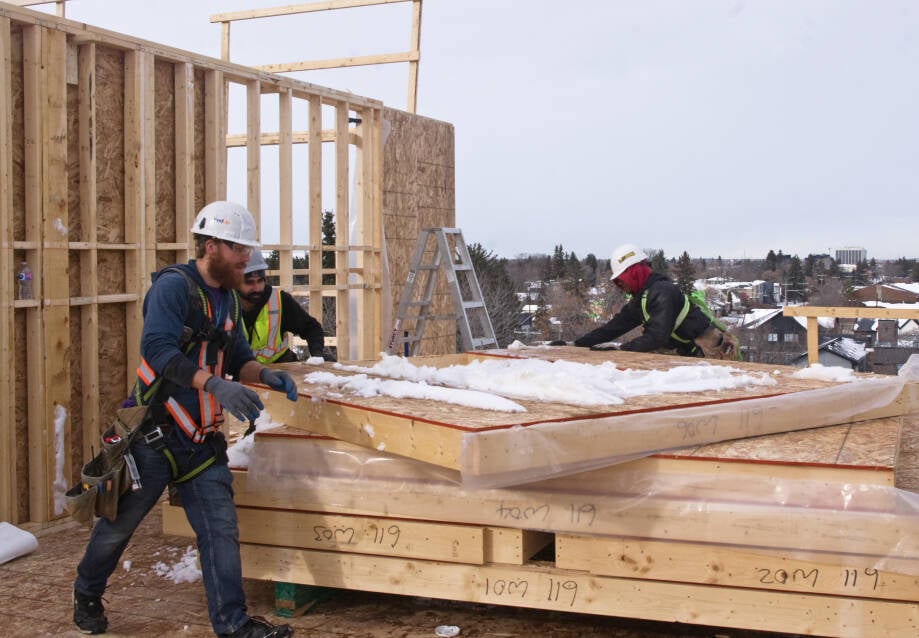
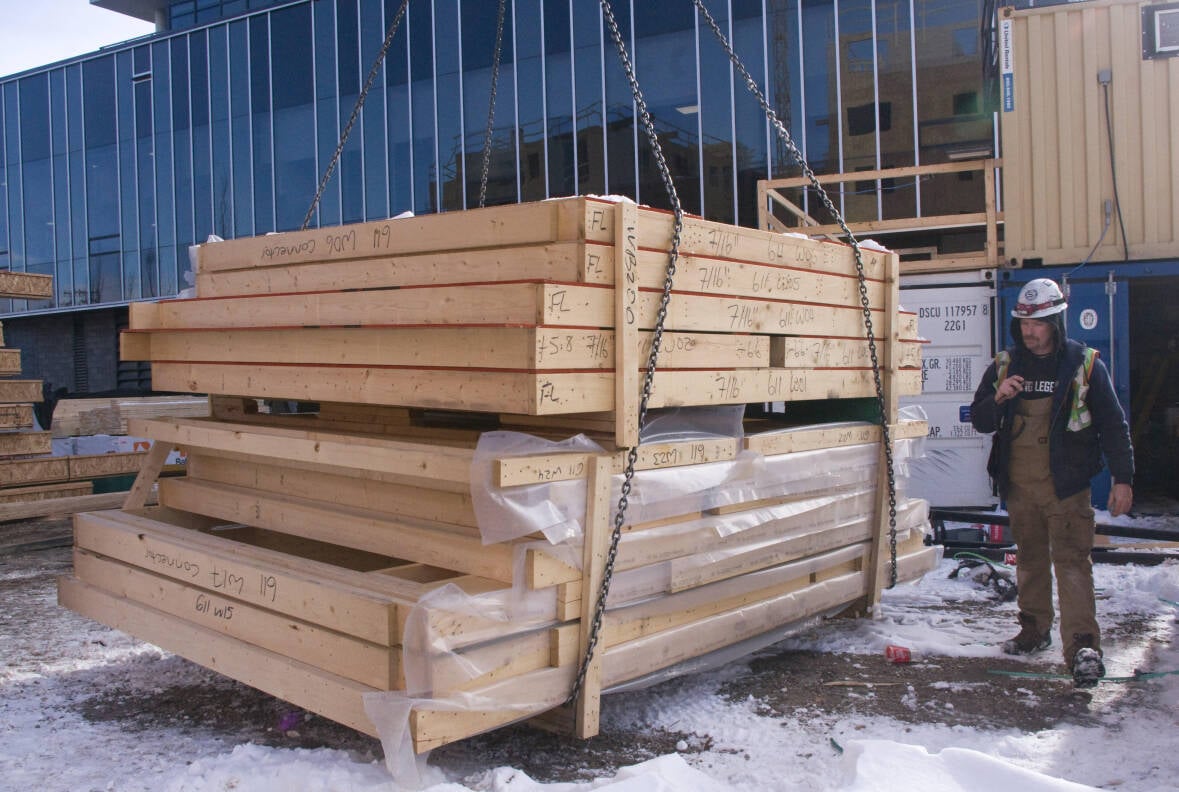
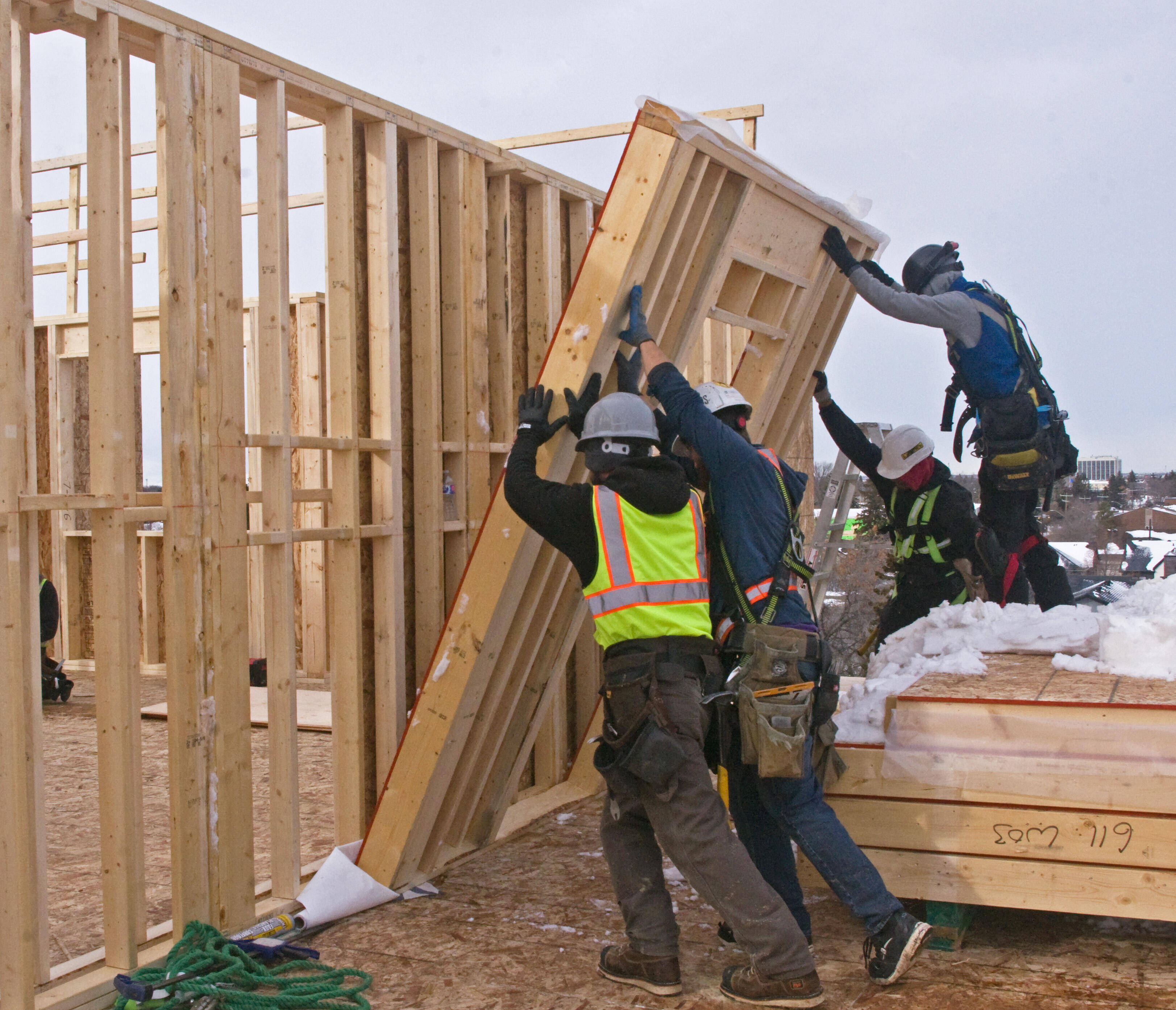
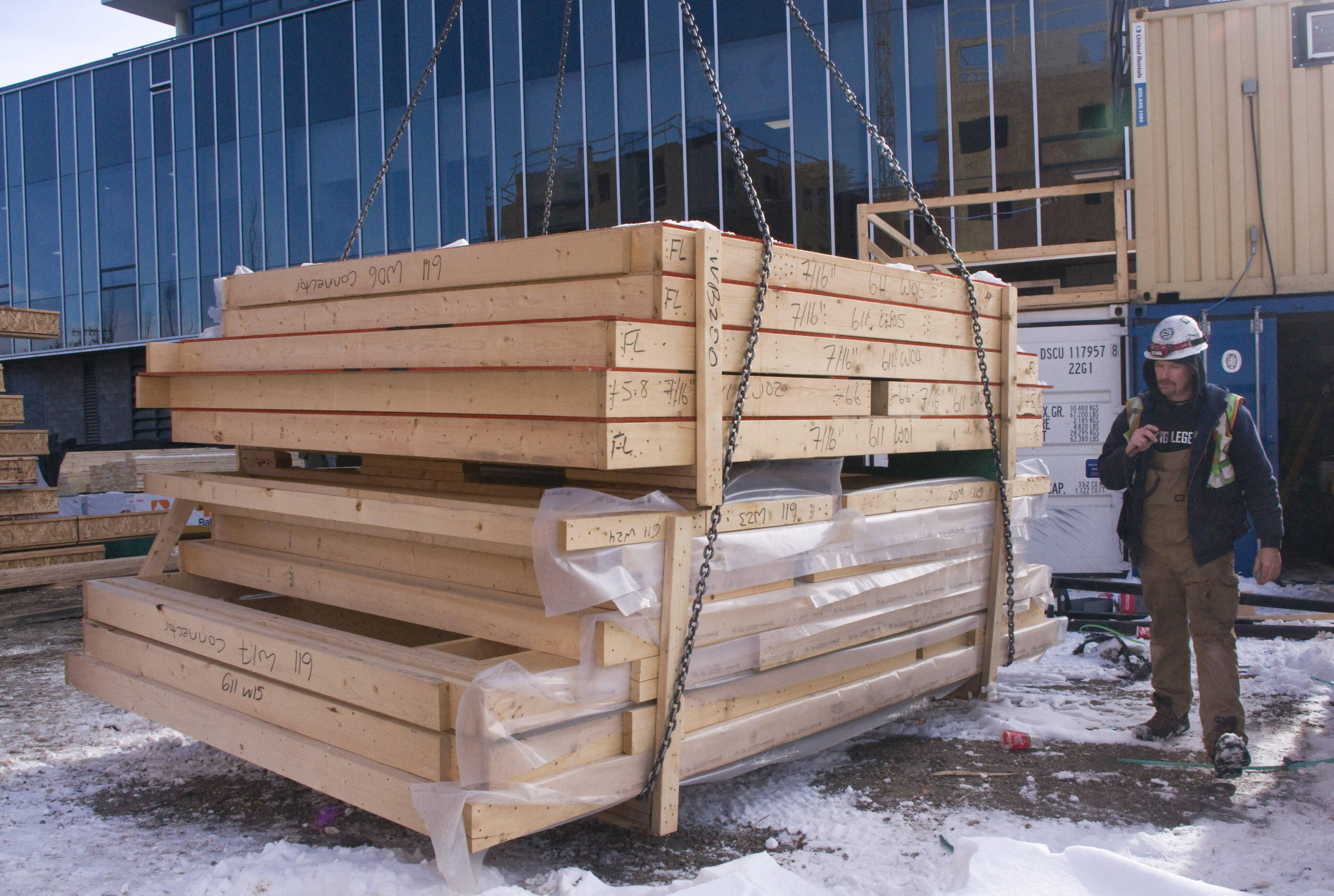
A sequentially stacked and labeled pack of prefabricated wall panels arrives for installation by overhead crane to framing crews at the 200 West Block midrise site. What's notable is the neatness of the packages and the lack of individual pieces of dimensional lumber lying around the workspace as with typical stick built construction. There is considerably less on site material waste with this style of building construction.
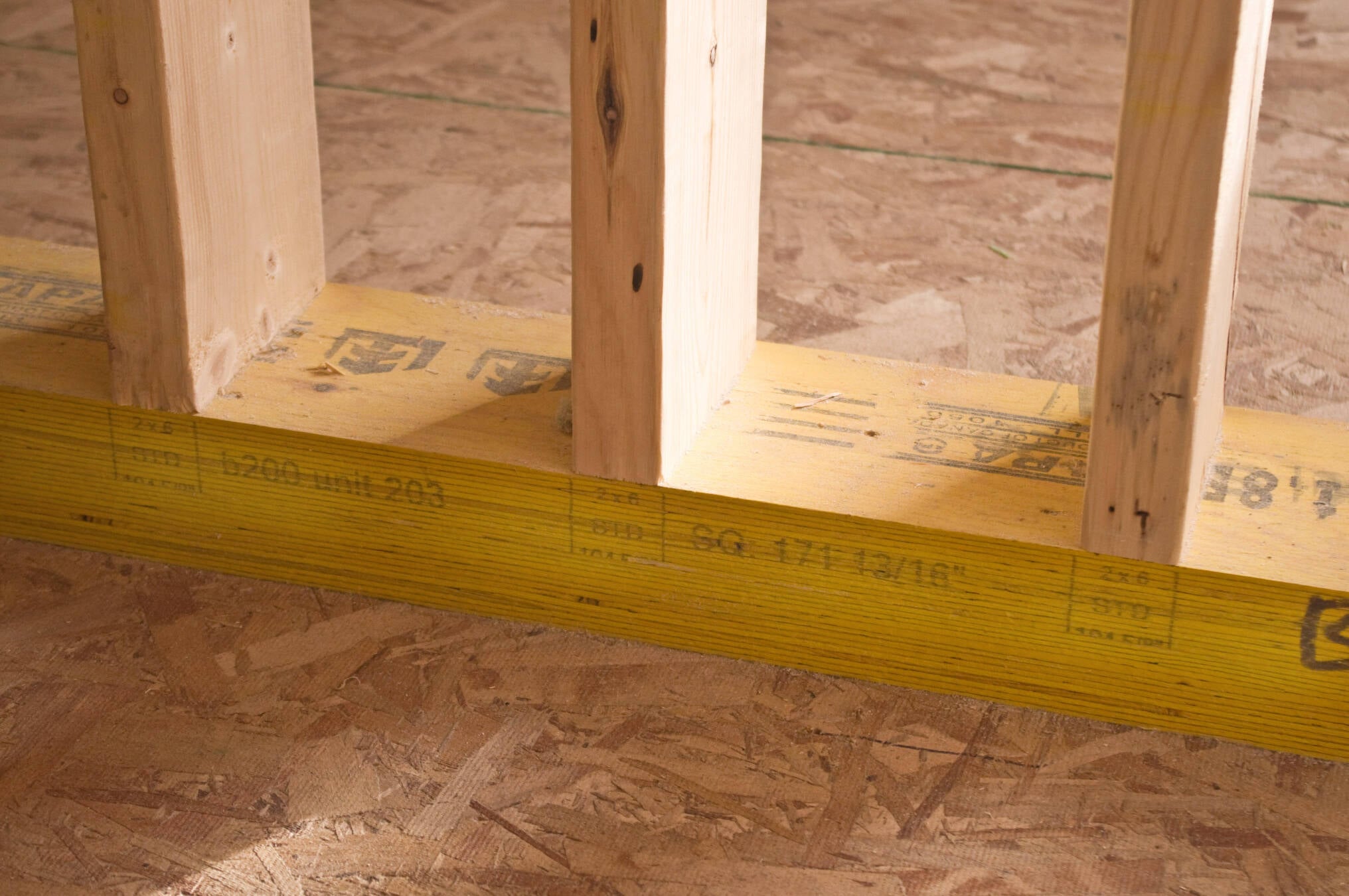
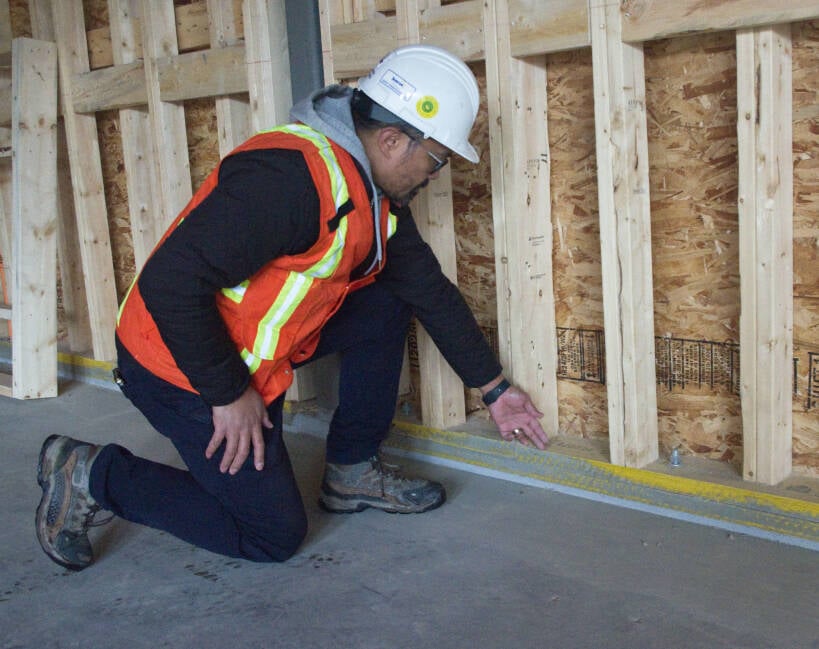
To contend with seismic loading, wind uplift and shrinkage on this six-storey midrise, over 100 vertical steel hold down rods of various lengths and thicknesses were installed as per engineering specifications. The install required careful coordination as floors were added.West Block -7 - The prefabricated wall panels for the 200 West Block midrise featured laminated veneer lumber, a more stable engineered wood product versus dimensional lumber, for the bottom and top sill plating to minimize building compression over the construction period. Also, as shown here, factory assembly workers knew exactly where to attach each vertical piece by the imprint provided to them by automated equipment in the factory prior to the piece arriving to them on the assembly line.
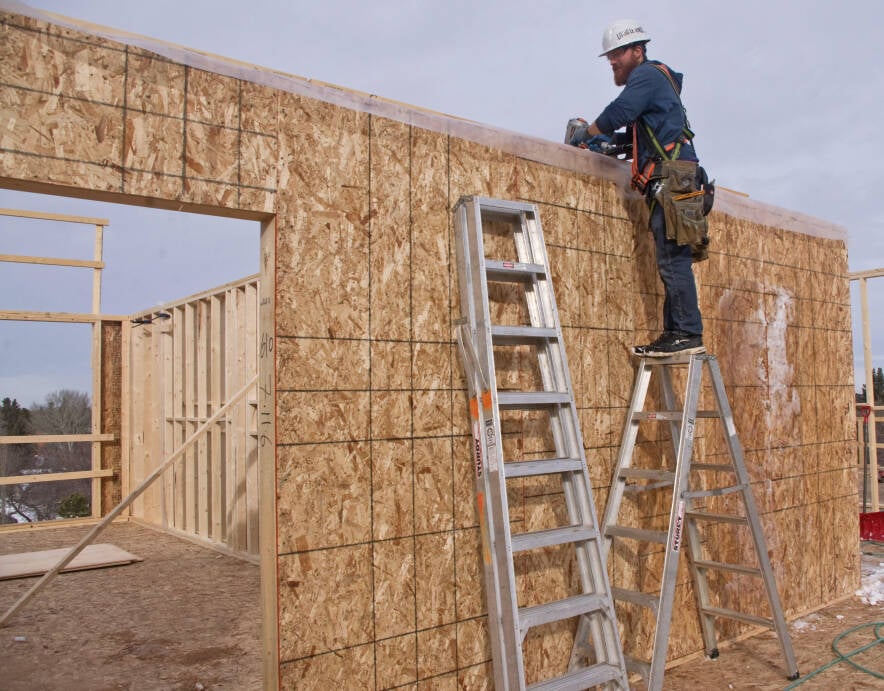
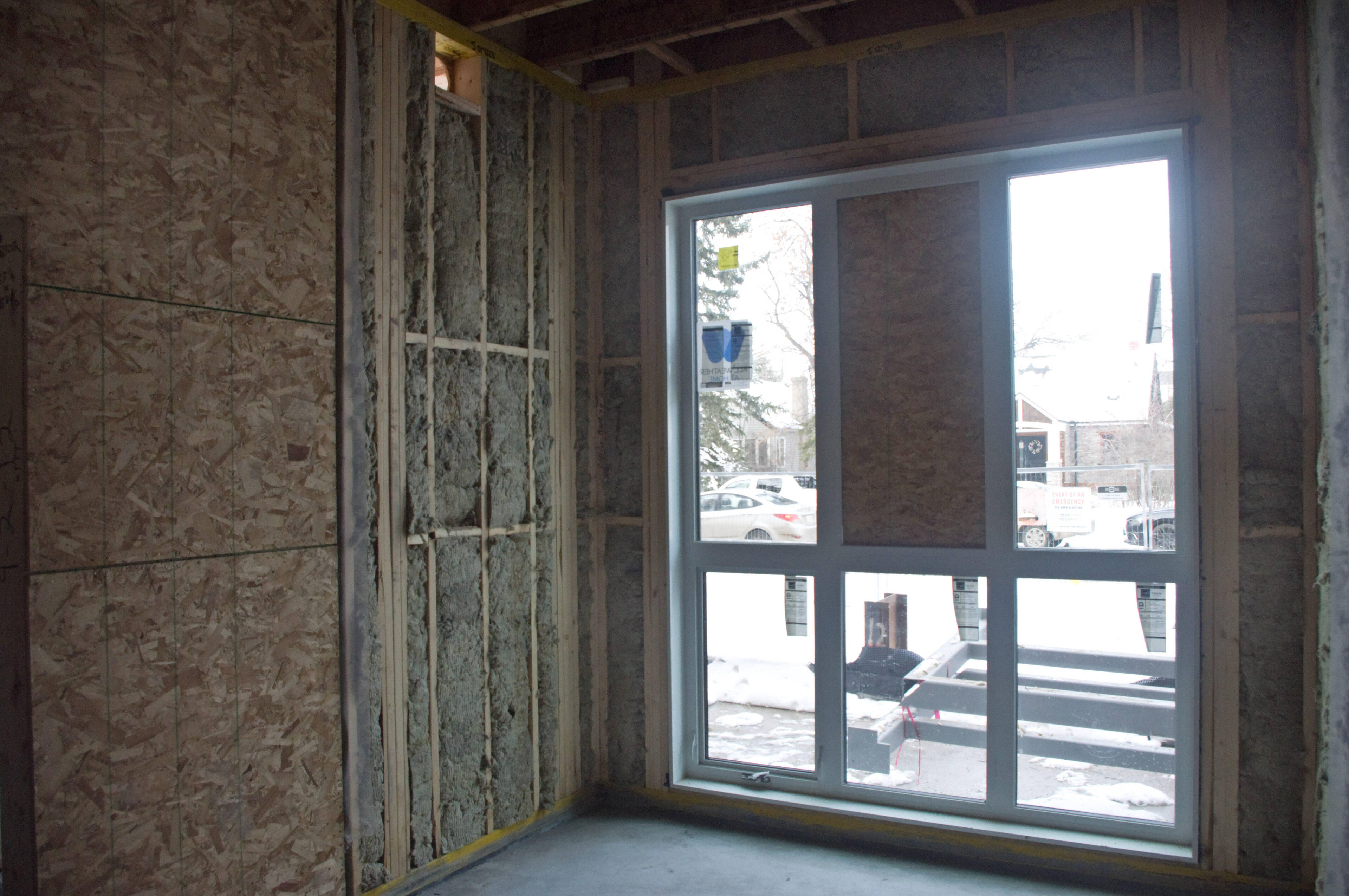
The 200 West Block midrise features 9' windows throughout. Before the windows were installed, Cantiro was required to install a firewall-rated drywall barrier on any window and door openings one floor below active framing as a fire spread prevention measure. The insulation inside the entire exterior wall was also required to be a high performance, fire resistant insulation.
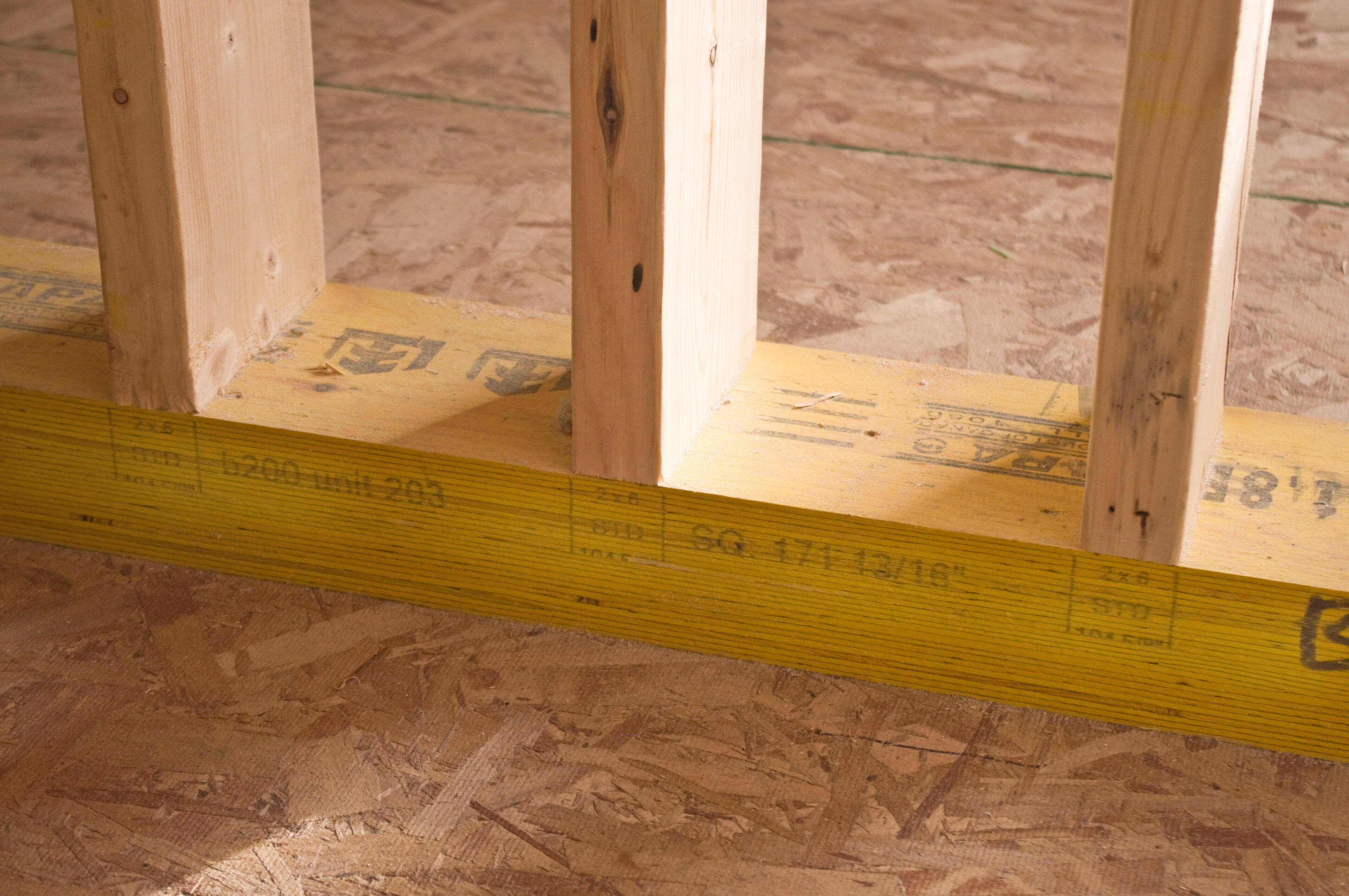
The 200 West Block project called for an engineered wood product like laminated veneer lumber for the sill plating as the bottom and top plates on wall panels on all floors. LVL is a more stable wood product, minimizing building compression over the construction period.
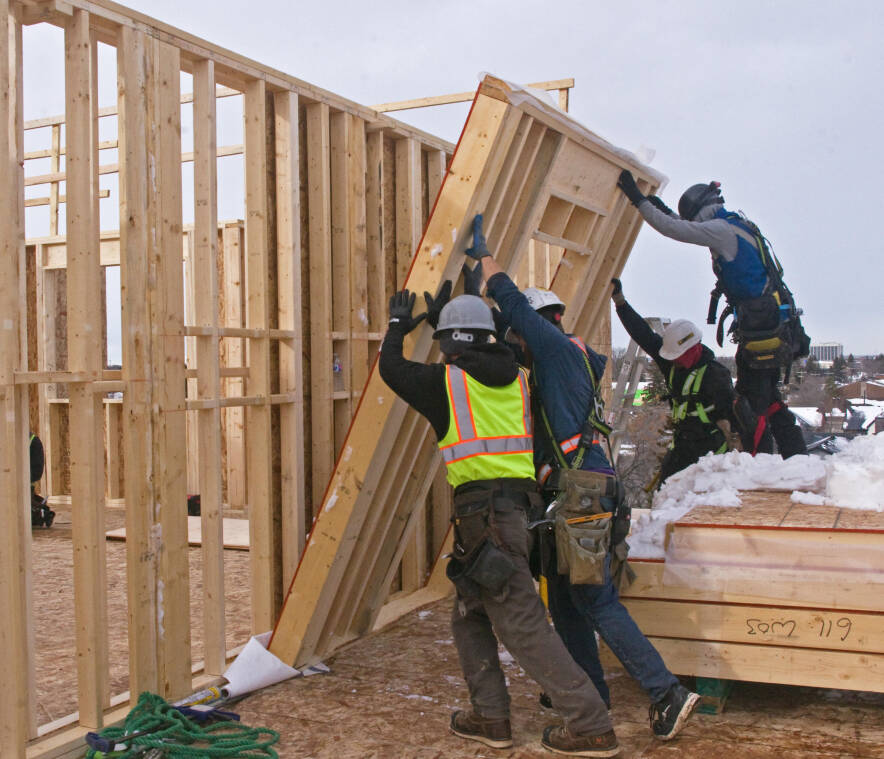
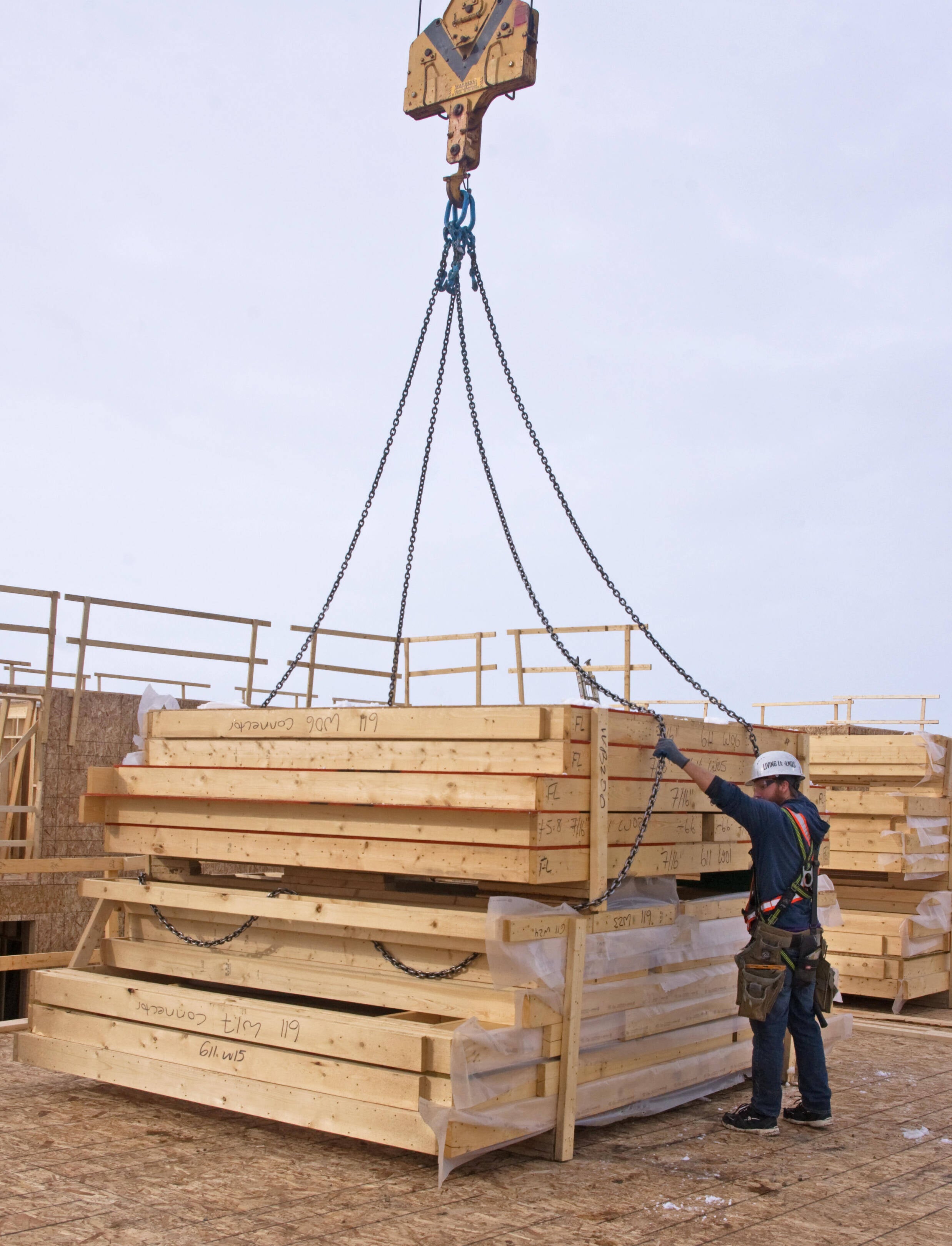
A designated member of the framing crew supervises the delivery of the next package of prefabricated wall panels to workers above using an overhead crane. Each package that arrives to the site is neatly labeled and delivered in sequence from the factory.
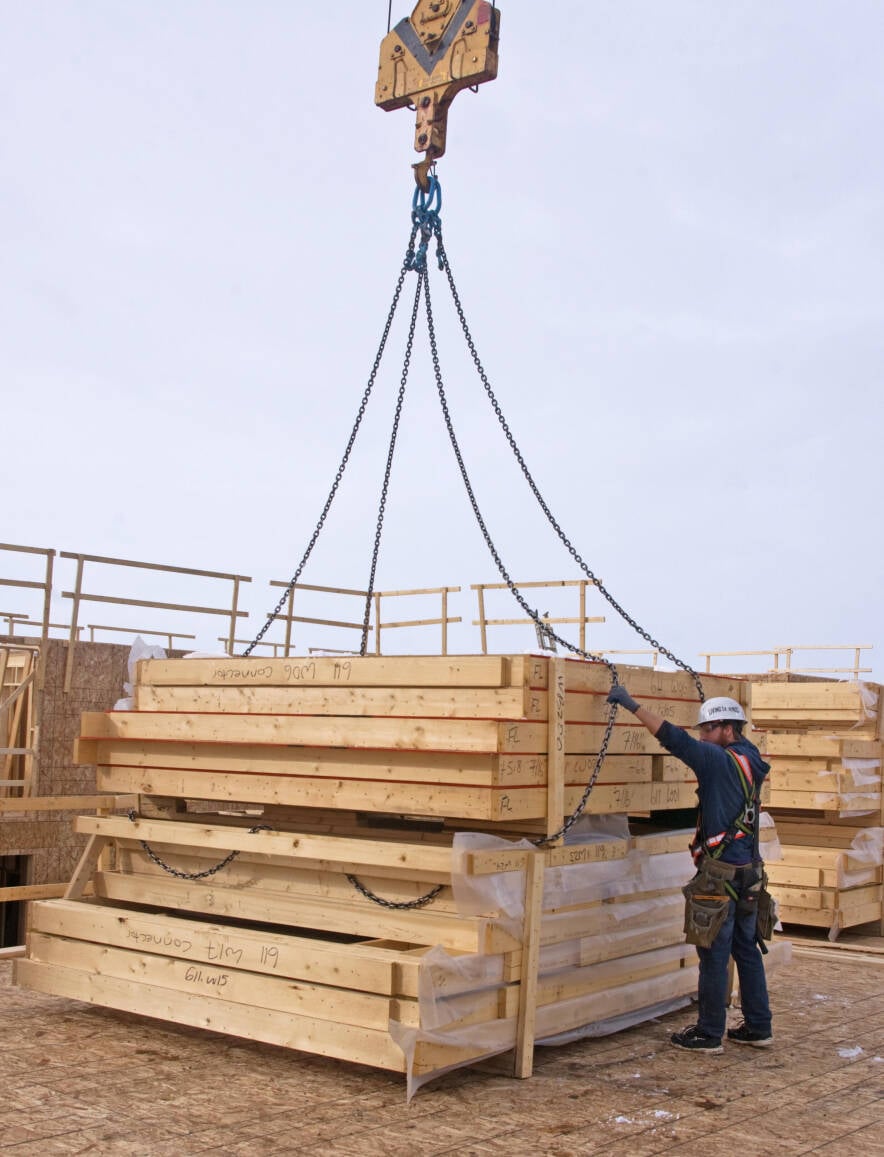
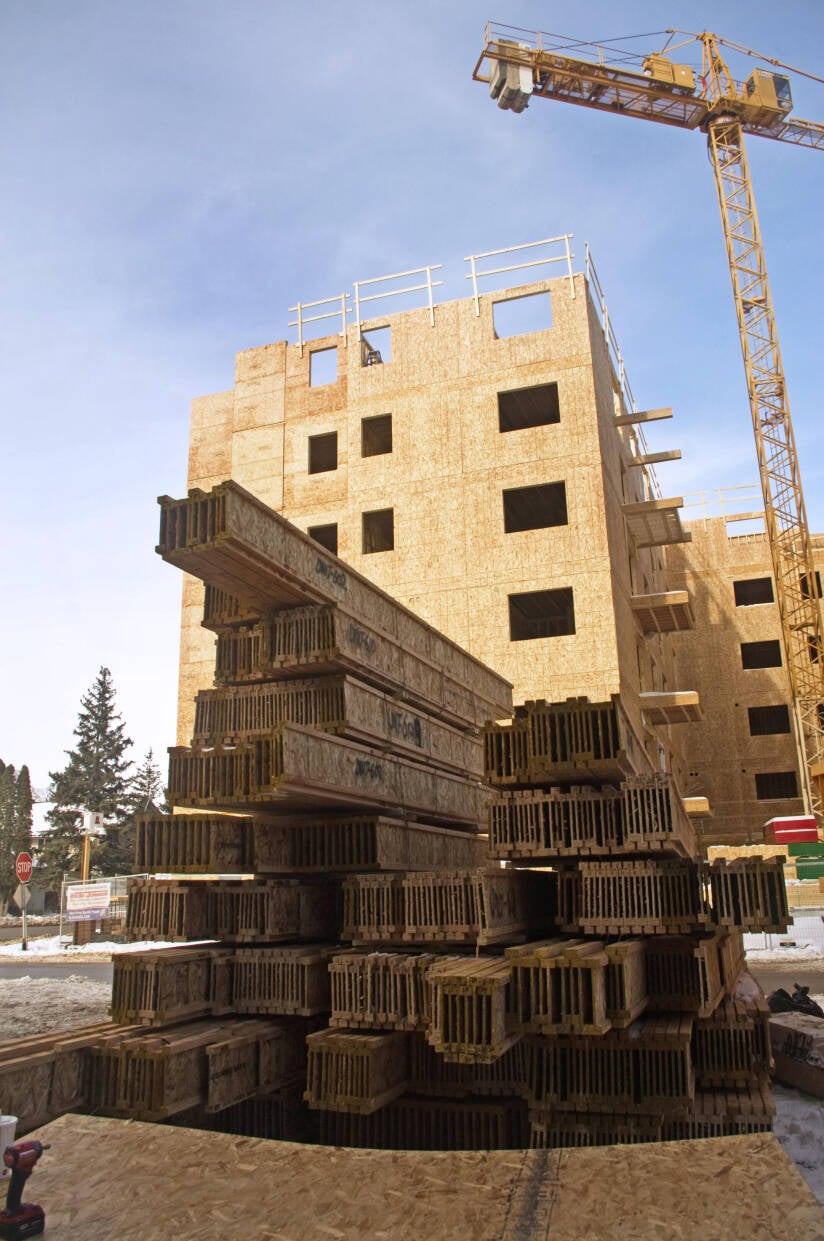
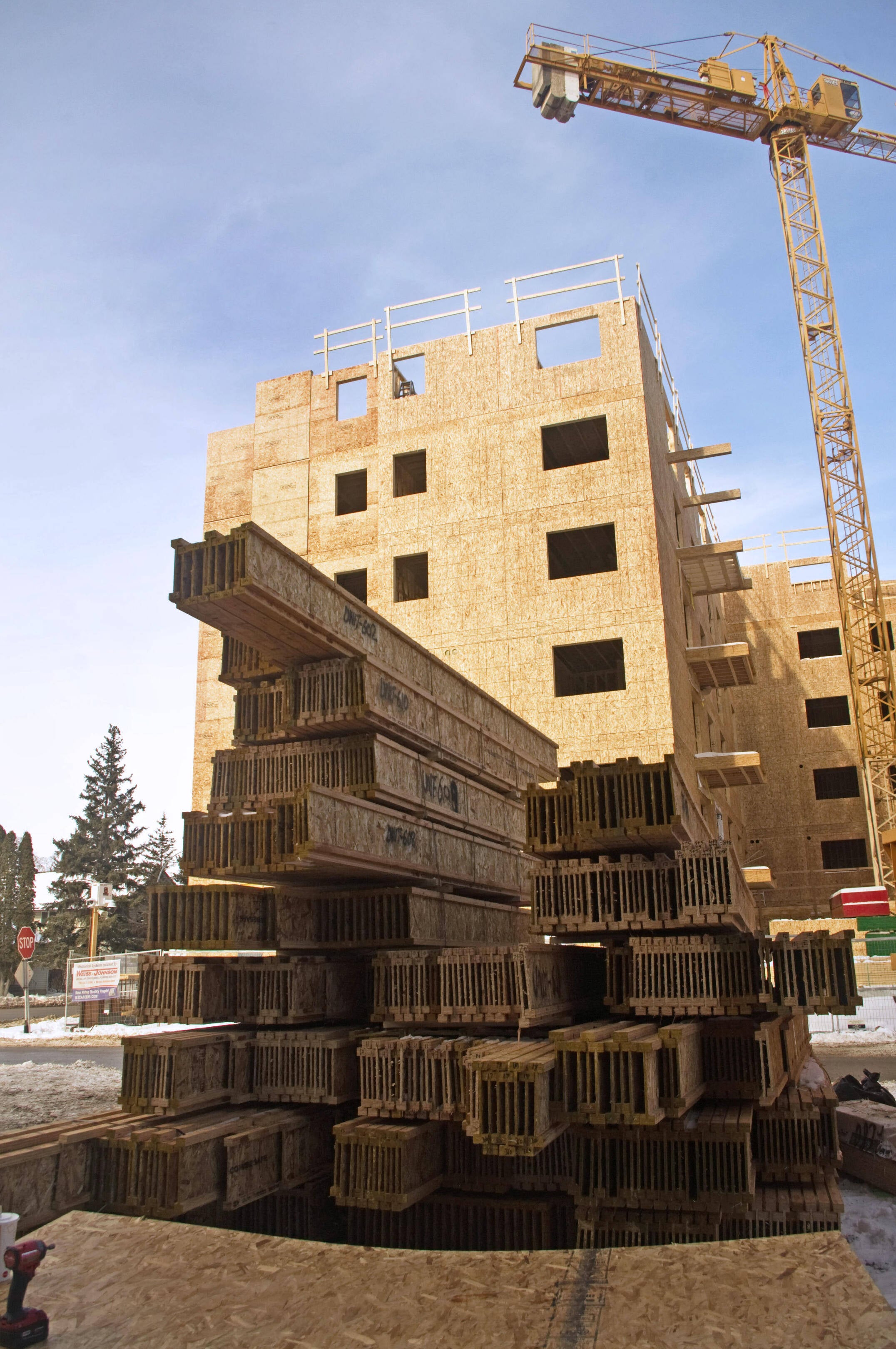
Pre-cut and packaged joists, beams, and headers in the foreground of Cantiro's six-storey, midrise, 200 West Block rental property, await transport using an overhead crane to be installed as the foundation for the next constructed floor.
By Tony Kryzanowski
"There are three big advantages to prefabricated wall panel construction that we see," says Fereday. "First is that prefabricated elements need to be designed virtually before they show up on site. So very early on you are resolving potential conflicts – such issues as door and window locations and placement of duct work – ensuring these issues are addressed before the components ever arrive on site."
Second, the wall panels packages are labeled and stacked in the order that they need to be assembled which limits the amount of double handling, and the precisely fabricated panels minimize on site measuring and cutting. In terms of actual assembly, once the first-floor joists and sheathing are installed, the sequence is to install the exterior walls, followed by corridors, interior walls, and plumbing walls, with that same sequence repeated for each floor.
Third, this prefabricated panelized construction approach helps to minimize disruption to surrounding businesses and residents. The building envelope is assembled quickly, the crane is dismantled sooner, and all remaining construction work takes place within the building envelope in a quicker time frame.
As with any construction project, fine tuning was needed to address several key factors. These included the Alberta Building Code’s relatively recent allowance for six-storey wood construction, as well as engineering considerations related to the weight of the building and wind forces for a taller project. Additional considerations stemmed from city ordinances related to safe building practices, particularly because of the constraints of the tight development site.
As a heavier six-storey midrise structure - compared to the four-storey buildings more common prior to the 2019 Alberta Building Code changes - structural assembly required careful consideration in the early design phase. Laminated veneer lumber (LVL) was selected for the sill, top, and bottom plates of wall panels on all floors due to its dimensional stability. This helped minimize cumulative building compression over the course of construction.
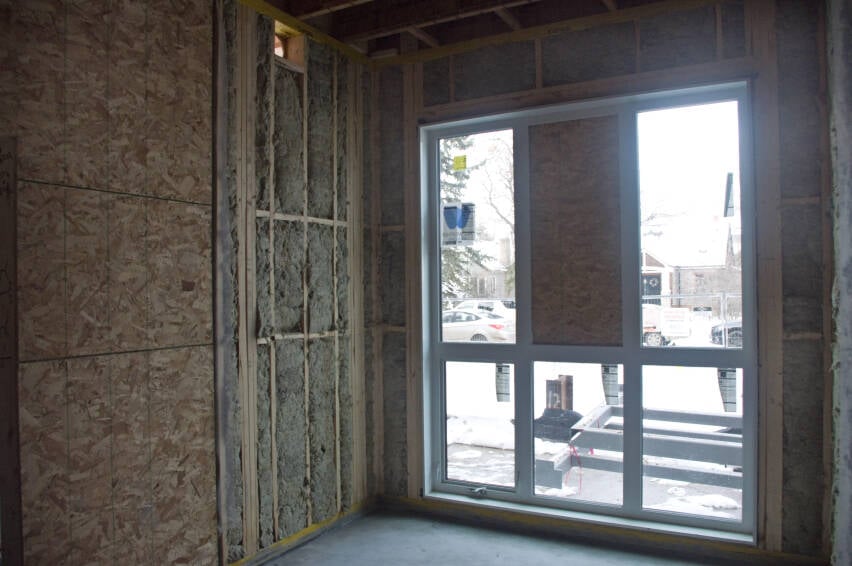
Because the project extended from property line to property line, the City's Adjacent Property Protection Plan applied. This required Cantiro to install a firewall-rated drywall barrier over all window and door openings one floor below the active framing level to limit the potential spread of interior fire to neighboring properties during construction. In addition, all exterior wall assemblies were insulated with mineral wool), a non-combustible, high-performance insulation, as an added fire protection measure.
To minimize trade overlaps and avoid introducing additional materials, Cantiro used prefabricated wood panels to enclose the elevator and stair shafts, eliminating the need to coordinate with concrete masonry during the building erection phase. This approach allowed the elevator shaft to be enclosed quickly, and upper floors installed without delay. According to Fereday, the result is an efficient, and high-quality structure that will last for decades to come.
Constructed offsite, these building material packages were delivered sequentially and on demand from the framing contractor in organized, number-coded bundles. Drawing on its experience with this type of construction, the framer deployed dedicated crews of three or four members for both exterior and interior wall installation, working in temperatures as low as -20 C.
According to Fereday, saving time by minimizing on-site framing work reduces costs and these savings can then be passed on to future tenants.
An overhead crane was used to transfer bundles from ground level to each successive floor, expediting assembly and enclosure of the six-storey exterior envelope, quickly creating a much more comfortable enclosed winter work environment for framers and trades.
A total of 2843 wall panels were installed. For this project, the framing contractor, Living Legends Construction, sourced the panels from local supplier, We Panel Inc., a company whose products and services they were familiar with from previous projects.
Both Booth and Fereday note a growing number of prefabricated panel suppliers, reflecting the broader shift towards prefabrication that the Canadian building industry has seen over the past decade. Greater selection is also driving greater competition, with the potential for cost savings.
Cantiro's Project Manager, Darrell Booth, says that the company is widely regarded as a design-forward developer and builder, focused not only on creating spaces where people want to be, but communities where people want to live.
For example, 200 West Block, a U-shaped building with a central courtyard, features 10' 6" high walls on the first floor where many social amenity spaces are situated, 9' windows in many units and on all floors, as well as in-floor hydronic heating throughout, all on top of underground parking.
However, Cantiro Executive Vice President for the company's multi-family division, Paul Fereday, says that at the end of the day, units still need to be affordable for people to rent and that's where the company's construction approach on 200 West Block will make a significant contribution.
Cantiro used prefabricated wood wall panels not only to maintain affordability but also minimize disruption to adjacent retail shops, offices, and existing residents.
Working with prefabricated joists in tandem with prefabricated wall panels minimizes on-site handling and storage in a context where the laydown area is extremely limited. The development area for 200 West Block extends from lot line to lot line.
"Previously, engineered floor and roof packages were delivered as large format joists, beams, headers, which framers would cut on site. Today, most suppliers pre-cut and assemble each unit, delivering them packed and labeled. This greatly increases installation efficiency, allowing quicker floor completion," says Booth.
According to Fereday, opting for panelized walls over site-built construction on the 200 West Block project reduced time-on-site building activity by 15 percent, about two months.
Winter construction in Edmonton is harsh. Add a confined site, nearby light rail transit construction, and neighbouring retail businesses working hard to attract customers, and the resulting construction environment is very complex.
The Cantiro Group, an Edmonton-based builder with projects stretching from B.C. to Ontario, used prefabricated wood construction methods to help to overcome these challenges to build a six-storey, 104-unit apartment rental property called 200 West Block.
With a construction window from summer 2025 to fall 2026, the 200 West Block midrise is just one of five buildings in the company's massive, phased, mixed-use, 1.4-hectare West Block development in the prestigious Glenora neighborhood of west central Edmonton.
FEATURE
Efficiency Under Pressure:
Prefabrication Reduces
On-Site Building Activity
by 15% for Busy Edmonton Midrise Construction Project
It was just a matter of reading labels for members of the framing crew in terms of knowing exactly where each prefabricated wall panel was to be installed. The framing contractor on the 200 West Block project had considerable previous experience with this type of construction, and even sourced and supplied the prefabricated wall panels as part of their contract.
A sequentially stacked and labeled pack of prefabricated wall panels arrives for installation by overhead crane to framing crews at the 200 West Block midrise site. What's notable is the neatness of the packages and the lack of individual pieces of dimensional lumber lying around the workspace as with typical stick built construction. There is considerably less on site material waste with this style of building construction.
The 200 West Block project called for an engineered wood product like laminated veneer lumber for the sill plating as the bottom and top plates on wall panels on all floors. LVL is a more stable wood product, minimizing building compression over the construction period.
A designated member of the framing crew supervises the delivery of the next package of prefabricated wall panels to workers above using an overhead crane. Each package that arrives to the site is neatly labeled and delivered in sequence from the factory.
Pre-cut and packaged joists, beams, and headers in the foreground of Cantiro's six-storey, midrise, 200 West Block rental property, await transport using an overhead crane to be installed as the foundation for the next constructed floor.
"There are three big advantages to prefabricated wall panel construction that we see," says Fereday. "First is that prefabricated elements need to be designed virtually before they show up on site. So very early on you are resolving potential conflicts – such issues as door and window locations and placement of duct work – ensuring these issues are addressed before the components ever arrive on site."
Second, the wall panels packages are labeled and stacked in the order that they need to be assembled which limits the amount of double handling, and the precisely fabricated panels minimize on site measuring and cutting. In terms of actual assembly, once the first-floor joists and sheathing are installed, the sequence is to install the exterior walls, followed by corridors, interior walls, and plumbing walls, with that same sequence repeated for each floor.
Third, this prefabricated panelized construction approach helps to minimize disruption to surrounding businesses and residents. The building envelope is assembled quickly, the crane is dismantled sooner, and all remaining construction work takes place within the building envelope in a quicker time frame.
As with any construction project, fine tuning was needed to address several key factors. These included the Alberta Building Code’s relatively recent allowance for six-storey wood construction, as well as engineering considerations related to the weight of the building and wind forces for a taller project. Additional considerations stemmed from city ordinances related to safe building practices, particularly because of the constraints of the tight development site.
As a heavier six-storey midrise structure - compared to the four-storey buildings more common prior to the 2019 Alberta Building Code changes - structural assembly required careful consideration in the early design phase. Laminated veneer lumber (LVL) was selected for the sill, top, and bottom plates of wall panels on all floors due to its dimensional stability. This helped minimize cumulative building compression over the course of construction.
The installation ease of prefabricated wall panels makes for a much more tolerable work environment for Alberta framers who will work in winter conditions to as low as -20 C.
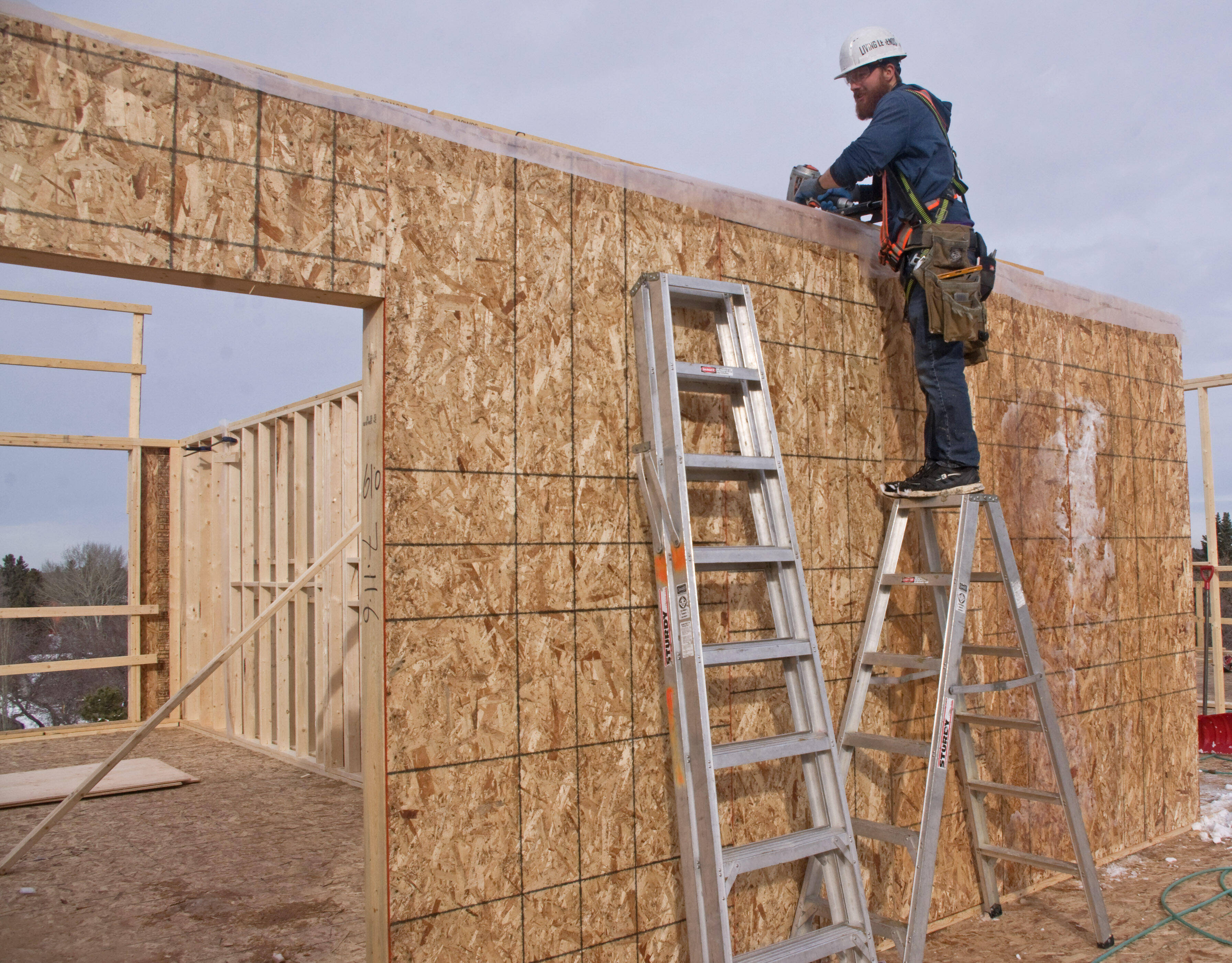
A journeyman carpenter puts the finishing touches to a newly-installed wood panel. The job of this trade on a construction site using prefabricated wall panels has changed considerably compared to sites featuring stick built construction, typically involving a lot more crew and installation oversight and less hands-on sawing and nailing.
The over 100 vertical steel hold down rods for seismic loading, wind uplift and shrinkage protection were installed one floor below each active construction zone and all firmly tightened once building erection was complete.

Prefabricated wall panel packages delivered to each floor feature a mix of exterior and interior walls. Typically, the framing contractor will have dedicated crews for each type of panel install. The sequence of installation is exterior walls, followed by corridors, interior walls, and plumbing walls.
Cantiro was able to maintain construction momentum by using prefabricated wall panels as enclosures for the elevator and stair shafts versus having to wait for and connect with concrete masonry units during the building erection phase.
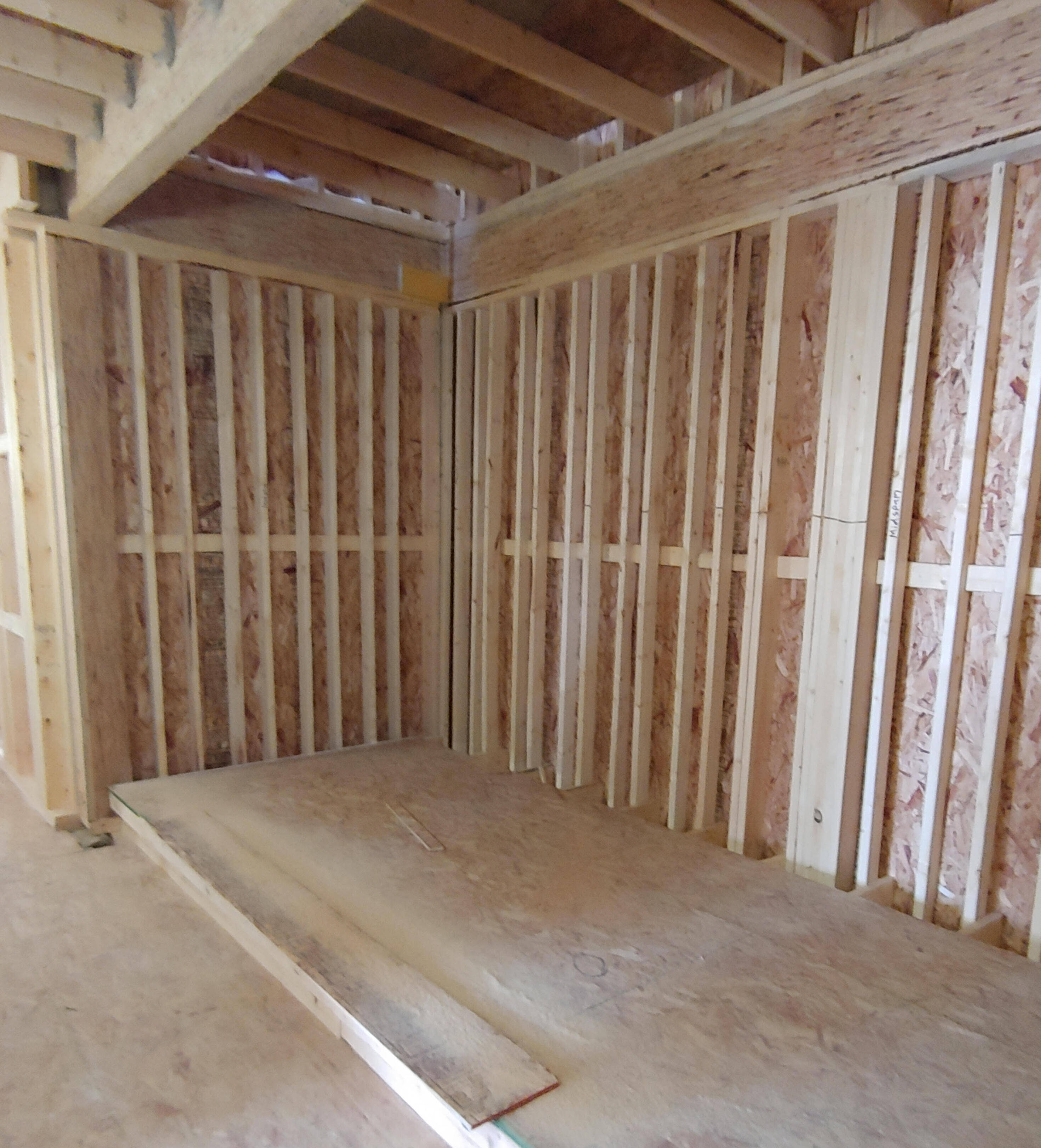
Because the project extended from property line to property line, the City's Adjacent Property Protection Plan applied. This required Cantiro to install a firewall-rated drywall barrier over all window and door openings one floor below the active framing level to limit the potential spread of interior fire to neighboring properties during construction. In addition, all exterior wall assemblies were insulated with mineral wool), a non-combustible, high-performance insulation, as an added fire protection measure.
To minimize trade overlaps and avoid introducing additional materials, Cantiro used prefabricated wood panels to enclose the elevator and stair shafts, eliminating the need to coordinate with concrete masonry during the building erection phase. This approach allowed the elevator shaft to be enclosed quickly, and upper floors installed without delay. According to Fereday, the result is an efficient, and high-quality structure that will last for decades to come.
To contend with seismic loading, wind uplift and shrinkage on this six-storey midrise, over 100 vertical steel hold down rods of various lengths and thicknesses were installed as per engineering specifications. The install required careful coordination as floors were added.West Block -7 - The prefabricated wall panels for the 200 West Block midrise featured laminated veneer lumber, a more stable engineered wood product versus dimensional lumber, for the bottom and top sill plating to minimize building compression over the construction period. Also, as shown here, factory assembly workers knew exactly where to attach each vertical piece by the imprint provided to them by automated equipment in the factory prior to the piece arriving to them on the assembly line.
The 200 West Block midrise features 9' windows throughout. Before the windows were installed, Cantiro was required to install a firewall-rated drywall barrier on any window and door openings one floor below active framing as a fire spread prevention measure. The insulation inside the entire exterior wall was also required to be a high performance, fire resistant insulation.
Constructed offsite, these building material packages were delivered sequentially and on demand from the framing contractor in organized, number-coded bundles. Drawing on its experience with this type of construction, the framer deployed dedicated crews of three or four members for both exterior and interior wall installation, working in temperatures as low as -20 C.
According to Fereday, saving time by minimizing on-site framing work reduces costs and these savings can then be passed on to future tenants.
An overhead crane was used to transfer bundles from ground level to each successive floor, expediting assembly and enclosure of the six-storey exterior envelope, quickly creating a much more comfortable enclosed winter work environment for framers and trades.
A total of 2843 wall panels were installed. For this project, the framing contractor, Living Legends Construction, sourced the panels from local supplier, We Panel Inc., a company whose products and services they were familiar with from previous projects.
Both Booth and Fereday note a growing number of prefabricated panel suppliers, reflecting the broader shift towards prefabrication that the Canadian building industry has seen over the past decade. Greater selection is also driving greater competition, with the potential for cost savings.
Cantiro's Project Manager, Darrell Booth, says that the company is widely regarded as a design-forward developer and builder, focused not only on creating spaces where people want to be, but communities where people want to live.
For example, 200 West Block, a U-shaped building with a central courtyard, features 10' 6" high walls on the first floor where many social amenity spaces are situated, 9' windows in many units and on all floors, as well as in-floor hydronic heating throughout, all on top of underground parking.
However, Cantiro Executive Vice President for the company's multi-family division, Paul Fereday, says that at the end of the day, units still need to be affordable for people to rent and that's where the company's construction approach on 200 West Block will make a significant contribution.
Cantiro used prefabricated wood wall panels not only to maintain affordability but also minimize disruption to adjacent retail shops, offices, and existing residents.
Working with prefabricated joists in tandem with prefabricated wall panels minimizes on-site handling and storage in a context where the laydown area is extremely limited. The development area for 200 West Block extends from lot line to lot line.
"Previously, engineered floor and roof packages were delivered as large format joists, beams, headers, which framers would cut on site. Today, most suppliers pre-cut and assemble each unit, delivering them packed and labeled. This greatly increases installation efficiency, allowing quicker floor completion," says Booth.
According to Fereday, opting for panelized walls over site-built construction on the 200 West Block project reduced time-on-site building activity by 15 percent, about two months.