With Nova Scotia’s reputation as a neighbourly province, it’s not surprising to hear that the contract for the Pictou County Sports Heritage Hall of Fame in Trenton, N.S., was signed a stone’s throw from the site.
Who better to build the new museum and community building than their neighbouring offsite construction company, Eastcut.
“We wanted as much as we could to have craftsmen from the local area,” explains Peter Van Kessel, chair of the building committee. “I don’t think there is anyone who wasn’t from the area who worked onsite.”
Eastcut and sister company DORA Construction took on the project alongside Halifax-based Harvey Architecture and a host of local tradespeople. The collaboration resulted in a building that thoughtfully marries engineered wood products and traditional wood construction.
Josh Dykens, Eastcut’s general manager and COO, said their goal from the start of the design process was to build with the best product for the application.
“We’re using the right material in the right places. We’re not trying to use the same product everywhere. We’re putting things where they are best suited and that is an advantage in cost and efficiency,” Dykens says.

FEATURE
Pictou County Sports Heritage Hall of Fame
Scroll to Read

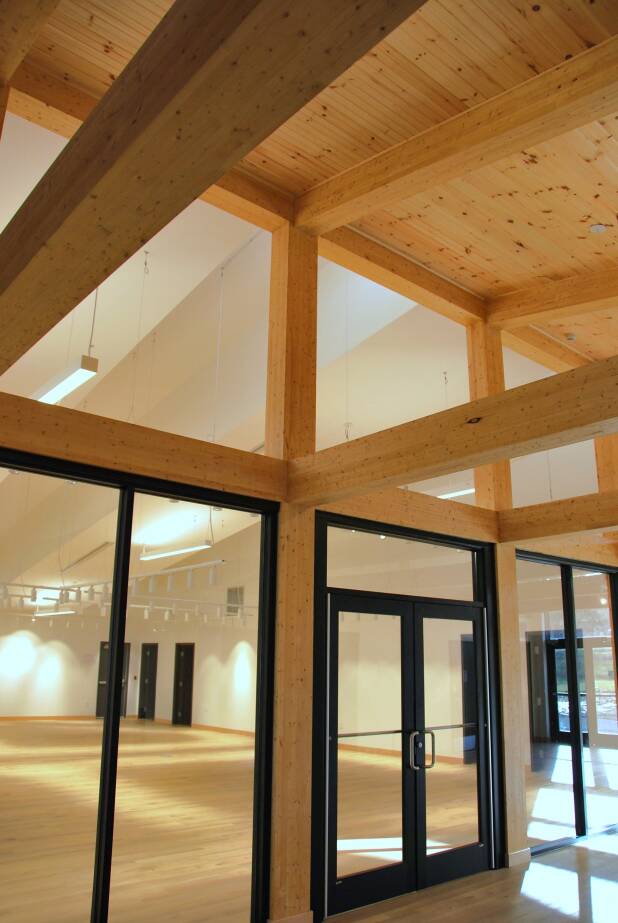
Placing the partition wall in the centre of the column line gave the designers an opportunity to expose the timbers in the exhibit area. Photo by Maria Church.
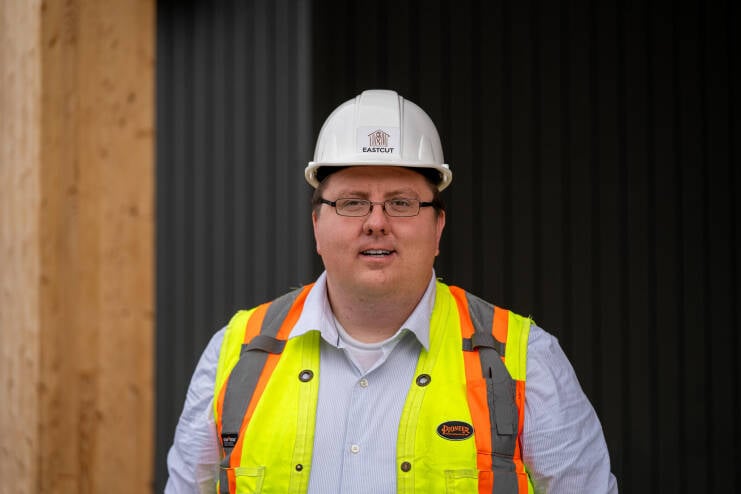
John Spencer is a structural designer with Eastcut and served as the install team project manager for the Hall of Fame project. Photo supplied by EastCut.
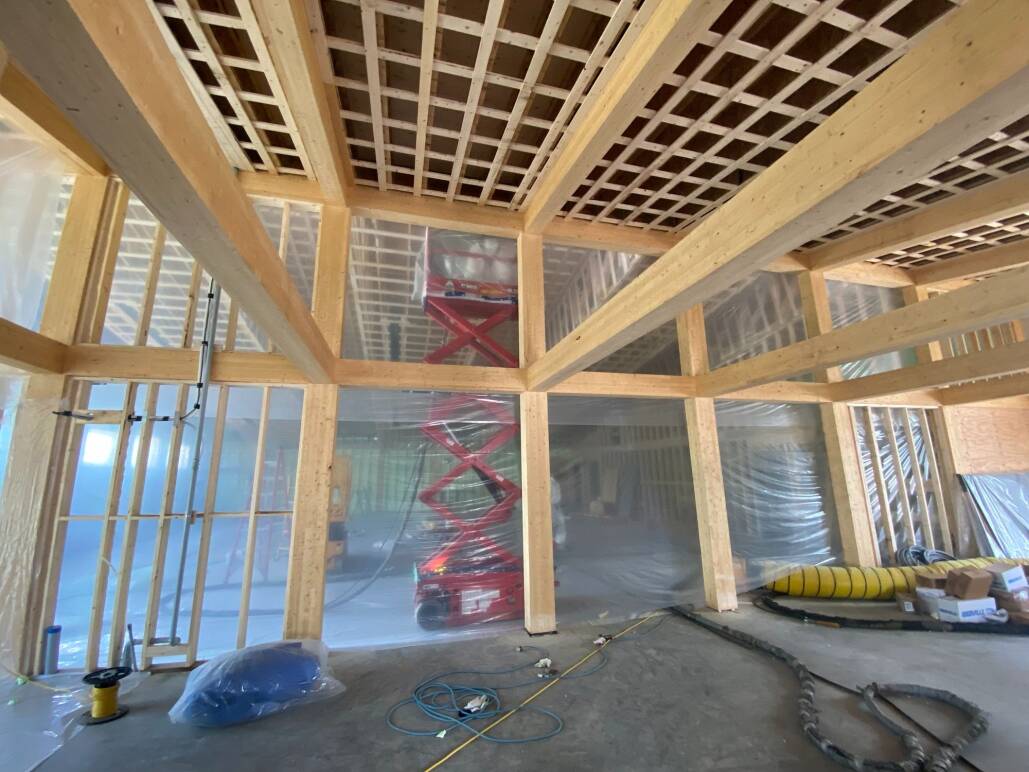
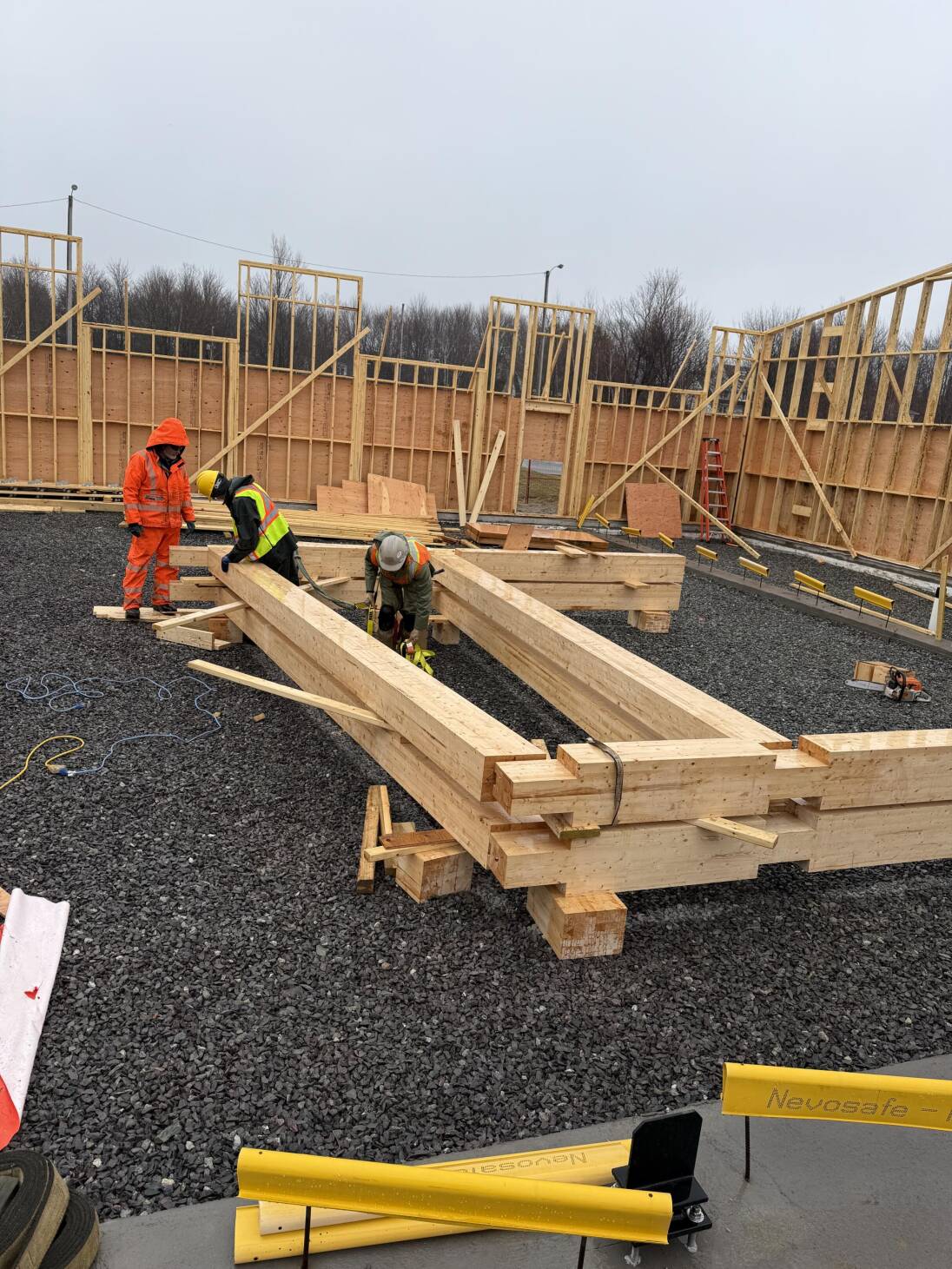
Offsite components combined with traditional lightwood framing construction made timing crucial to ensure the correct sequence of materials went in. Photo supplied by EastCut.
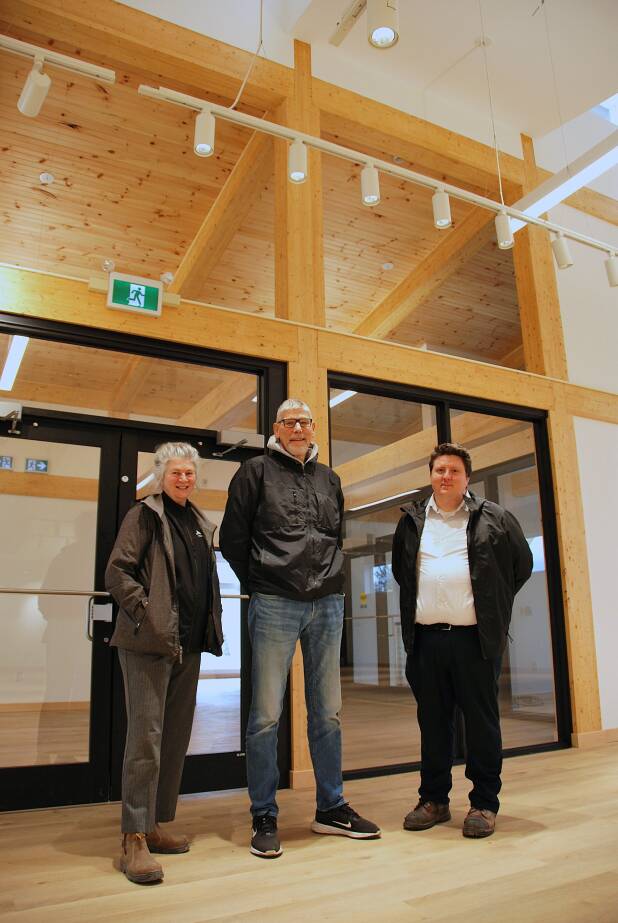
From left, Cynthia Thompson, senior communications and marketing consultant for EastCut, Peter vanKessel, chair of the building committee for the Pictou County Sports Heritage Hall of Fame, and John Spencer, structural designer with Eastcut. Photo by Maria Church.
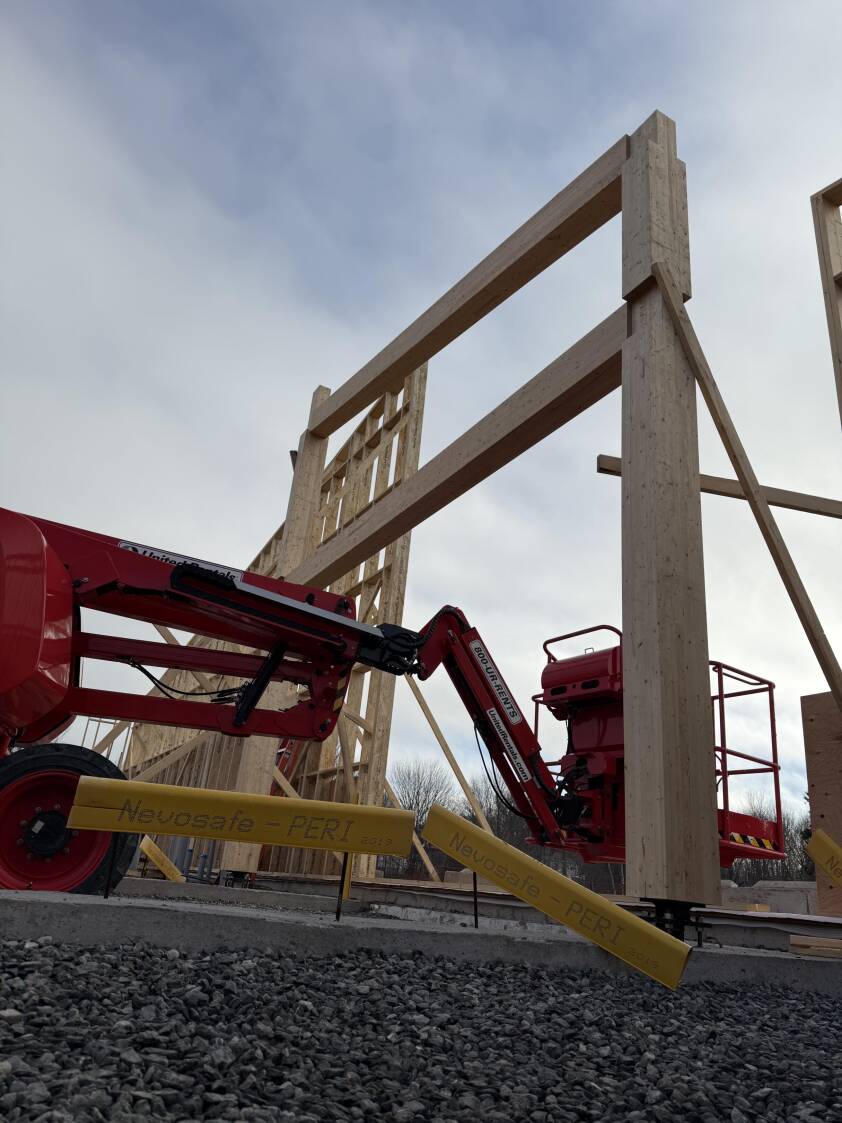
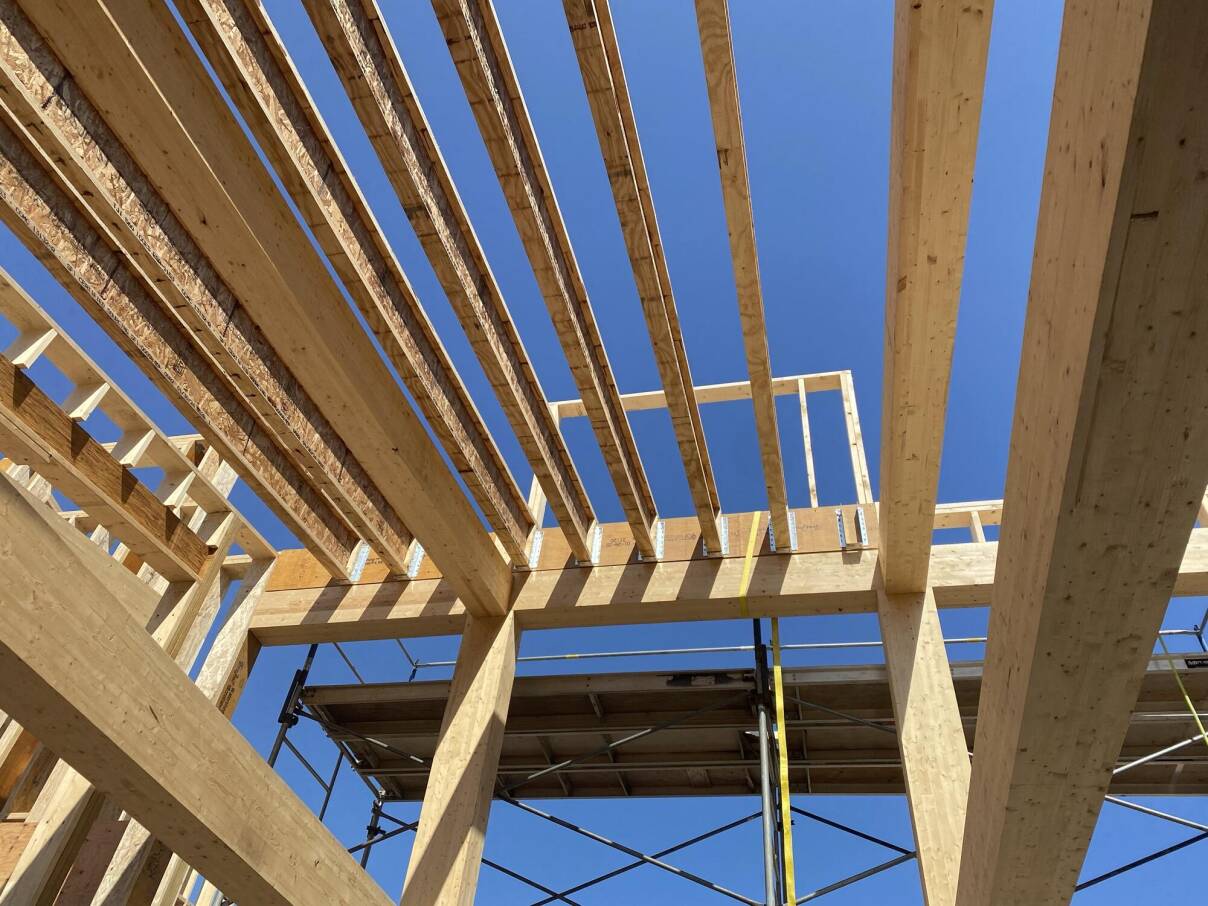
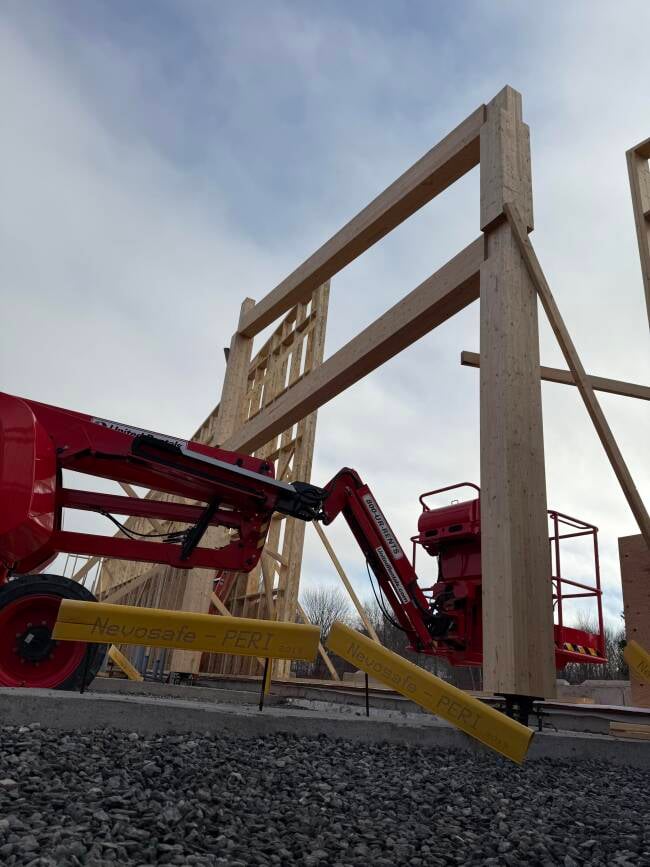
The exterior panels went up first just before the mass timber frame. A portion of the frame was supported by engineered wood within the walls. Photo supplied by EastCut.
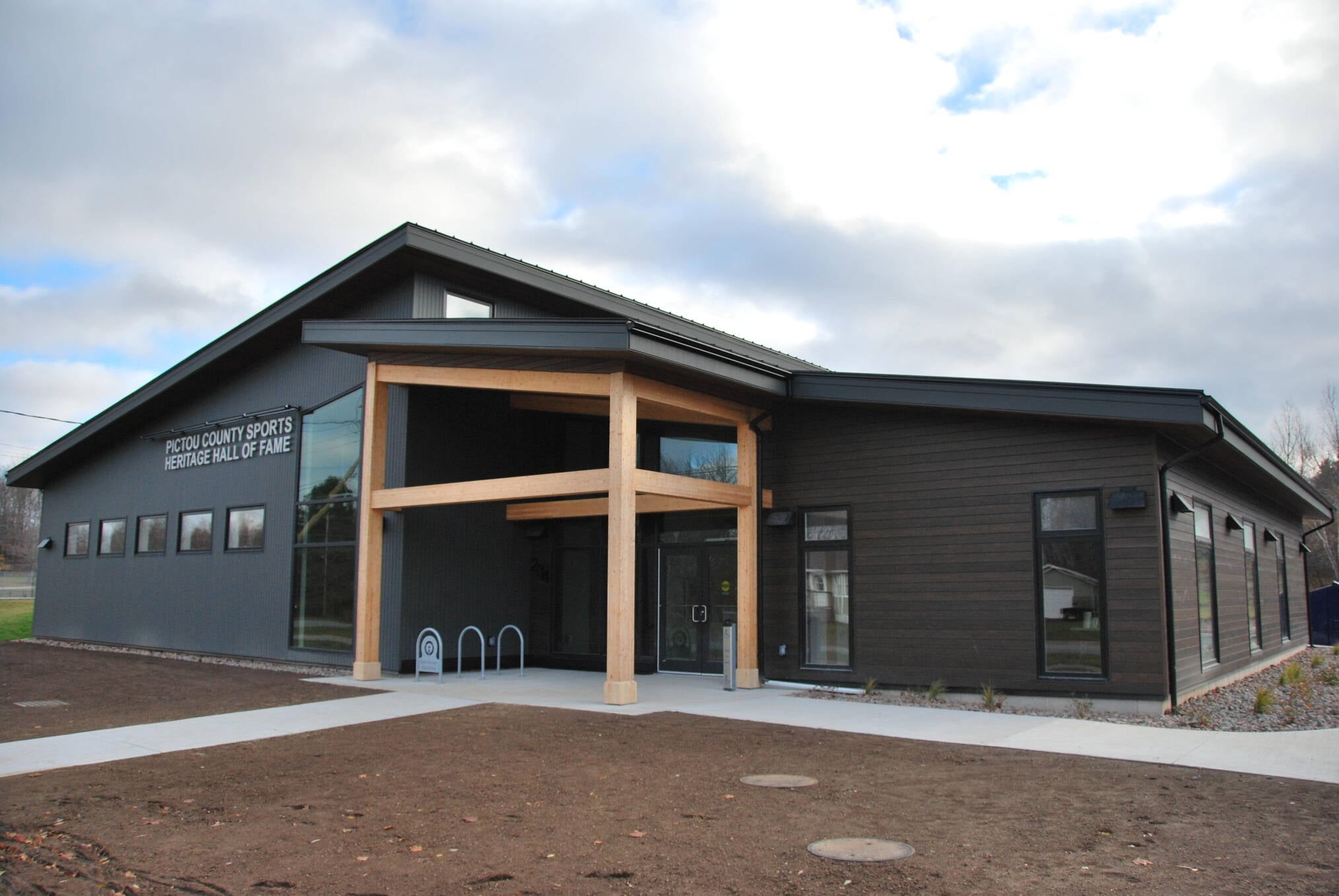
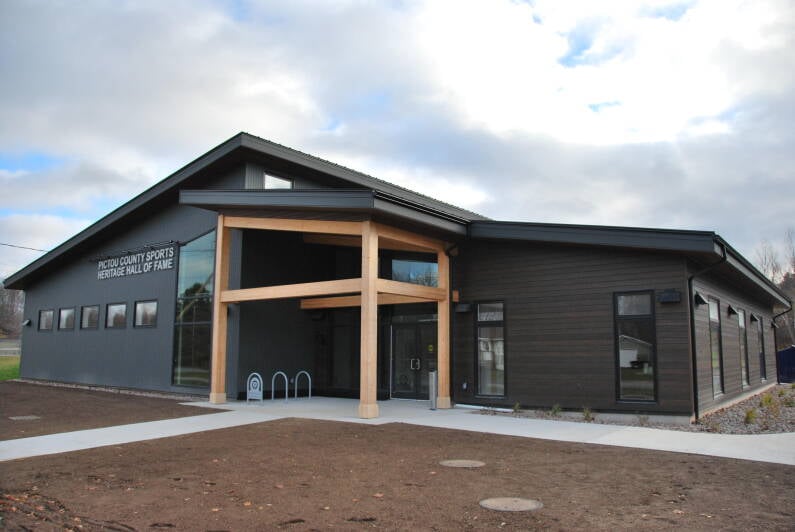
Exposed glulam columns support the canopy and frame the entrance doors to the Pictou County Sports Heritage Hall of Fame in Trenton, N.S. Photo by Maria Church.
Placing the partition wall in the centre of the column line gave the designers an opportunity to expose the timbers in the exhibit area. Photo by Maria Church.
Offsite components combined with traditional lightwood framing construction made timing crucial to ensure the correct sequence of materials went in. Photo supplied by EastCut.
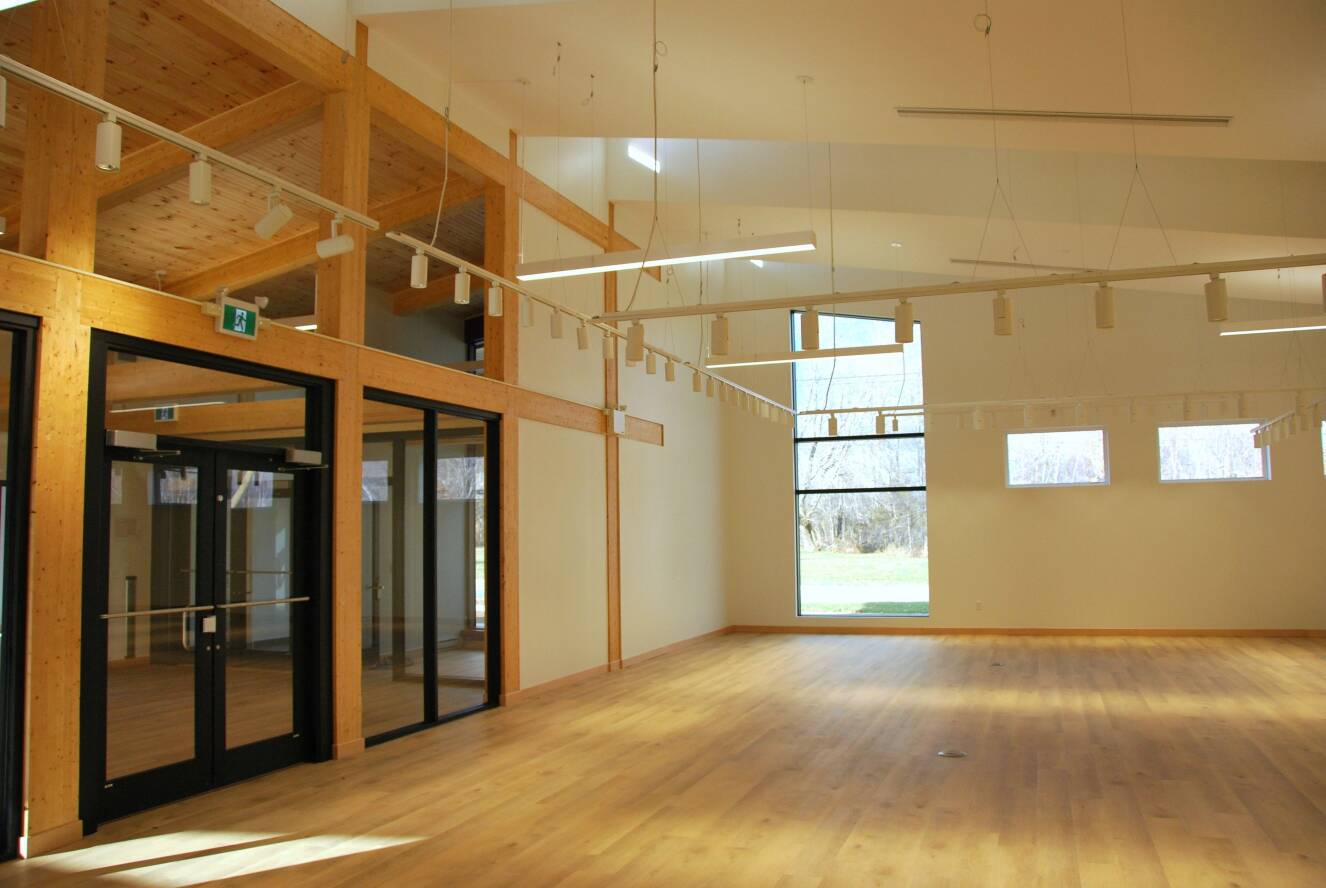
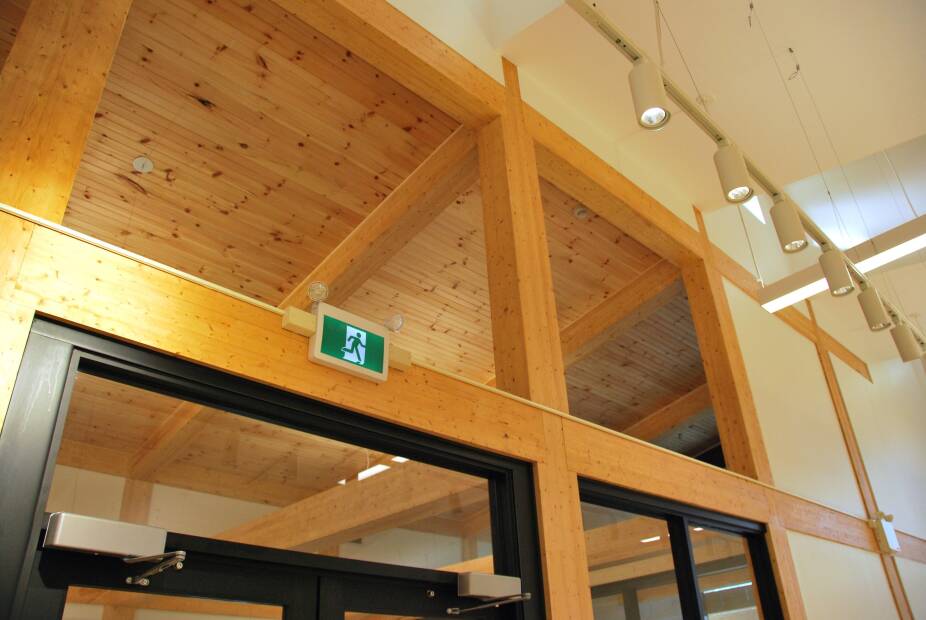
The wall area above the doors from the main corridor to the exhibit room was intentionally left open to provide an unobstructed view of the exposed mass timber ceiling and columns. Photo: Maria Church.
Offsite components combined with traditional lightwood framing construction made timing crucial to ensure the correct sequence of materials went in. Photo supplied by EastCut.
Offsite benefits
Eastcut opened as an offsite construction arm of family-owned Macklan Group five years ago. Starting out manufacturing lightwood frame panels, the company ventured into volumetric modular buildings two years ago.
While light-frame construction offers the cheapest materials, the speed and consistency of offsite modular construction make it more than competitive when it comes to a major project, Dykens explains.
“With shortages in labour… producing in factories we’re able to have more control over that. Quality control as a result of building inside with a heated space, protected from the weather, is very advantageous as well,” he says.
The preplanning and precision of the offsite methodologies contributes significantly to the final quality of the building, as evidenced by the Pictou project. The right wood product was meticulously selected for each application to create a standout building worthy of the title “Hall of Fame.”
Looking at the future of building with wood in Nova Scotia, Dykens is optimistic we’ll be seeing more.
“Five years ago, there weren’t any timber projects here,” he says. “We were really behind western Canada, but we’re seeing more demand. Especially looking at buying local, using local products. I think we’ll see more and more of it replacing buildings that you would typically see as steel and concreate.”
From a designer’s perspective, Addison says they too are seeing growing interest in modular design, building offsite, and engineered wood. “People are more open to considering wood,” he says. “We have questions quite often in briefs about potentially doing a heavy timber building, or a modular or a somewhat panelized building.”
Timing it right
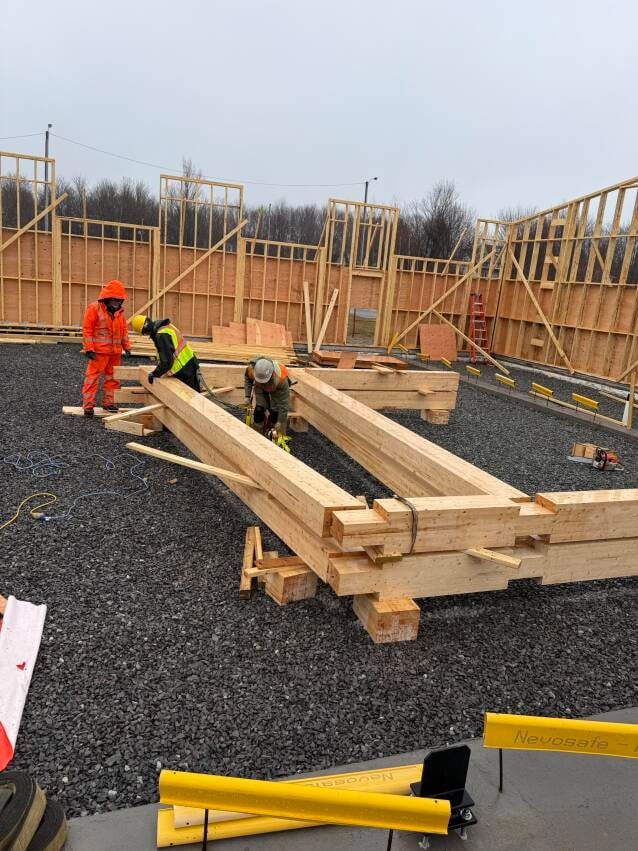
With so many different offsite components, timing was crucial to ensure the correct sequence of materials went in.
The build began with the exterior panelized walls, some nearly 24 feet tall supported by LVL and LSL studs around windows and doors, all manufactured at Eastcut’s 60-acre site in Trenton.
“Panelizing them and then connecting them together, that’s where some of the technical challenges came from, but it came together great. Once they were shipped to site, the walls were lifted within two days,” Spencer says.
Next, they installed the mass timber frame, which supports both an upper and a lower roof section with windows in between. Nordic Structures supplied the mass timber and Eastcut fabricated the required components.
With the mass timber in, DORA oversaw installation of the Eastcut-fabricated trusses and i-joists, which included 55-foot-long clear span trusses and roof panels hanging off girder trusses.
Lightwood framing followed in the south section of the building, which has a large community room, a kitchen, and a storage area.
With multiple contractors working on separate but intertwined components, there was some on-the-fly solutions needed to make everything come together, but Spencer says they were fantastic at seeing each other’s needs and co-ordinating for success.
Thanks to the offsite construction methodology, the building went up in a matter of weeks. The county is currently securing contracts for the museum display cases and other components to get ready for a spring opening to the public.
Why wood?
Wood is the natural choice for Eastcut, explains Dykens, who is a carpenter by trade. Atlantic Canada has an enviable supply of fibre for lightwood framing and, to date, they had no trouble procuring quality engineered wood products made in Canada, he says.
“Wood is a locally sourced product that’s very strong, has a low-carbon, even negative-carbon footprint, that is pretty important,” Dykens says. “And it’s just really good to work with. It creates a really warm space when it’s finished. There’s a word that describes it … biophilic design. How people feel in a space that has wood in it is quite different than traditional steel and drywall.”
The biophilic design – an architectural approach that emphasises connection to nature – is on full display at the Pictou County Sports Heritage Hall of Fame. Visitors are immediately welcomed by exposed glulam columns acting as the canopy framing the entrance doors. The building is clad with dark brown texturized steel designed to look like wood, contrasting beautifully with the light black spruce columns.
Walking in, the grand foyer is nearly all exposed wood products including mass timber columns and beams, and a ceiling clad with tongue and groove pine boards.
Heading into the museum exhibit area, drywall and white paint cover the panelized walls and ceiling, but large glass windows and doors and a fully open truss area offer a view of the foyer. A warm wood floor complements the view. The museum area also showcases the mass timber structure of the foyer by exposing a cross section that stands out against the white walls almost like artwork.
Steven Addison, a senior draftsperson at Harvey Architecture and the lead designer on the Pictou project, said early in the design process the goal was to expose timbers.
“The desire was to express the wood as much as possible,” he explains. One of the ways they did that was by placing the partition wall in the centre of the column line so that they were able to expose the wood on each side.
Because the building is just one storey, they also had the freedom to keep the wall looking into the exhibit space wide open. “No glass, no partition, just open air really made the project I think … it’s such a true expression of the material and the structure,” Addison says.
“It’s a beautiful building,” Van Kessel says. “You can’t talk to anybody who drives by and doesn’t say the same thing: what a beautiful building. We wanted something the community could be proud of. They’re all waiting to get in.”
The result is a beautiful medley of building materials, from lightwood framing and panelized walls to mass timber to engineered wood products like laminated veneer lumber (LVL), laminated strand lumber (LSL), and parallel strand lumber (PSL).
“It’s kind of the Where’s Waldo of wood products. If you look around you can find everything,” jokes John Spencer, a structural designer with Eastcut. Spencer served as the project manager for the install team for the Hall of Fame project.
The now completed 6,000 square-foot structure is sectioned into three areas. The North side – the museum portion – is built with tall-wall panelized engineered wood products. The south side – the offices and additional community spaces – is traditional lightwood 2x6 construction, and the middle foyer/corridor area is mass timber.
“It’s a marriage of old and modern construction practices resting on a mass timber frame,” Spencer says. “Everything we do – panelization, modularization, and mass timber – is in this structure.”
With Nova Scotia’s reputation as a neighbourly province, it’s not surprising to hear that the contract for the Pictou County Sports Heritage Hall of Fame in Trenton, N.S., was signed a stone’s throw from the site.
Who better to build the new museum and community building than their neighbouring offsite construction company, Eastcut.
“We wanted as much as we could to have craftsmen from the local area,” explains Peter Van Kessel, chair of the building committee. “I don’t think there is anyone who wasn’t from the area who worked onsite.”
Eastcut and sister company DORA Construction took on the project alongside Halifax-based Harvey Architecture and a host of local tradespeople. The collaboration resulted in a building that thoughtfully marries engineered wood products and traditional wood construction.
Josh Dykens, Eastcut’s general manager and COO, said their goal from the start of the design process was to build with the best product for the application.
“We’re using the right material in the right places. We’re not trying to use the same product everywhere. We’re putting things where they are best suited and that is an advantage in cost and efficiency,” Dykens says.
FEATURE
Pictou County Sports Heritage Hall of Fame
Placing the partition wall in the centre of the column line gave the designers an opportunity to expose the timbers in the exhibit area. Photo by Maria Church.
John Spencer is a structural designer with Eastcut and served as the install team project manager for the Hall of Fame project. Photo supplied by EastCut.
Offsite components combined with traditional lightwood framing construction made timing crucial to ensure the correct sequence of materials went in. Photo supplied by EastCut.
From left, Cynthia Thompson, senior communications and marketing consultant for EastCut, Peter vanKessel, chair of the building committee for the Pictou County Sports Heritage Hall of Fame, and John Spencer, structural designer with Eastcut. Photo by Maria Church.
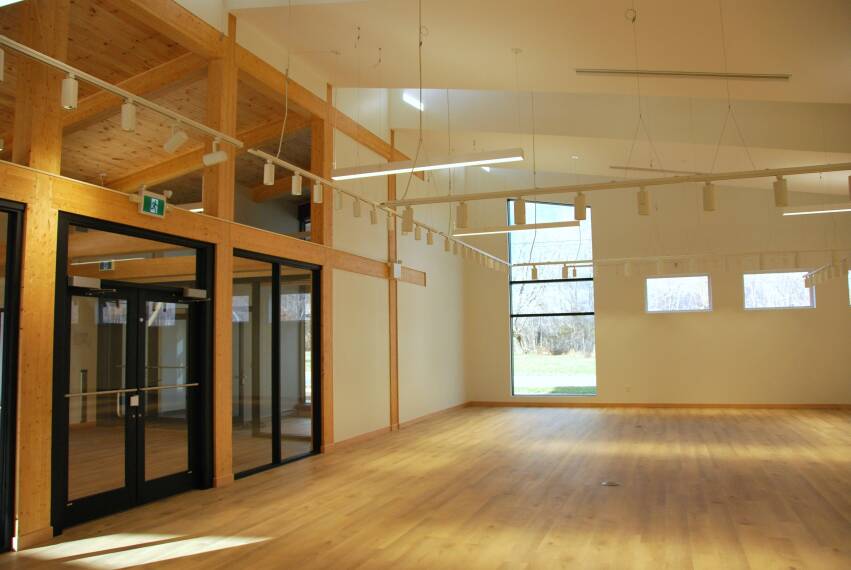
The wall area above the doors from the main corridor to the exhibit room was intentionally left open to provide an unobstructed view of the exposed mass timber ceiling and columns. Photo: Maria Church.
Offsite benefits
Eastcut opened as an offsite construction arm of family-owned Macklan Group five years ago. Starting out manufacturing lightwood frame panels, the company ventured into volumetric modular buildings two years ago.
While light-frame construction offers the cheapest materials, the speed and consistency of offsite modular construction make it more than competitive when it comes to a major project, Dykens explains.
“With shortages in labour… producing in factories we’re able to have more control over that. Quality control as a result of building inside with a heated space, protected from the weather, is very advantageous as well,” he says.
The preplanning and precision of the offsite methodologies contributes significantly to the final quality of the building, as evidenced by the Pictou project. The right wood product was meticulously selected for each application to create a standout building worthy of the title “Hall of Fame.”
Looking at the future of building with wood in Nova Scotia, Dykens is optimistic we’ll be seeing more.
“Five years ago, there weren’t any timber projects here,” he says. “We were really behind western Canada, but we’re seeing more demand. Especially looking at buying local, using local products. I think we’ll see more and more of it replacing buildings that you would typically see as steel and concreate.”
From a designer’s perspective, Addison says they too are seeing growing interest in modular design, building offsite, and engineered wood. “People are more open to considering wood,” he says. “We have questions quite often in briefs about potentially doing a heavy timber building, or a modular or a somewhat panelized building.”
The exterior panels went up first just before the mass timber frame. A portion of the frame was supported by engineered wood within the walls. Photo supplied by EastCut.
Offsite components combined with traditional lightwood framing construction made timing crucial to ensure the correct sequence of materials went in. Photo supplied by EastCut.
Why wood?
Wood is the natural choice for Eastcut, explains Dykens, who is a carpenter by trade. Atlantic Canada has an enviable supply of fibre for lightwood framing and, to date, they had no trouble procuring quality engineered wood products made in Canada, he says.
“Wood is a locally sourced product that’s very strong, has a low-carbon, even negative-carbon footprint, that is pretty important,” Dykens says. “And it’s just really good to work with. It creates a really warm space when it’s finished. There’s a word that describes it … biophilic design. How people feel in a space that has wood in it is quite different than traditional steel and drywall.”
The biophilic design – an architectural approach that emphasises connection to nature – is on full display at the Pictou County Sports Heritage Hall of Fame. Visitors are immediately welcomed by exposed glulam columns acting as the canopy framing the entrance doors. The building is clad with dark brown texturized steel designed to look like wood, contrasting beautifully with the light black spruce columns.
Walking in, the grand foyer is nearly all exposed wood products including mass timber columns and beams, and a ceiling clad with tongue and groove pine boards.
Heading into the museum exhibit area, drywall and white paint cover the panelized walls and ceiling, but large glass windows and doors and a fully open truss area offer a view of the foyer. A warm wood floor complements the view. The museum area also showcases the mass timber structure of the foyer by exposing a cross section that stands out against the white walls almost like artwork.
Steven Addison, a senior draftsperson at Harvey Architecture and the lead designer on the Pictou project, said early in the design process the goal was to expose timbers.
“The desire was to express the wood as much as possible,” he explains. One of the ways they did that was by placing the partition wall in the centre of the column line so that they were able to expose the wood on each side.
Because the building is just one storey, they also had the freedom to keep the wall looking into the exhibit space wide open. “No glass, no partition, just open air really made the project I think … it’s such a true expression of the material and the structure,” Addison says.
“It’s a beautiful building,” Van Kessel says. “You can’t talk to anybody who drives by and doesn’t say the same thing: what a beautiful building. We wanted something the community could be proud of. They’re all waiting to get in.”
Exposed glulam columns support the canopy and frame the entrance doors to the Pictou County Sports Heritage Hall of Fame in Trenton, N.S. Photo by Maria Church.
Placing the partition wall in the centre of the column line gave the designers an opportunity to expose the timbers in the exhibit area. Photo by Maria Church.
Offsite components combined with traditional lightwood framing construction made timing crucial to ensure the correct sequence of materials went in. Photo supplied by EastCut.
Timing it right
With so many different offsite components, timing was crucial to ensure the correct sequence of materials went in.
The build began with the exterior panelized walls, some nearly 24 feet tall supported by LVL and LSL studs around windows and doors, all manufactured at Eastcut’s 60-acre site in Trenton.
“Panelizing them and then connecting them together, that’s where some of the technical challenges came from, but it came together great. Once they were shipped to site, the walls were lifted within two days,” Spencer says.
Next, they installed the mass timber frame, which supports both an upper and a lower roof section with windows in between. Nordic Structures supplied the mass timber and Eastcut fabricated the required components.
With the mass timber in, DORA oversaw installation of the Eastcut-fabricated trusses and i-joists, which included 55-foot-long clear span trusses and roof panels hanging off girder trusses.
Lightwood framing followed in the south section of the building, which has a large community room, a kitchen, and a storage area.
With multiple contractors working on separate but intertwined components, there was some on-the-fly solutions needed to make everything come together, but Spencer says they were fantastic at seeing each other’s needs and co-ordinating for success.
Thanks to the offsite construction methodology, the building went up in a matter of weeks. The county is currently securing contracts for the museum display cases and other components to get ready for a spring opening to the public.
The result is a beautiful medley of building materials, from lightwood framing and panelized walls to mass timber to engineered wood products like laminated veneer lumber (LVL), laminated strand lumber (LSL), and parallel strand lumber (PSL).
“It’s kind of the Where’s Waldo of wood products. If you look around you can find everything,” jokes John Spencer, a structural designer with Eastcut. Spencer served as the project manager for the install team for the Hall of Fame project.
The now completed 6,000 square-foot structure is sectioned into three areas. The North side – the museum portion – is built with tall-wall panelized engineered wood products. The south side – the offices and additional community spaces – is traditional lightwood 2x6 construction, and the middle foyer/corridor area is mass timber.
“It’s a marriage of old and modern construction practices resting on a mass timber frame,” Spencer says. “Everything we do – panelization, modularization, and mass timber – is in this structure.”