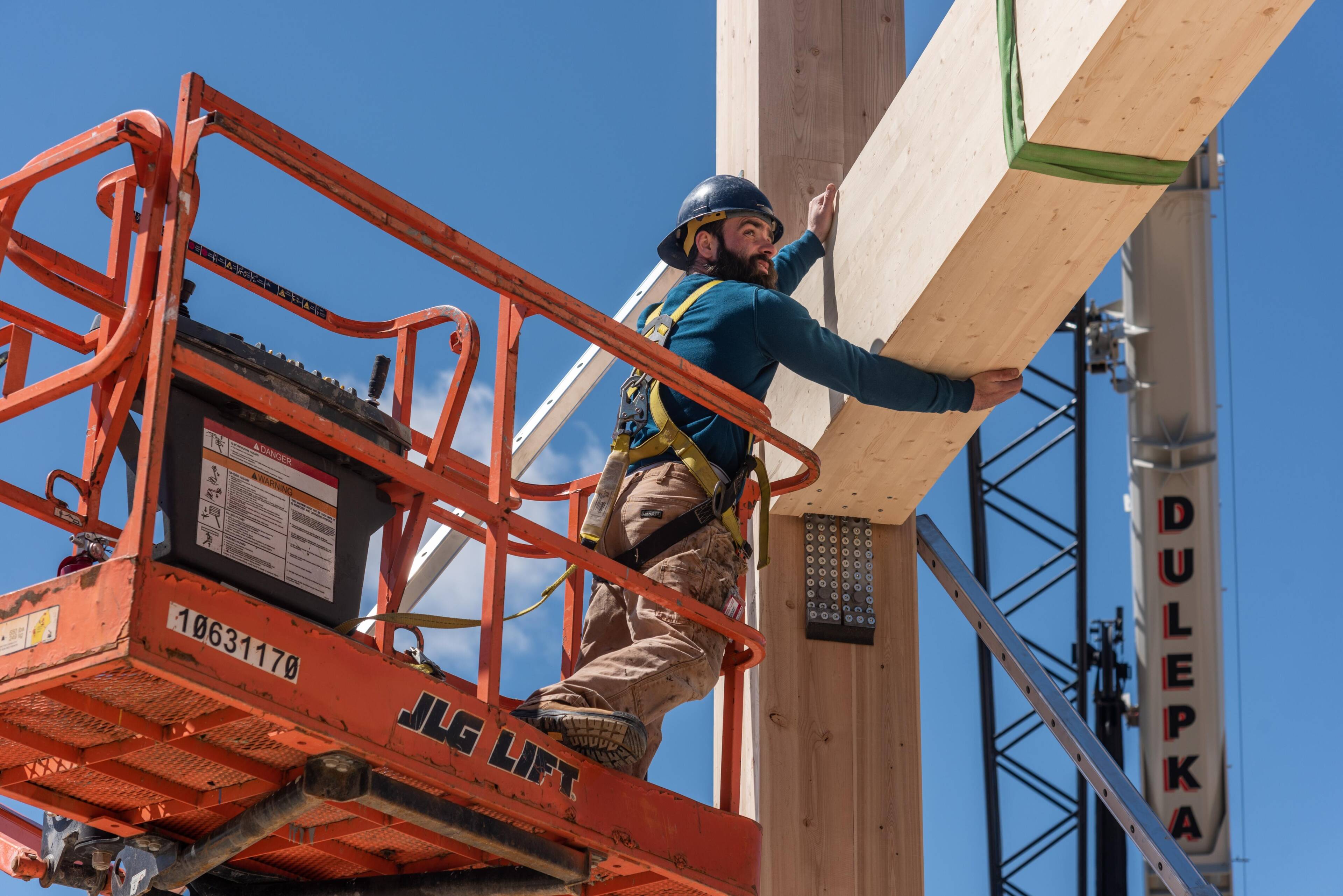
As prefabrication gains momentum, the margin for error is shrinking. In this interview, Nicholas Sills discusses why tolerances matter more than ever—and how clearer communication and better coordination can unlock real gains in performance, cost, and schedule.
Derek Ratzlaff
Nick, thank you for sitting down with me today. Before we get into our discussion on tolerances, I’d like to ask you about how you got your start in the wood industry.
Nicholas Sills
I grew up in the mountain community of Whistler, BC, where there were a lot of timber frames being built. My dad was a timber framer. I grew up in the forest. We also had a small Nordic ski resort where we had to build the trails. So, we were logging to create trails and then framed the buildings on site with those materials. That really inspired me. Wood is a beautiful, locally available material that we should be using more whenever possible, it combines air ( carbon), sunshine (solar), water and a small amount of soil to create a solid structural material. This can be argued as many engineers’ dream, we just need to work with this nearly magic, organic structure appropriately.
Derek Ratzlaff
You helped us write the tolerances solutions paper we just issued: Understanding Tolerances in Prefabricated Timber Construction. How significant is this issue in the industry right now?
Nicholas Sills
I've worked in mass timber for over 15 years, and nearly every project I've worked on has had a connection that didn't fit or something that didn't line up. When you break down what's happening in those issues, sometimes it's a straight up mistake. But often, and it feels like maybe 50% of the time, the issue comes down to how tolerances are defined and communicated, with different people using the same term to mean different things. And when you add all these things together, it doesn't fit. And that results in a delay on site, a back charge, frustration, failure to deliver what was promised, et cetera. So, it's just very finite to any prefab work. We need to speak the same language to make sure we can deliver the results we're trying to achieve.
Derek Ratzlaff
And as the use of pre-fab construction expands, that language issue becomes increasingly critical in terms of the tolerances and specificity required.
Nicholas Sills
Yes.
Derek Ratzlaff
What changes have you seen over the years when it comes to how people describe geometry and how they handle coordination within the industry? How are people communicating and has that changed over time?
Nicholas Sills
I don't want to suggest there are tiers of consultants, but there are certainly teams with more experience in certain areas. I have seen terminology and communication improve significantly among groups that have designed 10, 15, 100 projects before. They anticipate where these incidents are going to occur, and when you raise a solution, they know what you're talking about right away and navigate through it smoothly.
Conversely, if you're working with a team that doesn't have that depth of experience,
someone might identify a potential issue and the team may dismiss it, thinking it's not going to be an issue. As a result, it doesn’t get addressed. And it may seem surprising, but teams are often focused on other priorities, may not want to put their effort there, and don't know there is a high potential for an issue to arise later and cause problems.
So, there’s real value in earning a few scars and then taking the time get into those details once you’re speaking the same language. And I think one reason teams don't dive into that is because the language sounds like we're talking in detail and saying the same things, but really, you're not until you experience those issues. That’s what enables you to use the proper language to clearly describe the issues that are going to occur or have occurred.
Derek Ratzlaff
Do you feel hopeful about the progression of this conversation within the industry?
Nicholas Sills
One hundred percent. We're going to progress really fast here. There's a much larger conversation happening. It’s not just in the world of mass timber; the world of prefab is expanding rapidly right now – there's a huge number of changes coming. I believe we're seeing that transition all the way from aerospace engineering into the built environment, and the more we can adapt and share technology, systems, and terminology, the more we're going to improve at putting things together with fewer issues, executing on the schedules that were promised.
Derek Ratzlaff
Looking ahead, what developments are you most hopeful to see in this area?
Nicholas Sills
I would love to see a more collaborative uptake of BIM. Right now, BIM is still 100% a bolt-on. I don't care what anyone says, most groups are working in Revit and other technologies that are designed to create 2D drawings and they are really good at doing that extremely fast. They are not great at getting into those detailed BIM models where you can go to the level of development where you start resolving tolerance issues in advance. The closer we bring that together, the better equipped we'll be to resolve, or prevent those issues from ever occurring. So, I'm very excited about that. I've been excited for about 15 years now and still waiting ! But it will start happening here as the real world, BIM, and 3D scanning start to converge in a more collaborative way.
Derek Ratzlaff
Last question: what are you excited about in the timber industry right now?
Nicholas Sills
I'm excited about bringing true cost competitiveness and better financial choices to developers, owners, and general contractors. I believe when we can show these schedule savings and show an adequate risk reduction – which we're not very good at showing right now – mass timber will no longer be seen as a risky category. With this work on the tolerance side, improved schedule robustness and reduced exposure on site – which limits your total risk exposure and should affect insurance values – we can start creating a value stack. Combined with earlier rent occupancy and other benefits, that creates a net present value or internal rate of return that is very appealing to anyone in the development and construction markets.
Derek Ratzlaff
Thank you for sharing your insights and experience with us today, Nick.