Prefabricated mass timber can significantly compress construction schedules, but only when project teams move critical decisions upstream. In my experience, schedule risk is concentrated in the window between the release of issued-for-construction (IFC) drawings and the start of fabrication. During this period, teams need to resolve geometry, interfaces, tolerances, connections, site conditions, logistics and erection sequence before components enter production.
As Rodrigo Freig of Modelo Tech Studio put it in our recent webinar on this topic, the objective is to “coordinate digitally, verify physically, fabricate confidently, and install predictably.” Achieving that objective takes more than a building information model (BIM). It requires a disciplined, managed workflow with clear ownership, milestones, and approval gates.
Why Fabrication Readiness is Different
A design model communicates intent. A fabrication model describes exactly how components will be manufactured, shipped, lifted, connected, and installed. To be fabrication-ready, the model must include actual service routes, openings, penetrations, supports, clearances, connections, and tolerances, not simply representative geometry.
This distinction becomes especially important in hybrid structures. Mass timber is manufactured to tight tolerances, while concrete and structural steel may be erected within broader tolerances. If those interfaces are not reconciled before production, what seems like a minor discrepancy can prevent a panel, beam, or connection from fitting on site.
A Sequenced Path to Fabrication
The workflow should be built backward from the required erection date and tied directly to procurement, approvals, manufacturing, and delivery lead times. Trying to complete several steps at once can create confusion, rework, and lost time.
A practical sequence is:
Establish the base model. Build a coordinated three-dimensional representation from the IFC drawings. Confirm grids, elevations, member sizes, and primary geometry before adding fabrication detail.
Federate discipline models. Combine architectural, structural, mechanical, electrical, plumbing, steel, and timber information in a shared environment accessible to consultants, contractors, trades, and fabricators.
Resolve interfaces and clashes. Review issues collaboratively, assign each item to an accountable party and record decisions. Resolve straightforward matters directly in the model; use formal requests for information when contractual clarification is required.
Revise and revalidate. Check every change against the other models so that solving one conflict does not create another. An issue is not closed simply because it has been marked complete; the revised condition must be confirmed.
Verify physical conditions. Compare critical installed work with the model through surveys, targeted measurements, or reality capture. This verification can happen progressively as foundations, concrete, and steel are completed.
Approve shop and erection drawings. Once geometry, routing, connections, and tolerances are stable, issue drawings for review. Coordinated team reviews can reduce repetitive revise-and-resubmit cycles.
Release fabrication information. Produce single-piece drawings and machine-ready data, then align manufacturing, packaging, loading, and delivery with the erection sequence.
Information Maturity and Manufacturing
The fabrication designer’s workflow typically advances through distinct information milestones. At level-of-development (LOD) 300, the team confirms geometry, member sizes and design intent. At LOD 350, connections, tolerances, and cross-trade coordination are added, and erection drawings are prepared for approval. Once approved, the model supports individual shop drawings, computer numerical control (CNC) programming, and factory assembly.
Machine framing is preferred where feasible because it improves precision, reduces processing time, and limits manual error. Connection steel and heavy hardware can then be installed under controlled factory conditions. Components should also be protected for transit and loaded in erection sequence. When this work is coordinated properly, installation becomes assembly rather than troubleshooting.
Roles, Ownership, and Collaboration
The contractor generally owns the process of achieving fabrication readiness and often manages the federated model, clash assignment, and issue closure. Design consultants remain responsible for design intent and support the process through model review, responses to questions, and shop-drawing review. Trades contribute buildable routing access, installation, and sequencing knowledge, while fabricators provide manufacturing-level detail.
Early involvement matters more than the specific contract form. Design-build and integrated project delivery can encourage collaboration, but the same principles can be applied to design-bid-build when responsibilities, deliverables, and decision dates are established early. A BIM specialist can support model federation and clash detection but cannot substitute for project-wide accountability.
Practical Controls That Reduce Rework
ASK AN EXPERT
From Model to Manufacturing: Achieving Fabrication Readiness
in Mass Timber

About the author:
Cameron is a Technical Advisor with WoodWorks BC, where he supports project teams in the design and delivery of wood, mass timber, and prefabricated building projects. With a background in general contracting and project management, he brings practical experience in procurement, coordination, scheduling, risk management, and construction execution. His areas of interest include mass timber, modern methods of construction, prefabrication, and improving collaboration between design and construction teams. He holds a Bachelor of Business Management from the University of British Columbia Okanagan.
The key scheduling point is straightforward: prefabrication coordination deserves the same disciplined approach as any other critical-path activity. When that discipline is applied, digital coordination protects the core advantages of mass timber: precision manufacturing, predictable delivery, and rapid installation.
Conclusion
Fabrication readiness is not simply a final drawing milestone. It is a controlled reduction of uncertainty. Successful teams distinguish design intent from manufacturing information, sequence coordination instead of compressing it, verify physical conditions, and assign clear ownership for decisions. The result is a reliable path from IFC documents to approved fabrication data with fewer surprises when the timber arrives on site.
Use a shared model-based platform as the primary coordination environment, while preserving formal records where required.
Hold regular multidisciplinary reviews focused on decisions, ownership, and closeout.
Bring detailers, fabricators, and major trades into the process before geometry and connections are frozen.
Build models that can absorb change efficiently through consistent, parametric detailing.
Define interface tolerances explicitly, including allowances for concrete, steel, tools, welds, and erection.
Verify high-risk existing conditions before dependent components are manufactured.

By Cameron Baker
ASK AN EXPERT
From Model to Manufacturing: Achieving Fabrication Readiness
in Mass Timber
Prefabricated mass timber can significantly compress construction schedules, but only when project teams move critical decisions upstream. In my experience, schedule risk is concentrated in the window between the release of issued-for-construction (IFC) drawings and the start of fabrication. During this period, teams need to resolve geometry, interfaces, tolerances, connections, site conditions, logistics and erection sequence before components enter production.
As Rodrigo Freig of Modelo Tech Studio put it in our recent webinar on this topic, the objective is to “coordinate digitally, verify physically, fabricate confidently, and install predictably.” Achieving that objective takes more than a building information model (BIM). It requires a disciplined, managed workflow with clear ownership, milestones, and approval gates.
Why Fabrication Readiness is Different
A design model communicates intent. A fabrication model describes exactly how components will be manufactured, shipped, lifted, connected, and installed. To be fabrication-ready, the model must include actual service routes, openings, penetrations, supports, clearances, connections, and tolerances, not simply representative geometry.
This distinction becomes especially important in hybrid structures. Mass timber is manufactured to tight tolerances, while concrete and structural steel may be erected within broader tolerances. If those interfaces are not reconciled before production, what seems like a minor discrepancy can prevent a panel, beam, or connection from fitting on site.
A Sequenced Path to Fabrication
The workflow should be built backward from the required erection date and tied directly to procurement, approvals, manufacturing, and delivery lead times. Trying to complete several steps at once can create confusion, rework, and lost time.
A practical sequence is:
Establish the base model. Build a coordinated three-dimensional representation from the IFC drawings. Confirm grids, elevations, member sizes, and primary geometry before adding fabrication detail.
Federate discipline models. Combine architectural, structural, mechanical, electrical, plumbing, steel, and timber information in a shared environment accessible to consultants, contractors, trades, and fabricators.
Resolve interfaces and clashes. Review issues collaboratively, assign each item to an accountable party and record decisions. Resolve straightforward matters directly in the model; use formal requests for information when contractual clarification is required.
Revise and revalidate. Check every change against the other models so that solving one conflict does not create another. An issue is not closed simply because it has been marked complete; the revised condition must be confirmed.
Verify physical conditions. Compare critical installed work with the model through surveys, targeted measurements, or reality capture. This verification can happen progressively as foundations, concrete, and steel are completed.
Approve shop and erection drawings. Once geometry, routing, connections, and tolerances are stable, issue drawings for review. Coordinated team reviews can reduce repetitive revise-and-resubmit cycles.
Release fabrication information. Produce single-piece drawings and machine-ready data, then align manufacturing, packaging, loading, and delivery with the erection sequence.
Information Maturity and Manufacturing
The fabrication designer’s workflow typically advances through distinct information milestones. At level-of-development (LOD) 300, the team confirms geometry, member sizes and design intent. At LOD 350, connections, tolerances, and cross-trade coordination are added, and erection drawings are prepared for approval. Once approved, the model supports individual shop drawings, computer numerical control (CNC) programming, and factory assembly.
Machine framing is preferred where feasible because it improves precision, reduces processing time, and limits manual error. Connection steel and heavy hardware can then be installed under controlled factory conditions. Components should also be protected for transit and loaded in erection sequence. When this work is coordinated properly, installation becomes assembly rather than troubleshooting.
Roles, Ownership, and Collaboration
The contractor generally owns the process of achieving fabrication readiness and often manages the federated model, clash assignment, and issue closure. Design consultants remain responsible for design intent and support the process through model review, responses to questions, and shop-drawing review. Trades contribute buildable routing access, installation, and sequencing knowledge, while fabricators provide manufacturing-level detail.
Early involvement matters more than the specific contract form. Design-build and integrated project delivery can encourage collaboration, but the same principles can be applied to design-bid-build when responsibilities, deliverables, and decision dates are established early. A BIM specialist can support model federation and clash detection but cannot substitute for project-wide accountability.
Practical Controls That Reduce Rework
Cost, timing and certainty
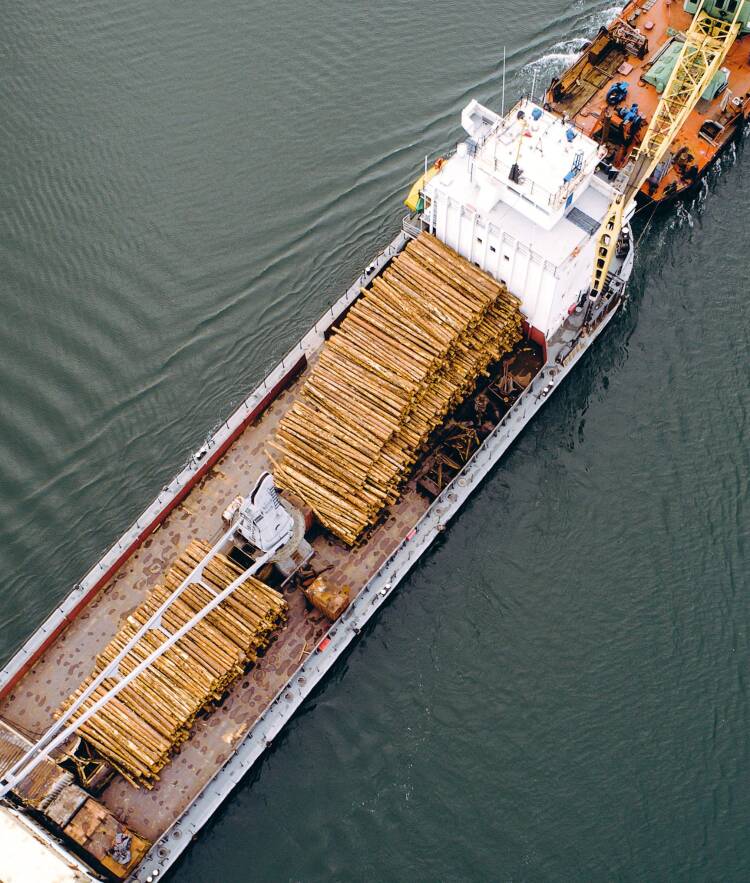
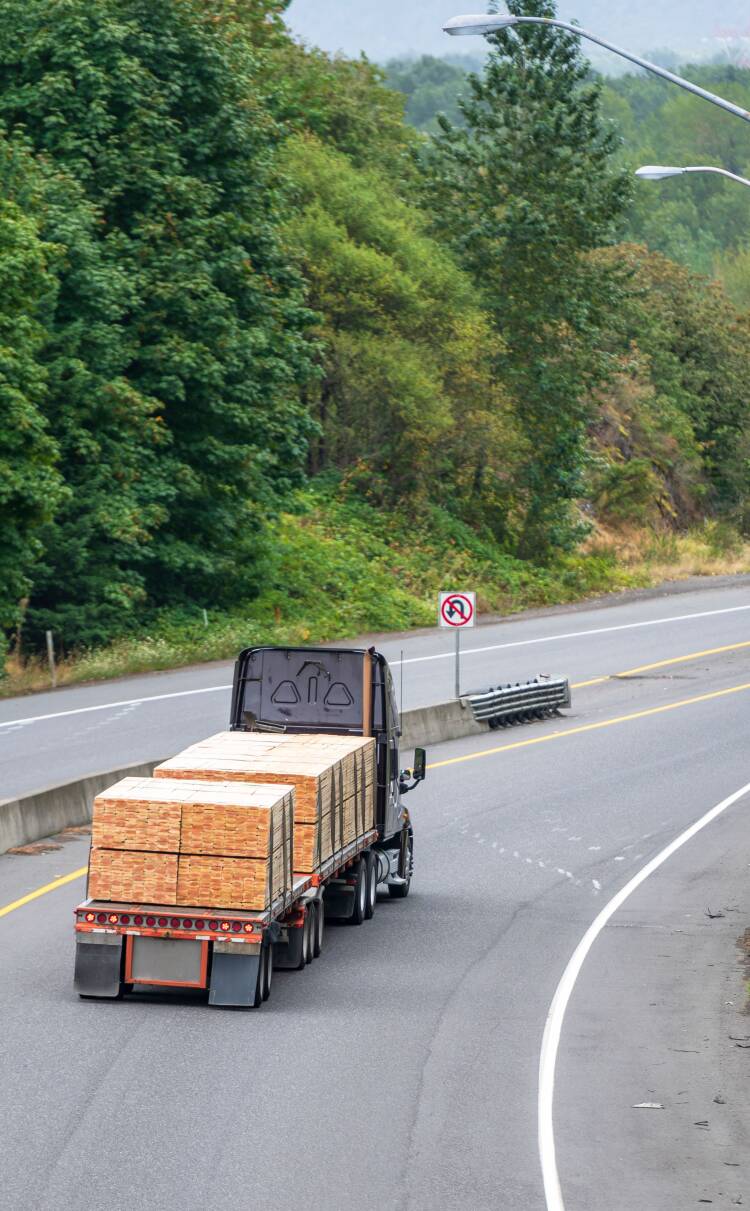
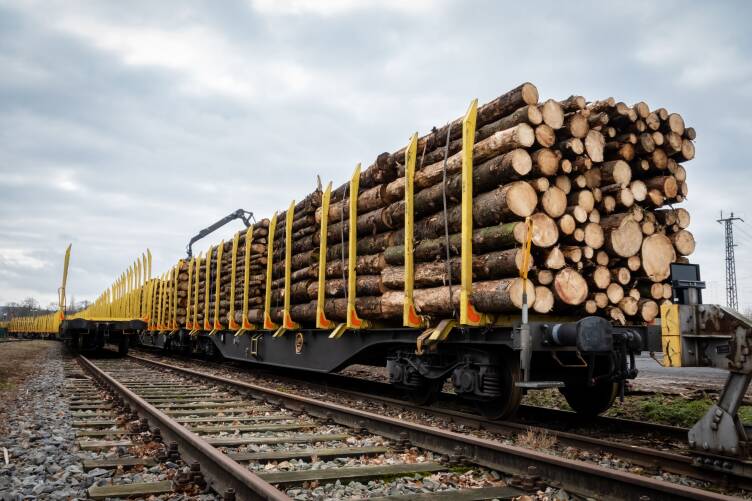
For lumber and other wood building materials like plywood and OSB, an average shipment travels roughly 1,200 kilometres over land. Approximately 90 per cent of Forest Products Association of Canada (FPAC) member mills are served by only one railway, limiting practical alternatives for long-distance movements. Trucks are indispensable for first- and last-mile connections, regional deliveries and access to rail terminals, but long-distance trucking is rarely economical for high-volume forest products. In many cases, rail remains the backbone of movement from mill regions to major domestic markets or gateways.
3
First, supply-chain performance should be measured in both operational and economic terms. Throughput is important, but it is not enough if products move at costs that make Canadian production uncompetitive. Public reporting should provide useful visibility into service, cost and corridor performance, while shippers need accessible remedies when service or pricing practices are unreasonable.
Second, infrastructure investment should focus on measurable user outcomes. Canada needs resilient trade corridors, but it also needs strategic first- and last-mile investments in transload capacity, inland terminals, warehousing, data technologies, road connections and projects that remove bottlenecks or provide redundancy. Policy should encourage private investment and prioritize projects that improve the performance of the network, rather than treating infrastructure announcements as outcomes in themselves.
Third, labour policy should support earlier negotiated settlements and credible, predictable processes that reduce the likelihood and duration of supply-chain stoppages. FPAC respects collective bargaining and represents a highly unionized sector. At the same time, repeated disruptions in rail, ports or marine transportation put forest-sector workers, customers and communities at risk. Labour stability and worker security should be treated as mutually reinforcing objectives.
1
Recent policy discussions about targeted rail relief have shown the importance of reflecting actual freight patterns, regional differences and potential effects on established truck-based supply chains. Durable improvements should strengthen the system as a whole and avoid shifting costs or traffic in ways that create new distortions.
FPAC proposed a roadmap to effective policy in its 2025 report,Fixing Canada's Transportation Supply Chains: Solutions for a Competitive Forest Sector. The strategy organized around three connected outcomes: stronger competition and accountability, modern infrastructure and data, and greater labour stability. These are practical foundations for a transportation system that supports housing, manufacturing and trade.
For lumber and other wood building materials like plywood and OSB,
an average shipment travels roughly 1,200 kilometres over land.
These conditions make delivered cost and service reliability central competitiveness issues. Rail and terminal expenses can represent a significant share of delivered product value, particularly when commodity prices are weak. FPAC analysis suggests that rail costs can represent 20–25% of typical delivered product value, or $2–3 billion annually for the sector. This is roughly equivalent to 15% of the forest industry’s annual real GDP, or 50% of current annual capital and repair expenditure across the sector.
In addition to cost pressures, reliability has been a persistent challenge within Canadian transportation supply chains. Interruptions, congestion, infrastructure outages and labour disputes can quickly leave mills without shipping capacity and buyers without predictable delivery. For construction customers, the result can be budget pressure, rescheduling and greater reluctance to adopt unfamiliar systems.
Persistent work stoppages at railways and ports have affected supply chains in 15 of the last 16 years, with prolonged disputes costing manufacturers millions per week and eroding customer confidence. In the trucking sector, historic tightness in labour markets for long haul drivers has been a persistent worry—Trucking HR Canada notes that the trucking industry’s job vacancy rate is still “1.5 times higher than the average across the Canadian economy.”
The issue becomes even more visible with modern methods of construction. Off-site manufacturing depends on a synchronized flow of inputs into factories and finished components out to projects. A late load of dimensional lumber can disrupt production, and a late mass-timber panel or modular element can interrupt an installation sequence.
A multimodal system, not a single-mode solution
Wood-based housing depends on a network in which each mode plays a different role. Trucks connect forests, mills, transload facilities, fabricators and local customers. Rail provides long-haul capacity for large volumes moving between regions. Ports and marine services connect producers to coastal and offshore markets and, in some regions, are essential to domestic movements as well. Weakness in one mode can cascade through the others.
This is why transportation policy should avoid assuming that one incentive or one mode can solve the full problem. Recent discussions about targeted rail relief have shown the importance of reflecting actual freight patterns, regional differences and potential effects on established truck-based supply chains. Durable improvements should strengthen the system as a whole and avoid shifting costs or traffic in ways that create new distortions.
2
About the author:
Cameron is a Technical Advisor with WoodWorks BC, where he supports project teams in the design and delivery of wood, mass timber, and prefabricated building projects. With a background in general contracting and project management, he brings practical experience in procurement, coordination, scheduling, risk management, and construction execution. His areas of interest include mass timber, modern methods of construction, prefabrication, and improving collaboration between design and construction teams. He holds a Bachelor of Business Management from the University of British Columbia Okanagan.
A national opportunity rooted in regional supply chains
Canada’s wood-products manufacturing base is distributed across the country, often in rural and remote communities, far from its largest construction markets. That geography is, on one hand, a significant asset. Canada’s forests produce slow-growing, high-quality timber that is valued globally for its physical properties, and forest-sector facilities support jobs, investment and economic activity in hundreds of communities. However, the vastness of our country also means transportation cannot be an afterthought.
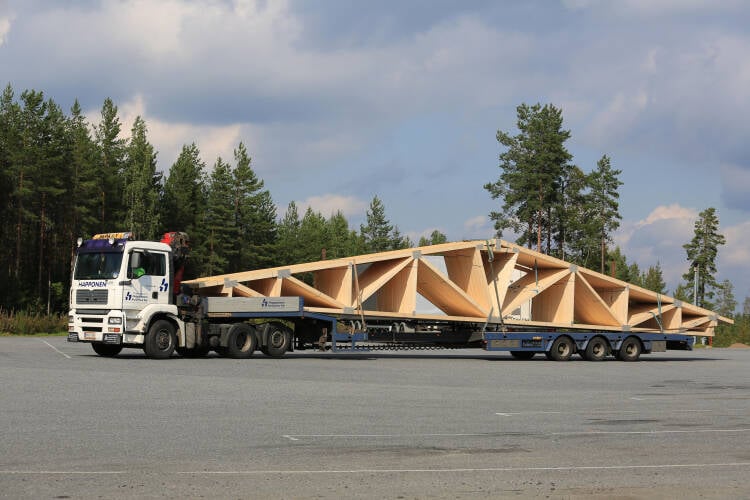
Different products follow different routes. Conventional lumber and panels may move from mills to wholesalers, lumber yards, retailers or directly to builders. Engineered wood products may pass through secondary manufacturers or fabricators. Mass-timber elements and prefabricated wall, floor or roof systems may require carefully sequenced deliveries to match installation schedules. The more construction becomes industrialized, the more important coordination becomes across manufacturers, logistics providers, project teams and sites.
Canadian Wood Council (CWC) analysis identifies more than 500 million board feet in incremental growth potential for wood products across residential and non-residential construction, even without an increase in housing starts. That's enough lumber to build nearly 30,000 additional homes, equivalent to adding the housing stock of a mid-sized Canadian city. Townhouses, mid-rise multi-unit housing, schools, warehouses and standardized public buildings can all support greater use of Canadian wood.But market growth will only be durable if the delivery system is as reliable as the building systems themselves.